Frequently Asked Questions
The most-asked questions about giant clams and marine bivalves.
What exactly is a giant clam?
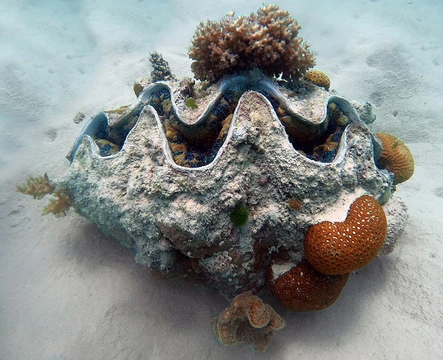
A giant clam is a large marine bivalve mollusk belonging to the family Tridacnidae, most commonly the genus Tridacna. Unlike many other clams that bury themselves in sand, they anchor to coral reefs with a byssal thread and keep their broad, colorful mantle tissue exposed to the water.
Who is the 'main character' of the giant clam world?
Tridacna gigas, the true giant clam, takes the lead role, capable of exceeding 120 cm in shell length and surpassing 200 kg in weight. The other four Tridacna species—squamosa, maxima, derasa, and crocea—round out the core cast with smaller but equally striking builds.
What gives them those vivid, almost psychedelic colors?
Their mantle houses billions of symbiotic microalgae called zooxanthellae, which photosynthesize and pass nutrients to the host. The clam's own chromatophore cells layer on top, creating the swirling blues, greens, and yellows that make each individual look like a one-of-a-kind painting.
Where do giant clams call home?
They inhabit shallow, sunlit coral reefs, lagoons, and rocky shores across the Indo-Pacific, stretching from the Red Sea and East African coast eastward to the Marshall Islands and Fiji. They need clear, well-lit water because their symbiotic algae depend on sunlight.
How are they different from an ordinary garden-variety clam?
Regular clams like quahogs or Manila clams are mostly buried, rely solely on filter-feeding, and stay relatively small. Giant clams keep their mantle out in the open, harvest energy from photosynthesis in addition to filtering plankton, and can grow to sizes no other bivalve approaches.
What's the single most important 'key fact' a new fan should know?
Giant clams are among the longest-lived invertebrates on Earth, with verified individuals exceeding 100 years of age. That slow, decades-long growth means a single overharvested shell represents a century of life lost.
What's their 'origin story'—how does a giant clam begin?
It starts as a microscopic, free-swimming larva drifting in the plankton for a few weeks before settling onto a hard substrate. From there it grows painfully slowly, often adding only a centimeter or two per year, and won't reach reproductive maturity for several years.
What is the biggest threat facing them today?
Decades of overcollection for the decorative shell trade and live-aquarium market drove many populations to near-collapse, particularly in the 1970s and 1980s. Ongoing pressures include coral-reef degradation from warming oceans and pollution, which destroy the shallow habitat they require.
What's a notable 'turning-point moment' in their conservation story?
In the 1990s the International Union for Conservation of Nature listed all Tridacna species under CITES Appendix II, sharply restricting international trade. That regulatory shift, combined with marine-protected-area designations in places like the Maldives and Thailand, allowed several depleted populations to begin a slow recovery.
Where should a newcomer start if they want to explore the wider world of marine bivalves?
Begin with the five Tridacna species to understand the 'flagship' clams, then branch out to other iconic bivalves like mussels, oysters, and scallops. A good next step is learning how bivalves fit into reef and estuary ecosystems as filter-feeders, which reveals why protecting them matters far beyond their beauty.