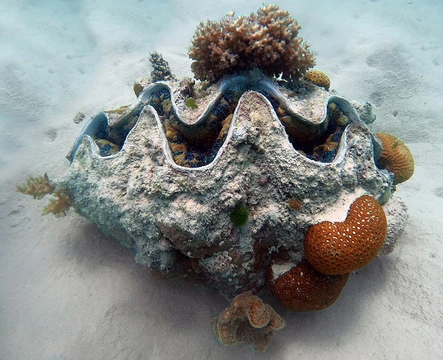
Giant clam
Largest living bivalve, known for symbiotic algae farming.

The giant clam (Tridacna gigas) is the best-known species of the giant clam genus Tridacna and the largest living bivalve mollusc. Native to the shallow coral reefs of the South Pacific and Indian oceans, it may weigh more than 200 kilograms, measure up to 120 cm across, and live over 100 years in the wild.
Quick Facts
- Genus
- Tridacna
- Species
- gigas
Facts from the source article.
Lore & Background
The giant clam was known to indigenous peoples of East Asia for thousands of years and was documented by Venetian scholar Antonio Pigafetta in 1521. It lives on flat coral sand or broken coral at depths up to 20 m, ranging across the Indo-Pacific, including the Philippines and the South China Sea. Populations are diminishing quickly, and it has become extinct in many areas where it was once common. Adult T. gigas are the only giant clams unable to close their shells completely, leaving part of the brownish-yellow mantle visible. The shell has four or five vertical folds, distinguishing it from the similar T. derasa. The mantle border is covered with hundreds to thousands of pinhole eyespots sensitive to three light ranges, including UV, allowing the clam to respond to dimming or movement.
Reader's Guide
The giant clam is notable for its symbiotic relationship with single-celled dinoflagellate algae (zooxanthellae), which provide 65–70 percent of its nutritional needs. This enables growth to large sizes even in nutrient-poor coral-reef waters. The clams cultivate algae in a special circulatory system, and recent modeling suggests they employ iridescent iridocyte cells to channel sunlight, achieving a quantum photon-to-electron conversion efficiency of up to ~67%, among the most efficient natural solar-energy harvesting systems known. Giant clams are hermaphrodites that broadcast spawn, releasing over 500 million eggs at a time, synchronized by a spawning induced substance. The main reason they are becoming endangered is intensive exploitation by bivalve fishers, who target large adults as the most profitable.
Did You Know?
- The largest known specimen measured 137 cm and weighed an estimated 250 kg alive.
- A heavier specimen found in 1956 off Ishigaki, Japan, weighed 333 kg dead and an estimated 340 kg alive.
- Giant clams host photosynthetic algae arranged in vertical columns, achieving up to ~67% quantum photon-to-electron conversion efficiency.
- An adult T. gigas can release more than 500 million eggs at a time.
More in Giant Clams and Marine Bivalves 1-24
Spotted an error? Know more?
Reader corrections go straight into our review queue. Suggest an edit · How this site is sourced