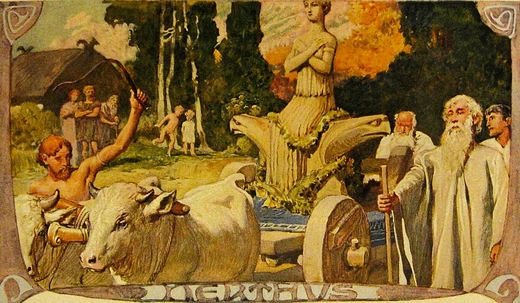
Tuisto
Last updated
Tuisto (or Tuisco) is a legendary divine ancestor of the Germanic peoples, first recorded by Tacitus in the 1st century AD. The figure is notable for being celebrated in ancient songs as an earth-born god and for the scholarly debate surrounding his name and possible connections to later Norse mythology.
Quick Facts
- Name variants
- Tuisto, Tuisco
- Offspring
- Mannus
- Grandsons
- Ingaevones
- Herminones
- Istaevones
- Etymology (tuisto)
- Proto-Germanic twai ('two') or twis ('twice', 'doubled')
- Etymology (tuisco)
- Proto-Germanic tiwisko ('son of Tiu')
Facts from the source article.
Etymology
The two primary manuscript variants of the name, Tuisto and Tuisco, have prompted different etymological proposals. Tuisto is commonly linked to the Proto-Germanic root twai, meaning 'two', and its derivative twis, meaning 'twice' or 'doubled', which gives Tuisto the core sense of 'double'. Any inference about gender from this root is purely conjectural, as the same roots also underlie other Germanic concepts, such as the word 'twist', which in most Germanic languages primarily denotes 'dispute' or 'conflict'.
The variant Tuisco, found in manuscript E, is reconstructed as Proto-Germanic tiwisko and connected to Tiwaz, suggesting the meaning 'son of Tiu'. Under this interpretation, Tuisco would be the offspring of the sky-god (cognate with Proto-Indo-European Dyeus) and the earth-goddess. Connections have also been drawn between Tuisto and the Norse primeval being Ymir, based on etymological and functional similarities. Meyer (1907) considered the two figures identical, while Lindow (2001) noted a key functional difference: Ymir is portrayed as a negative figure, whereas Tuisto is described as celebrated in song.
Theories and interpretations
Tacitus's account fits within the classical ethnographic tradition, which often merged anthropogony, ethnogony, and theogony. Rives (1999) noted that the Germanic claim of descent from an earth-born god supported Tacitus's argument that they were indigenous, as the Latin word indigena carried the same sense as Greek autochthonos, meaning 'born from the land itself'. Lindauer (1975) judged this claim as stemming from Tacitus's ignorance, but added that it was somewhat correct when compared to the turbulent Mediterranean region. The name Tuisto also appears as Tuitsch or Teutsch, and the founding figure Tuisco was claimed to have led the Germans from the Tower of Babel into Europe, giving rise to the names Deutsch and Deutschland.
Later influence
In 1498, the monk Annio da Viterbo published the 'Pseudo-Berossus' fragments, now considered a forgery, which claimed that Tuiscon or Tuisto was the fourth son of Noah and the first ruler of Scythia and Germany after the dispersion of peoples, succeeded by his son Mannus. Later historians, such as Johannes Aventinus, added further details, and James Anderson asserted that this Tuiscon was identical to the biblical Ashkenaz, son of Gomer.
More in Germanic Mythology
Sources
Compiled from Wikipedia and the sources listed below. Text from Wikipedia is available under CC BY-SA 4.0; this entry is adapted from it.
- Wikipedia: Tuisto (CC BY-SA 4.0).
Spotted an error? Know more?
Reader corrections go straight into our review queue. Suggest an edit · How this site is sourced