
Faust (1926 film)
A 1926 silent fantasy film by F. W. Murnau.

Andreas.stockhausen · CC BY-SA 4.0
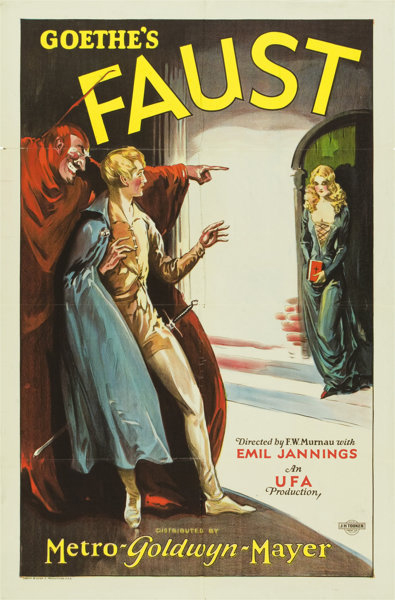
Faust – A German Folktale (German: *Faust – Eine deutsche Volkssage*) is a 1926 silent fantasy film from Ufa, directed by F. W. Murnau. The cast includes Gösta Ekman as Faust, Emil Jannings as Mephisto, Camilla Horn as Gretchen, Frida Richard as her mother, Wilhelm Dieterle as her brother, and Yvette Guilbert as her neighbor Marthe Schwerdtlein. Murnau’s film pulls from older versions of the Faust legend as well as Goethe’s 1808 play. Ufa originally wanted Ludwig Berger to direct, but Murnau—backed by Jannings—pushed producer Erich Pommer to give him the job after finishing *Variety*.
This was Murnau’s last German film; he left for the United States right after to make *Sunrise: A Song of Two Humans* (1927) for William Fox. By the time *Faust* premiered at the Ufa-Palast am Zoo in Berlin, Murnau was already filming in Hollywood. The movie is noted for its special effects and is considered a key example of German expressionist cinema.
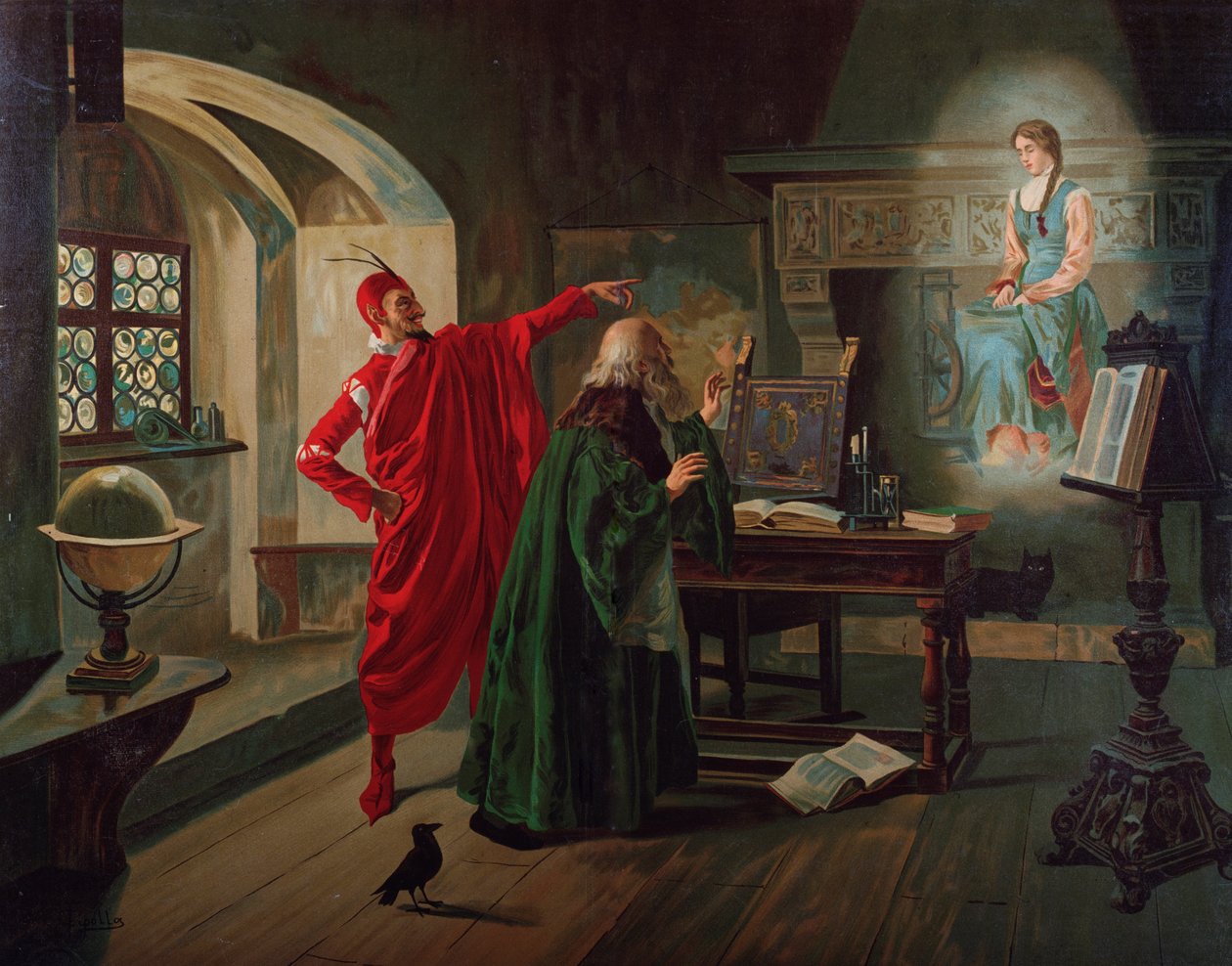
The plot begins with Mephisto betting an Archangel that he can corrupt a righteous man and destroy his divine nature. If he wins, the Devil gets dominion over Earth. The Devil sends a plague to the village where Faust, an elderly alchemist, lives. His prayers fail, so he throws his alchemy books and Bible into the fire. One book falls open, revealing how to gain power through a pact with the Devil. Faust goes to a crossroads, summons evil, and Mephisto offers a trial 24-hour deal: Faust gets Mephisto’s service until the hourglass runs out, then the pact ends. Faust uses his power to help the villagers, but they shun him when they see he cannot face a cross. Stoned, he retreats home.
Faust then makes a permanent deal: Mephisto restores his youth and offers earthly pleasures and a kingdom in exchange for his soul. Mephisto shows him a vision of a beautiful woman, then takes him to a wedding in Parma, where Faust meets the Duchess. He leaves with her while the Devil kills her groom. As Faust makes love to her, the sand runs out. To continue, he seals the deal forever.
Faust soon tires of debauchery and longs for home. He falls for an innocent girl, Gretchen, who is charmed by a golden chain left by the Devil. Faust visits her room; the Devil rouses Gretchen’s mother, who drops dead from shock. The Devil then incites her brother Valentin to catch the lover.
Quick Facts
- Director
- F. W. Murnau
- Producer
- Erich Pommer
- Writer
- Hans Kyser
- Starring
- Gösta Ekman / Emil Jannings / Camilla Horn / Wilhelm Dieterle / Frida Richard / Yvette Guilbert
- Music
- Werner Richard Heymann (in the premiere) / William Axt (U.S., uncredited)
- Cinematography
- Carl Hoffmann
- Distributor
- Ufa (Germany) / Metro-Goldwyn-Mayer (U.S.)
- Released
- 14 October 1926 · Berlin, Germany · 1926 · 12 · 5 · U.S.
- Runtime
- 106 minutes
- Country
- Germany
- Language
- Silent film / German intertitles
- Gross
- 1 million (equivalent to €DE · 1 · 1926 million in DE)
Facts from the source article.
Lore & Background
The demon Mephisto bets an Archangel that he can corrupt a righteous man's soul. The Devil delivers a plague to Faust's village; after prayers fail, Faust makes a pact with Mephisto. He first helps the villagers but is shunned when they learn he cannot face a cross. Faust then trades his soul for youth and earthly pleasures, eventually falling in love with Gretchen. Their relationship leads to tragedy: Gretchen's mother dies of shock, her brother Valentin is killed, and Gretchen is executed for the death of her child. Faust joins her on the pyre, and their spirits rise to heaven, showing that love has triumphed.
Reader's Guide
Faust was the most technically elaborate and expensive Ufa production until Metropolis the following year. Filming took six months at a cost of 2 million ℛ︁ℳ︁, only half recovered at the box office. The film used two cameras and multiple takes; a short sequence of a contract written in fire took an entire day. Intertitles were originally assigned to Hans Kyser, but Gerhart Hauptmann was engaged instead for 40,000 ℛ︁ℳ︁. After a pre-release showing, Ufa rejected Hauptmann's titles, and the film opened with Kyser's intertitles. Five versions of Faust are known to exist, including a German original, a French version, and a U.S. version prepared by Murnau with scenes tailored for American audiences. The film is regarded as a key example of German expressionist cinema.
Gallery

Frequently Asked Questions
Who directed Faust (1926 film)?
F. W. Murnau helmed the picture for Ufa. He secured the directorial chair after Emil Jannings lobbied producer Erich Pommer to reassign the project from Ludwig Berger to Murnau, who had just wrapped up Variety.
Who plays Mephisto in Faust (1926 film)?
Emil Jannings takes on the role of Mephisto opposite Gösta Ekman as Faust. Camilla Horn portrays Gretchen, with Yvette Guilbert appearing as her neighbor Marthe Schwerdtlein.
What is the source material behind Faust (1926 film)?
Murnau's screenplay weaves together older tellings of the Faust legend and Goethe's 1808 dramatic version. The result is a silent fantasy that blends folkloric elements with literary drama.
Why is Faust (1926 film) significant in German cinema?
Produced by Ufa on a two-million-Mark budget, it stands as one of the most ambitious silent fantasy pictures of the era. The film also serves as a key showcase of Murnau's expressive visual storytelling and Jannings' commanding screen presence.
How does the story of Faust (1926 film) end?
Following the tragic arc of Gretchen, the narrative culminates in her downfall as a consequence of Faust's pact with Mephisto. The film closes on the dark, fateful resolution drawn from both the folk tradition and Goethe's play.
More in German fantasy films 1-24
Spotted an error? Know more?
Reader corrections go straight into our review queue. Suggest an edit · How this site is sourced