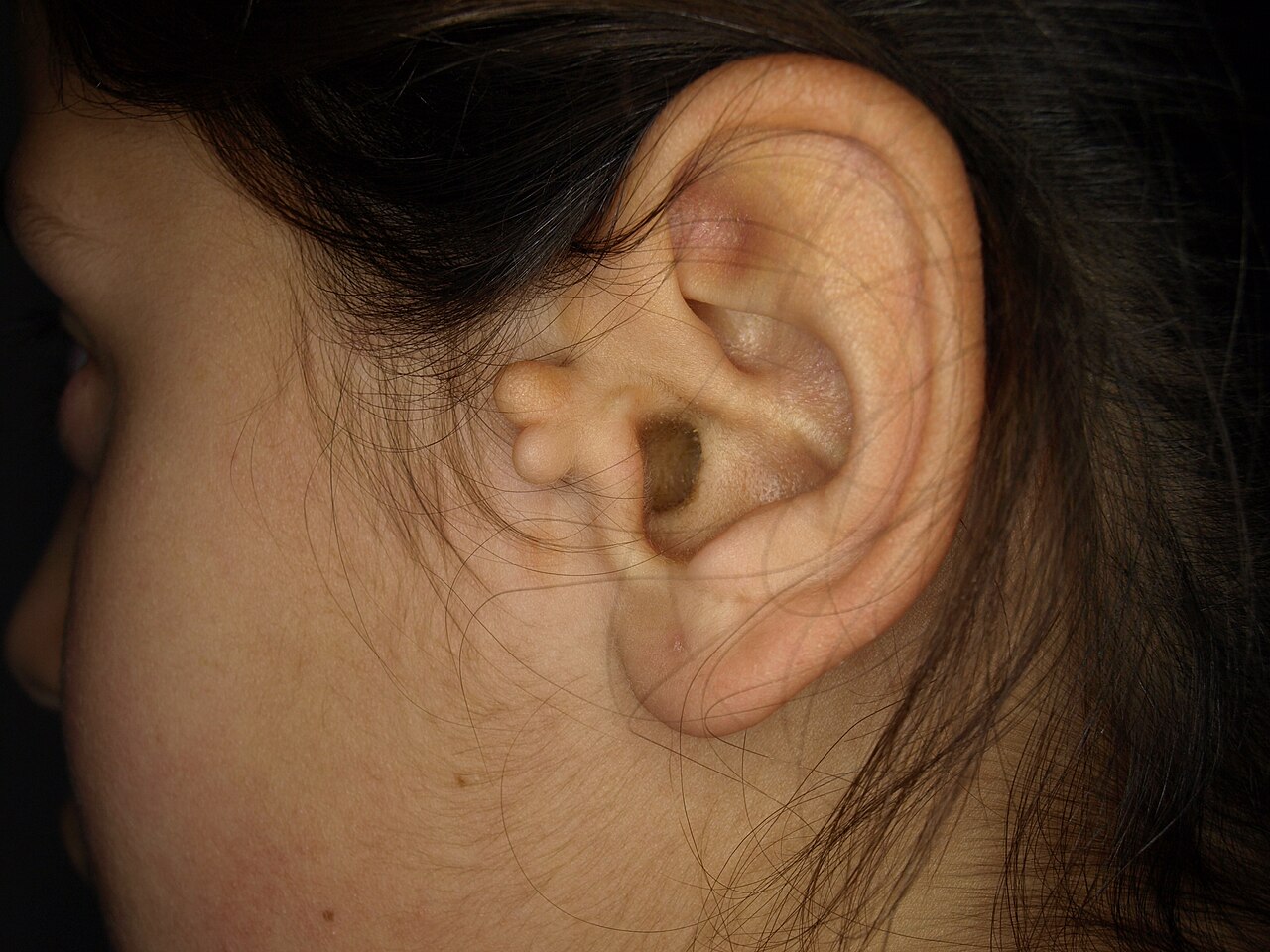
Accessory auricle
Congenital nodule near the ear, often surgically correctable.

Klaus D. Peter, Wiehl, Germany · CC BY 3.0 de
A congenital anomaly presenting as a skin-colored nodule, most commonly situated just anterior to the ear, is termed an accessory auricle.[1] Newborns are the typical age group in which these lesions are first observed, but they can go unnoticed until adulthood when cosmetic concerns arise.[2] The frequency of this condition is between 3 and 6 cases per 1000 live births, and it affects males and females equally.[2]
Quick Facts
- Field
- dermatology
Facts from the source article.
Key facts and history
The general presentation is a skin-covered nodule, papule, or nodule of the skin surface, usually immediately anterior to the auricle.[3] The nodule can be found on both sides of the head and may occur in any location within the tissues surrounding the ear.[3] A nodule may be attached by a stalk (pedunculated) or sit directly on the skin (sessile), and its consistency can be soft or contain cartilage.[4] When examined under a microscope, the tissue structure of the lesion mirrors that of a normal outer ear.[4]
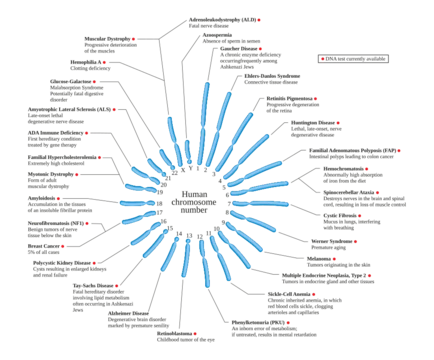
An autosomal dominant inheritance pattern was identified in a study of a family where 11 members had an accessory auricle.[5] Removing the nodule through a simple surgical procedure provides a cure, and most patients regain a normal appearance.[6]
What the research sources say
The 2007 "Dermatology" textbook (Mosby) states these lesions usually present in newborns and occur in approximately 3–6 per 1000 live births.[7][2] The 2007 Mosby textbook "Dermatology" states that the condition has no gender predilection.[7][2]
Gallery
References
- Wikipedia, "Accessory auricle" (CC BY-SA 4.0), which cites: Hwang, "Accessory auricle: Classification according to location, protrusion pattern and body shape", Archives of Plastic Surgery, September 2018, p. 411–417; Cardesa, "Pathology of the Head and Neck", Springer, 2016, p. 397 (we also read that source) en.wikipedia.org
- Wikipedia, "Accessory auricle" (CC BY-SA 4.0), which cites: Rapini, Ronald P., "Dermatology: 2-Volume Set", Mosby, 2007, p. 894 (we also read that source) en.wikipedia.org
- Wikipedia, "Accessory auricle" (CC BY-SA 4.0), which cites: Cardesa, "Pathology of the Head and Neck", Springer, 2016, p. 397; Cardesa, "Pathology of the Head and Neck", Springer, 2016, p. 397; Cardesa, "Pathology of the Head and Neck", Springer, 2016, p. 397 (we also read that source) en.wikipedia.org
- Wikipedia, "Accessory auricle" (CC BY-SA 4.0), which cites: Jansen, "Accessory tragus: Report of two cases and review of the literature", Pediatric Dermatology, 2000, p. 391–394; Brownstein, "Accessory tragi", Archives of Dermatology, 1971, p. 625–631 (original not read by us) en.wikipedia.org
- Wikipedia, "Accessory auricle" (CC BY-SA 4.0), which cites: Yang, "A locus for autosomal dominant accessory auricular anomaly maps to 14q11.2–q12", Human Genetics, 2006, p. 144–147 (original not read by us) en.wikipedia.org
- Wikipedia, "Accessory auricle" (CC BY-SA 4.0), which cites: Pan, "Surgical management of polyotia", Journal of Plastic, Reconstructive & Aesthetic Surgery, 2010, p. 1283–1288; "Scott-Brown's Otorhinolaryngology", Hodder Arnold, 2016-06-15, p. 969 (original not read by us) en.wikipedia.org
- Open Library record, ISBN 9781416029991 ("Dermatology"). CC0 (metadata); book content not read. openlibrary.org
Each numbered sentence above was checked against the source it cites before publication. Sentences citing Wikipedia adapt text from the English Wikipedia article Accessory auricle (contributors), used under CC BY-SA 4.0; this entry is available under the same licence. Other sources were used for facts only; no text or images are copied from them.
More in Genetic disorders with OMIM but no gene
Spotted an error? Know more?
Reader corrections go straight into our review queue. Suggest an edit · How this site is sourced