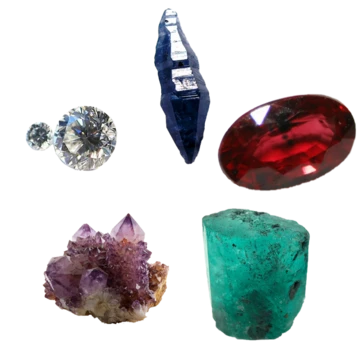
Tanzanite
A rare blue-violet gemstone found only in Tanzania.
Last updated
Depending on the crystal orientation and the type of light, tanzanite can show blue, violet, or burgundy colors due to its strong trichroism.[1][2] Plate tectonic activity and extreme heat in the region that eventually became Mount Kilimanjaro created tanzanite roughly 585 million years ago, during the mid-Ediacaran period.[3] No laboratory has ever managed to synthesize tanzanite, meaning every genuine specimen comes from natural sources.[4][5]
Key facts and history
Tiffany's marketing department introduced it to the market in 1968, finding the scientific name "blue-violet zoisite" not sufficiently consumer friendly.[6] Total reserves of tanzanite are estimated at 109,000,000 carat according to a 2018 report.[7] On 24 June 2020, artisanal miner Saniniu Laizer unearthed two rough tanzanite stones weighing 11.14 kg total, which he sold to the Tanzanian government for TSh 7.74 billion.[8] While herding cattle in January 1967 at the Mererani hills in Tanzania's Kiteto District, Jumanne Mhero Ngoma discovered sparkling blue stones.[9][10]
The Tanzania Commission for Science and Technology issued Ngoma a certificate for scientific discovery in 1984.[9][10] Tiffany & Co. named the gem "tanzanite" after the country of its discovery, Tanzania.[6] A law passed by the Tanzanian government in June 2003 prohibited the export of unprocessed tanzanite to India.[11]
What the cited sources add
Synthetic forsterite has been produced in Russia as an imitation of tanzanite, but it can be distinguished using a refractometer or a Hanneman filter.[4] A test with a dichroscope can distinguish genuine tanzanite from imitations, as only tanzanite will appear doubly refractive.[4][5] A color-grading system introduced by the Tanzanite Foundation sorts tanzanite colors into hues ranging from bluish-violet and indigo to violetish-blue.[12][13] Because untreated tanzanite is trichroic, light entering the anisotropic crystal is refracted along three separate paths, each absorbing a different color.[14][15]
A vacuum-deposited cobalt coating is sometimes applied to lower-grade tanzanite to give it a deeper blue color.[4][5] The cobalt film tends to wear off over time because it does not bond well, leaving the stone with a much less intense color.[5][4]
References
- Wikipedia, "Tanzanite" (CC BY-SA 4.0), which cites: E. Skalwold, "Pleochroism: trichroism and dichroism in gems", Nordskip.com (original not read by us) en.wikipedia.org
- Wikipedia, "Tanzanite" (CC BY-SA 4.0), which cites: "Study of Heat Treatment", Yourgemologist.com (original not read by us) en.wikipedia.org
- Wikipedia, "Tanzanite" (CC BY-SA 4.0), which cites: "Tanzanite Mining", TanzaniteOne, 2018 (original not read by us) en.wikipedia.org
- Zagoritis, "Tanzanite synthetics and imitations", The Rare Gemstone Company (theraregemstonecompany.com). facts only, no text reused. theraregemstonecompany.com
- Wikipedia, "Tanzanite" (CC BY-SA 4.0), which cites: Zagoritis, "Tanzanite synthetics and imitations", The Rare Gemstone Company (theraregemstonecompany.com) (we also read that source) en.wikipedia.org
- Wikipedia, "Tanzanite" (CC BY-SA 4.0), which cites: "AGTA GTC to Issue Tanzanite Reports", JCK Magazine, 12 November 2007 (we also read that source) en.wikipedia.org
- Wikipedia, "Tanzanite" (CC BY-SA 4.0), which cites: "National Environment Statistics Report - Tanzania Mainland", National Bureau of Statistics (NBS) (Tanzania), June 2018; Luvanda, "Presentation of Tanzania High Commissioner Of Tanzania Minerals And Metals Outlook, 2030", The High Commission of the United Republic of Tanzania, 10 October 2018 (original not read by us) en.wikipedia.org
- Wikipedia, "Tanzanite" (CC BY-SA 4.0), which cites: Cobley, "World's Biggest Tanzanite Gem Found Near Kilimanjaro (Update3)", Bloomberg, 3 August 2005 (original not read by us) en.wikipedia.org
- Wikipedia, "Tanzanite" (CC BY-SA 4.0), which cites: "Mgunduzi wa madini Tanzanite afariki dunia", BBC News Swahili; "Tanzanian gemstone finder living in poverty", www.aa.com.tr (we also read that source) en.wikipedia.org
- "Tanzanian gemstone finder living in poverty", www.aa.com.tr. facts only, no text reused. aa.com.tr
- Wikipedia, "Tanzanite" (CC BY-SA 4.0), which cites: "Export ban on tanzanite in Africa leaves Jaipur gems sector in lurch", The Times of India, 3 October 2013 (original not read by us) en.wikipedia.org
- "AGTA GTC to Issue Tanzanite Reports", JCK Magazine, 12 November 2007. facts only, no text reused. jckonline.com
- Wikipedia, "Tanzanite" (CC BY-SA 4.0), which cites: "The Tanzanite Foundation", The Tanzanite Foundation, 22 April 2013; Roskin, Gary, "Tanzanite Transformed: TanzaniteOne Introduces Quality Grading, Pricing Changes, and a Sight System", JCK Magazine, May 2005 (original not read by us) en.wikipedia.org
- Wikipedia, "Tanzanite" (CC BY-SA 4.0), which cites: Richard W. Wise, "Secrets of the Gem Trade: The Connoisseur's Guide to Precious Gemstones", Brunswick House Press, 31 December 2005, p. 35,220 (we also read that source) en.wikipedia.org
- Open Library record, ISBN 9780972822381 ("Secrets of the Gem Trade"). CC0 (metadata); book content not read. openlibrary.org
Each numbered sentence above was checked against the source it cites before publication. Sentences citing Wikipedia adapt text from the English Wikipedia article Tanzanite (contributors), used under CC BY-SA 4.0; this entry is available under the same licence. Other sources were used for facts only; no text or images are copied from them.
More in Gemstones
Sources
Compiled from Wikipedia and the sources listed below. Text from Wikipedia is available under CC BY-SA 4.0; this entry is adapted from it.
- Wikipedia: Tanzanite (CC BY-SA 4.0).
Spotted an error? Know more?
Reader corrections go straight into our review queue. Suggest an edit · How this site is sourced