Frequently Asked Questions
The most-asked questions about galaxy clusters and groups.
What's the actual difference between a galaxy group and a galaxy cluster?
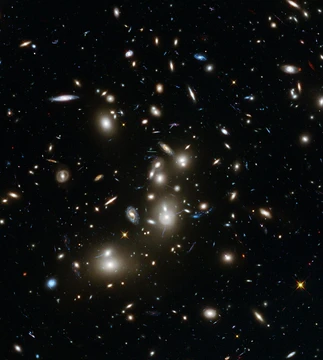
A galaxy group is a small, loosely bound collection of roughly 2 to 50 galaxies held together by mutual gravity, while a galaxy cluster packs hundreds to thousands of galaxies into a far denser, more massive structure. The dividing line is fuzzy, but the jump in total mass and the presence of hot intracluster gas in clusters is the clearest tell.
What is the Local Group and why does every fan start here?
The Local Group is the modest collection of about 80 galaxies that includes the Milky Way, Andromeda, and the Triangulum Galaxy, spanning roughly 10 million light-years. It's the most natural entry point because it's the structure we actually live inside, making it the easiest to visualize and the best springboard for understanding how larger clusters work.
What makes the Coma Cluster the 'main character' of cluster astronomy?
Coma (Abell 1656) sits about 330 million light-years away and contains over 1,000 galaxies, making it one of the nearest rich clusters and the first one studied in depth by Fritz Zwicky in the 1930s. Its sheer size, proximity, and the fact that it revealed the dark-matter problem give it a central role in the history of the field.
What actually holds a galaxy cluster together?
Gravity is the binding force, but the visible stars and gas account for only about a fifth of the total mass; the rest is dark matter, which forms a vast halo enveloping the entire structure. Without that invisible scaffolding, the fastest-moving galaxies would simply fly apart.
What is the Perseus Cluster famous for?
Perseus (Abell 426) is renowned for its enormous central supermassive black hole, which drives multi-million-light-year-scale jets and bubbles through the hot intracluster medium. It also hosts a spectacular X-ray cavity structure that made it a landmark target for Chandra and XMM-Newton observations.
How many galaxies do you need before a 'group' becomes a 'cluster'?
There is no single hard cutoff, but the convention is that groups contain up to around 50 members while clusters contain several hundred or more. In practice the transition is gradual, and some intermediate systems like the Virgo Cluster (about 2,000 members) blur the line.
What is the Bullet Cluster and why do fans call it a 'smoking gun'?
The Bullet Cluster (1E 0657-56) is a colliding pair of clusters where the hot X-ray-emitting gas has been slowed and separated from the gravitational mass inferred by lensing. That spatial offset between the baryonic gas and the dark-matter halo is widely cited as some of the strongest direct evidence that dark matter is a distinct, collisionless component.
What is the Shapley Supercluster?
The Shapley Supercluster, sometimes called the Great Attractor region, is a vast concentration of hundreds of galaxy groups and clusters stretching over about 300 million light-years. It is one of the most massive known structures in the nearby universe and sits at the heart of large-scale cosmic flow patterns.
What is the hot intracluster medium and why do fans fixate on it?
The intracluster medium is a tenuous plasma of ionized hydrogen and helium at temperatures of 10 to 100 million kelvin that fills the space between galaxies in a cluster. Although it is extremely diffuse, it contains more ordinary matter than all the stars in the galaxies combined, making it the dominant baryonic reservoir and a primary X-ray source.
Where should a newcomer begin if they want to follow cluster and group astronomy?
Start with the Local Group to build intuition, then move to the Virgo Cluster as the nearest rich example, and finally to Coma or Perseus for the full 'rich cluster' experience. Tracking the dark-matter story from Zwicky's original mass discrepancy through the Bullet Cluster to modern weak-lensing surveys gives a satisfying through-line across the history of the field.