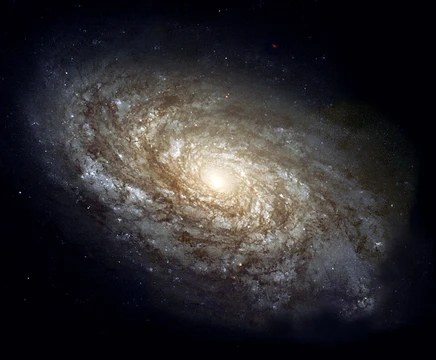
Ionization cone
Cone of ionized gas from an active galactic nucleus.
An ionization cone is a cone-shaped region of ionized material extending from the active nucleus of a galaxy, most commonly observed in type II Seyfert galaxies. These structures are detected through their emission of visible and infrared radiation, with spectroscopy used to analyze the shape, temperature, density, composition, and degree of ionization of the material. The Circinus Galaxy, the closest Seyfert type II galaxy to the Milky Way, hosts a prominent example of such a cone.
Did You Know?
- Interstellar clouds at the Milky Way's galactic poles are highly ionized, possibly indicating a period of high activity in the Galactic Center.
- Ionization cones are thought to be present only in a small fraction of galaxies.
Characteristics
Ionization cones have a distinct conical shape with the galactic center at the apex. They are thought to arise from a dense torus-like structure of interstellar gas and dust surrounding the central black hole, co-planar with the accretion disk. This torus blocks photons from the inner region around the black hole, preventing ionization of galactic matter outside the torus. Along the symmetry axis, where the density of interstellar matter is much lower, ionization can occur, and radiation pressure forces the ionized material away from the center, forming the cone. There is no scientific consensus on the orientation of ionization cones relative to the galactic plane, though they usually align with radio sources near the galactic nucleus. In NGC 5252, two large ionization cones align with a radio source 10 kiloparsecs from the nucleus rather than the nucleus itself. In NGC 5728, a 1.8 kiloparsec-long ionization cone aligns within 3 degrees of a nearby radio source. In Messier 77, the alignment is thought to be influenced by central radio sources and the torus angle, closely matching radio emissions near the nucleus. Deviations from the galactic plane may result from complex interactions of torus material with inflowing gas and dust in the accretion disk and outward-pushed gas and radiation from the black hole. Soft X-ray spectroscopy of Markarian 3, which has a bi-conical ionization cone, showed that plasma photoionized from collision with the interstellar medium emitted almost no X-rays, indicating that ionization cones usually do not emit significant X-rays.
Examples
Ionization cones are found in only a small number of galaxies, mostly Seyferts. The closest Seyfert type II, the Circinus Galaxy, displays a large, prominent example. In Messier 77, the cone formed when hypersonic ejecta from the nucleus slammed into interstellar gas, creating extreme ultraviolet light that ionized the material and made it shine in emission lines. Markarian 348 and Markarian 3 (its type is debated) show very intense inverse bi-conical cones. These structures are not limited to active galactic nuclei; the X-ray binary LMC-X1 also hosts a similar cone, as such systems can match the X-ray power density of galactic nuclei, though on a vastly smaller scale.
More in Galaxies
Spotted an error? Know more?
Reader corrections go straight into our review queue. Suggest an edit · How this site is sourced