Galactic lens
An elliptical galactic component with uniform brightness, often linked to bars.
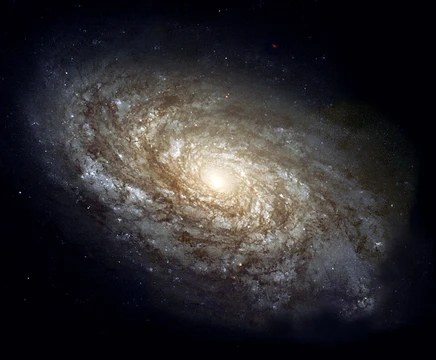
A galactic lens is a component of a galaxy that exhibits an almost uniform distribution of surface brightness. It is notable for its elliptical shape and sharp boundaries, often appearing in the region between the bulge and the disk. Lenses are closely connected with bars and are frequently found in barred galaxies.
Quick Facts
- Percentage in sbab-sbc galaxies
- 76%
- First discovered by
- Gérard de Vaucouleurs
- Year of discovery
- 1959
Facts from the source article.
Shape
The lens is an elliptical-shaped component with a nearly uniform distribution of surface brightness and sharp boundaries. Its contribution is most noticeable in the region between the bulge and the disk, though it can appear elsewhere. Lenses are triaxial ellipsoids: flattened perpendicular to the galactic plane, but not as much as disks. In projection onto the disk plane, the average ratio of major to minor axes is 0.9. Lenses are often found in galaxies with bars, occurring in 54% of SB0-SBa galaxies and 76% of SBab-SBc galaxies. When both a bar and a lens are present, their sizes most often coincide.
Formation
Most galactic lenses are thought to originate from bars, though some lens types remain unexplained by this. Two formation processes are known. A bar can gradually become more axisymmetric, but not all its material is necessarily rearranged right away, since many galaxies contain both a bar and a lens. Alternatively, lenses can form through the same bar-generating instability that creates bars. Astronomers have known about lenses since at least 1959, when Gérard de Vaucouleurs first identified them and introduced a galaxy classification system.
More in Galaxies
Spotted an error? Know more?
Reader corrections go straight into our review queue. Suggest an edit · How this site is sourced