
Antennarius scaber
A valid Western Atlantic frogfish with a two-lobed lure.
Last updated

Pauline Walsh Jacobson · CC BY 4.0
It belongs to the striatus species group within the genus Antennarius, family Antennariidae, order Lophiiformes.[1][2] The French zoologist Georges Cuvier originally described this frogfish species in 1817 under the name Chironectes scaber, designating Martinique as the type locality.[1]
Scientific classification
- KingdomAnimalia
- PhylumChordata
- ClassActinopterygii
- DivisionTeleostei
- OrderLophiiformes
- FamilyAntennariidae
- GenusAntennarius
- SpeciesAntennarius scaber
Named by (Cuvier, 1817)
Close relatives
Other species of Antennarius with a Codexery entry.
- Antennarius biocellatus Antennarius biocellatus
- Antennarius commerson Antennarius commerson
- Antennarius indicus Antennarius indicus
- Antennarius pauciradiatus Antennarius pauciradiatus
- Antennarius pictus Antennarius pictus
- Leopard frogfish Antennarius pardalis
- Longlure frogfish Antennarius multiocellatus
- Randall's frogfish Antennarius randalli
Sources: Wikipedia taxobox: Antennarius scaber (CC BY-SA 4.0) · order, family and genus agree with WoRMS AphiaID 301302 (CC BY 4.0)
Conservation status
Least Concern (LC)
- LC▲ this species
- NT
- VU
- EN
- CR
- EW
- EX
Source: IUCN Red List assessment · GBIF copy of the Red List category
Where the antennarius scaber has been recorded
Each dot is a place where the species has been observed and reported (205 records, half-degree grid) — not a modelled range. 7 inland records left out (institution coordinates).
Map: drawn by Codexery. Data: GBIF occurrence search (records CC0 / CC BY) · Natural Earth basemap (public domain) · place coordinates: Wikipedia (CC BY-SA 4.0)
Biology and range
Eggs are laid in gelatinous masses called rafts or veils and remain there until hatching.[3] Antennarius scaber is found in the western Atlantic from New Jersey and Bermuda south through the Bahamas, Gulf of Mexico, and Caribbean to southern Brazil.[4][5] Its mouth is notably large and oriented upward, containing many small teeth.[6] Bifurcated spinules densely cover the rough skin.[6]
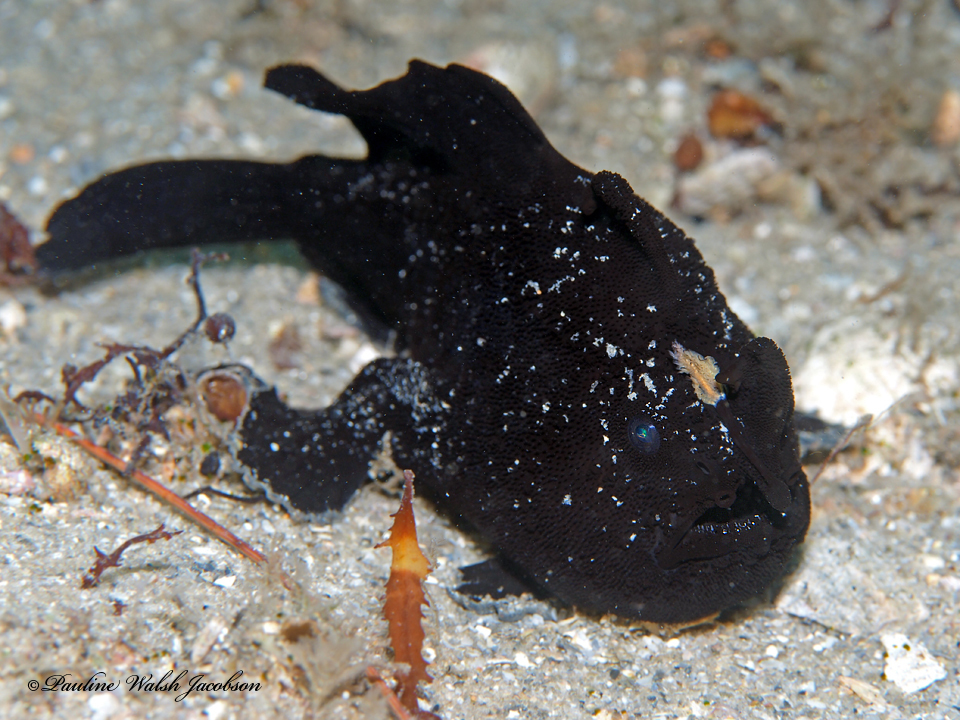
The body, head, and fins display irregular slender brown bars and spots, with the overall coloration ranging from yellow, orange, green, brown, grey, to almost white.[6][7] This species employs an ambush strategy, using its illicium and esca to attract prey close enough to strike.[3]
What the specialist sources record
The Shorefishes of the Greater Caribbean account notes the esca consists of two vermiform appendages and that the second dorsal spine is straight and connected to the head by a smooth membrane.[6] The frogfish.ch website states that Antennarius scaber reaches about 15 cm in length, while the similar Antennarius striatus can reach 20 cm.[5] According to frogfish.ch, A. scaber was synonymized with A. striatus by Pietsch & Grobecker (1987) and later revalidated as a separate species by Pietsch & Arnold in 2020.[5] The same source reports that A. scaber is restricted to the western Atlantic and can be confused with A. striatus, which occurs in the eastern Atlantic, Indian Ocean, and Pacific.[5]
The World Register of Marine Species lists the species as accepted, with a marine and brackish environment.[2]
References
- Wikipedia, "Antennarius scaber" (CC BY-SA 4.0), which cites: ; Smith-Vaniz, W.F., "Antennarius striatus (Gulf of Mexico assessment)", 2015; "Antennarius scaber", www.frogfish.ch; "Fishes of the World", John Wiley & Sons, 2016, p. 508–518 (we also read that source) en.wikipedia.org
- World Register of Marine Species, Antennarius scaber (AphiaID 301302). CC BY 4.0. marinespecies.org
- Wikipedia, "Antennarius scaber" (CC BY-SA 4.0), which cites: Cathleen Bester, "Striated Frogfish Antennarius striatus", Discover Fishes (we also read that source) en.wikipedia.org
- Wikipedia, "Antennarius scaber" (CC BY-SA 4.0), which cites: ; "Species: Antennarius scaber, Splitlure Frogfish, Striated Frogfish", Shorefishes of the Greater Caribbean online information system (we also read that source) en.wikipedia.org
- "Antennarius scaber", www.frogfish.ch. facts only, no text reused. frogfish.ch
- Wikipedia, "Antennarius scaber" (CC BY-SA 4.0), which cites: "Species: Antennarius scaber, Splitlure Frogfish, Striated Frogfish", Shorefishes of the Greater Caribbean online information system (we also read that source) en.wikipedia.org
- "Species: Antennarius scaber, Splitlure Frogfish, Striated Frogfish", Shorefishes of the Greater Caribbean online information system. facts only, no text reused. biogeodb.stri.si.edu
Each numbered sentence above was checked against the source it cites before publication. Sentences citing Wikipedia adapt text from the English Wikipedia article Antennarius scaber (contributors), used under CC BY-SA 4.0; this entry is available under the same licence. Other sources were used for facts only; no text or images are copied from them.
More in Frogfish
Elsewhere in Frogfish and Dragonets
Test yourself
Three questions drawn from this entry’s sources. Pick an answer to check it.
Answers checked against the source article
Sources
Compiled from Wikipedia and the sources listed below. Text from Wikipedia is available under CC BY-SA 4.0; this entry is adapted from it.
- Wikipedia: Antennarius scaber (CC BY-SA 4.0).
- Classification: the source article's taxobox; order, family and genus checked against WoRMS, the World Register of Marine Species (CC BY 4.0).
- Conservation status: IUCN Red List assessment.
- Occurrence records: GBIF (CC0 / CC BY). Basemap: Natural Earth (public domain).
- Word definitions: the , each quoted from its Wikipedia article.
Spotted an error? Know more?
Reader corrections go straight into our review queue. Suggest an edit · How this site is sourced