Louisiana Purchase
The 1803 U.S. acquisition of Louisiana from France.

via Wikipedia: Louisiana Purchase · see source
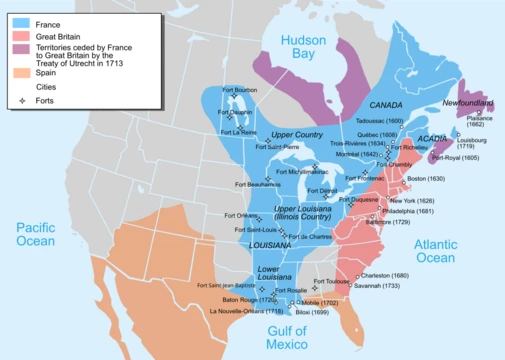
In 1803, the United States acquired the territory of Louisiana from the French First Republic for fifteen million dollars, or approximately eighteen dollars per square mile ($7/km2). However, France only controlled a small fraction of this area, most of which was inhabited by Native Americans; effectively, for the majority of the area, the United States bought the preemptive right to obtain Indian lands by treaty or by conquest, to the exclusion of other colonial powers.
Quick Facts
- Official name
- Louisiana Purchase; Vente de la Louisiane
- Nation
- the United States
- Subdivision
- Expansion
- Established
- 1803
- Dissolved
- 1804
- Date start
- July 4
- Event end
- Disestablished
- Date end
- October 1
Facts from the source article.
Did You Know?
- At the time of the purchase, the territory of Louisiana's non-native population was around 60,000 inhabitants, of whom half were enslaved Africans.
- The western borders of the purchase were later settled by the 1819 Adams–Onís Treaty with Spain, while the northern borders were adjusted by the Treaty of 1818 with the British.
- The Louisiana Purchase corresponds, nowadays, to more than 26% of the present area of the contiguous United States, which is 2,959,064.44 sqmi.
Negotiation
Fear of a French invasion spread across America in 1801 after Napoleon sent a military force to Saint-Domingue. President Thomas Jefferson, though urging moderation, threatened an alliance with Britain to undercut Federalists who called for hostilities against France. Jefferson supported France's plan to retake Saint-Domingue, then under Toussaint Louverture after a slave rebellion, but growing concern that Napoleon would send troops to New Orleans led Jefferson to send Livingston to Paris in 1801 with authorization to purchase New Orleans. In December 1801, France sent General Charles Leclerc, Napoleon's brother-in-law, on an expedition to Saint-Domingue to reassert French control. Jefferson declared neutrality in relation to the Caribbean, refusing credit to the French but allowing war contraband to reach the rebels. In 1803, Pierre Samuel du Pont de Nemours, a French nobleman living in the United States with close ties to Jefferson, began to help negotiate with France. During a visit to France, du Pont engaged in back-channel diplomacy with Napoleon on Jefferson's behalf and introduced the idea of the much larger Louisiana Purchase as a way to defuse potential conflict.
Domestic opposition and constitutionality
The Louisiana Purchase was officially announced on July 4, 1803, after Monroe and Livingston returned from France. This gave President Jefferson and his cabinet until October, when the treaty required ratification, to debate whether the deal was constitutional. Jefferson initially thought about a constitutional amendment, but his cabinet talked him out of it. He then argued that the purchase was like a guardian using a ward's money to buy an important piece of nearby land, saying he did it for the ward's good. Before ratification, he decided the purchase was constitutional because it protected U.S. citizens. Historians like Henry Adams have called Jefferson hypocritical, since he was a strict constructionist but stretched the Constitution to justify the deal. Federalists opposed the purchase due to its cost, their belief that France could not have held Louisiana against the U.S. and Britain, and what they saw as Jefferson's hypocrisy. Both Federalists and Jeffersonians worried about the purchase's constitutionality. In the House, Majority Leader John Randolph led the opposition. Federalists feared western states would weaken the Atlantic seaboard's power and that new slave states would deepen North-South divides. Senator Timothy Pickering of Massachusetts led a group of Northern Federalists who considered forming a separate northern confederacy. The House voted 59 to 57 against blocking the purchase, failing by two votes.
Financing
The United States financed the Louisiana Purchase through a combination of assuming French debts and issuing sovereign bonds. The American government, having appointed Francis Baring and Company of London as its official banking agent after the failure of Bird, Savage & Bird, asked Barings to manage the deal. Barings partnered with Hope & Co. of Amsterdam, leveraging Hope’s expertise in bond issuance and Barings’ American ties. In April 1803, Alexander Baring and Pierre Labouchère traveled to Paris to aid negotiations. The final price was set at 80 million francs ($15 million), reduced from an initial 100 million francs. The U.S. took over up to 20 million francs ($3.75 million) of French debts owed to American citizens. The remaining 60 million francs ($11.25 million) was covered by U.S. bonds at 6% interest, redeemable between 1819 and 1822. In October 1803, the U.S. Treasury held roughly $5.86 million in specie, with $2 million allocated toward the assumed debts. To satisfy Napoleon’s demand for quick payment, Barings and Hopes bought the bonds for 52 million francs, making an initial 6 million franc payment followed by 23 monthly installments of 2 million francs each. The first bonds were issued on January 16, 1804, though the banks had already advanced 10 million francs to France in July 1803. By April 1804, they transferred an additional 40.35 million francs to settle their obligations. Ultimately, the banks acquired the $11.25 million in bonds for $9.44 million. The U.S. Treasury paid off the final bonds in 1823, with the total cost including interest reaching $23,313,567.73.
Boundaries
Neither the 1762 Treaty of Fontainebleau, the 1801 Third Treaty of San Ildefonso, nor the 1803 Louisiana Purchase agreement defined the territory's boundaries, sparking a dispute between Spain and the United States. The U.S. argued that Louisiana covered the entire western Mississippi River drainage basin up to the Rocky Mountains, plus land reaching the Rio Grande and West Florida. Spain countered that it was only the Mississippi's west bank, New Orleans, and St. Louis. The Adams–Onís Treaty of 1819 settled this, giving the U.S. most of its western claim. To the north, the purchase reached into the vaguely defined British Rupert's Land. The Anglo-American Convention of 1818 ceded territory north of the 49th parallel to Britain in exchange for parts of the Red River Basin south of that line. The eastern boundary followed the Mississippi from its then-unknown source to the 31st parallel. Below that parallel, the line was disputed: the U.S. claimed as far as the Perdido River, while Spain insisted its Florida Colony's border stayed at the Mississippi. The Adams–Onís Treaty, ratified in 1821, resolved this. Today, the 31st parallel forms the northern boundary of the western Florida Panhandle, and the Perdido River marks Florida's western edge.
More in French Colonization of the Americas
Spotted an error? Know more?
Reader corrections go straight into our review queue. Suggest an edit · How this site is sourced