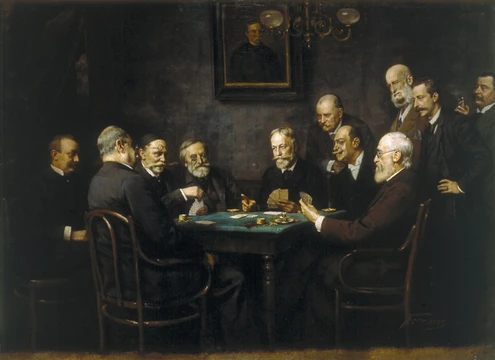
Napoleon (card game)
A five-card trick-taking game with bidding and a slang legacy.
Last updated
Napoleon, often called Nap, is a straightforward trick-taking game where each player receives five cards and the highest bidder names trumps and attempts to win at least that many tricks. It has been described as a simplified version of Euchre, though David Parlett considers it more like an elaboration of Rams. The game has given English the slang expression 'to go nap', meaning to take five of anything, and was possibly first named after Napoleon III.
History
Rules for Napoleon were first published in England in 1876, described as 'a very spirited and interesting game'. A shorter set appeared in 1882, calling it 'comparatively new' but 'exceedingly interesting'. An 1884 treatise claimed its 'popularity stands unrivalled' and that it was played by 'tens of thousands'.
The 1885 American Hoyle called it a French modification of Euchre. Hoffmann's 1889 account introduced Wellington and Misery bids. That same year the French Revue Britannique noted it was 'very popular on both sides of the Atlantic'.
By 1897 it had become the national card game of England, with Foster stating that 'few games have become so widely known in such a short time'. By 1982 it was widely played in pubs, though technically illegal if played for money without a licence. It has since declined but is still played in parts of southern England and Strathclyde.
Rules
In Napoleon, each player receives five cards dealt one at a time. Bidding begins with the player to the dealer’s left, known as eldest hand, and continues clockwise. Players may bid to take a certain number of tricks, with the highest possible bid being Napoleon, which means winning all five. The player who bids the highest then plays alone against everyone else and leads the first trick; the suit of that lead card becomes trump.
Everyone must follow suit if they can, otherwise they may play any card. Winning tricks are kept face down in front of the winner, while other played cards stay face up. The game works best with four or five players using a reduced deck. For four players, 28 to 32 cards are used; for five, 36 to 40.
With six players, the dealer gets no hand but still wins or loses like the others. Cards rank with ace highest, except when cutting to decide the first dealer, where ace counts below two. After shuffling, the player to the dealer’s right cuts the deck, leaving at least four cards in each pile. Each player is dealt five cards in two rounds: first three, then two.
Bidding moves clockwise, starting with eldest hand and ending with the dealer. Each player may bid only once, and each bid must be higher than the last or be a pass. The allowed bids are: Three (win at least three tricks), Four (win at least four), Nap (win all five), Napoleon or Bonaparte (win all five by leading the lowest trump first), and Wellington (win all five by leading the lowest non-trump first).
Variants
In Peep Nap, an extra card is dealt face down on the table. Each player on their turn to bid may pay one penny (or higher stake) to the pool for a private look at the card. When all have bid, if the winning bidder has peeped, they may exchange a hand card for the table card. In Ecarté Nap, after the deal and before any bid, the dealer serves out fresh cards in exchange for as many cards as players wish to throw away.
For each fresh card, players pay one stake to the pool. They may not exchange more than once per round, and may buy up to five cards. Ecarté Nap should be confined to four players, and bids should be made on stronger hands. In Seven-card Nap, each player receives seven cards; there is no exchange or peep, and bids of Wellington and Blücher are not permitted.
Players may bid from three up to seven tricks. Misère ranks as next highest bid to Nap. The order of bids with stakes: Three = stake of 3; Four = stake of 4; Nap = stake of 10; Misère = stake of 10; Six = stake of 18; Seven = stake of 24. For Misère, the bidder wins 3 from every player if successful, or pays 3 to every player if failing.
Wellington: bidder wins or pays 10. Blücher: stakes are double Wellington, so bidder pays 20 to every player if failing.
Sir Garnet stakes are the same as an ordinary Nap call. Ecarté Nap is more expensive than ordinary Nap but more interesting. In Seven-card Nap, players losing nap, misery, six, or seven pay half stakes.
More in French Card Games
Sources
Compiled from Wikipedia and the sources listed below. Text from Wikipedia is available under CC BY-SA 4.0; this entry is adapted from it.
- Wikipedia: Napoleon (card game) (CC BY-SA 4.0).
Spotted an error? Know more?
Reader corrections go straight into our review queue. Suggest an edit · How this site is sourced