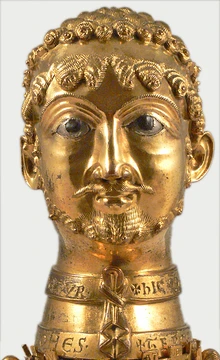
History of the Expedition of the Emperor Frederick
Anonymous Latin chronicle of Frederick I's Third Crusade expedition.
Last updated
The History of the Expedition of the Emperor Frederick is an anonymous Latin account of Frederick I's campaign during the Third Crusade. It covers the period from 1187 to 1196, focusing on the expedition of 1189–1190. The work provides a nearly day-to-day narrative of the army's march through the Balkans and Anatolia, ending with Frederick's death in a swimming accident.
Quick Facts
- Language
- Latin
- Period covered
- 1187–1196
- Focus
- Expedition of 1189–1190
- Earliest surviving copy
- Around 1200
- Benedictine abbey of Saint Lambrecht
- Styria
- Other early manuscript
- Before 1221
- Praemonstratensian monastery of Milevsko (Mühlhausen)
- Bohemia
- Full text known from
- Two 18th-century copies commissioned by Josef Piter
Facts from the source article.
Date, authorship and manuscripts
The History attained its finished form no later than about 1200, with an early draft existing before 1195. The final form cannot be earlier than the summer of 1196, as Frederick's son Henry VI, who died in September 1197, is referred to as living throughout. Parts appear to have been written contemporaneously, shown by references to persons still alive, such as Count Philip of Flanders, who died in 1191. The earliest surviving copy, made around 1200 at the Benedictine abbey of Saint Lambrecht in Styria, contains only a third of the text.
Another very early copy, made before 1221 at the Praemonstratensian monastery of Milevsko in Bohemia, is also incomplete. The full text is known only from two 18th-century copies commissioned by the Moravian abbot Josef Piter, which were not made from either known earlier manuscript. In the Milevsko manuscript, Abbot Gerlach added a notice stating the work was written by an Austrian cleric present on the expedition. Later in the 13th century, someone added the author's name: 'called Ansbert'.
Some scholars accept these notices, while others question the name or the implication of a single author. Variations in cursus suggest multiple authors; it is possible that only the last part was written by an Austrian cleric, who may also have compiled the whole. The earlier parts appear to have been written in the diocese of Passau.
Structure and sources
The work is split into three sections. A preface addresses the 1187 loss of Jerusalem and the subsequent crusade preparations. The main, lengthy portion follows Frederick’s crusade. A final appendix, about a quarter as long as the middle part, covers Henry VI’s rule up to the summer of 1196.
The preface includes full quotations of Pope Gregory VIII’s call for the Third Crusade, an anonymous letter to Hospitaller master Archumbald about the Battle of Hattin, and a letter from Hospitaller steward Hermengar to Duke Leopold V of Austria on Saladin’s 1188 gains in northern Syria. The central section appears to have been assembled from reports sent back to Germany. Anton Chroust proposed it was built from three separate parts: the first ending in November 1189, when Frederick dispatched reports to Henry VI and King Béla III; the second at Easter 1190, when a report went with Pisan merchants; and the third starting on 29 March 1190, which draws heavily on the diary of Bavarian cleric Tageno.
The account from 16 May to 9 June 1190 is taken almost word for word from Tageno. Some scholars suggest Ansbert may have been on the crusade and authored the three reports that form the basis of these main sections.
Uses
The chronicle known as the History of the Expedition of the Emperor Frederick was consulted by several later writers. Abbot Gerlach quoted it in his continuation of Vincent of Prague’s chronicle. Magnus of Reichersberg, who died in 1195, used an early version for his own work. Around 1200, the anonymous author of the History of the Pilgrims, another account of Frederick I’s crusade, also had access to it.
The History gives a nearly day-by-day record of the expedition, noting specific dates and places. This detail lets readers track the army’s route and calculate its pace, such as covering 20 kilometers per day in hostile territory. It names seventy participants, including Duke Frederick VI of Swabia, Duke Berthold of Merania, eleven German bishops, one Hungarian bishop, two margraves, and twenty-six counts. The work is regarded as the most reliable source for Frederick’s dealings with the Byzantines, surpassing the main Greek account by Niketas Choniates.
More in Frederick Barbarossa
Sources
Compiled from Wikipedia and the sources listed below. Text from Wikipedia is available under CC BY-SA 4.0; this entry is adapted from it.
- Wikipedia: History of the Expedition of the Emperor Frederick (CC BY-SA 4.0).
Spotted an error? Know more?
Reader corrections go straight into our review queue. Suggest an edit · How this site is sourced