New Albion
English territorial claim on the Pacific coast of North America.
Sir Francis Drake claimed a stretch of the North American coast north of Mexico for England in 1579, naming it New Albion, or Nova Albion, after an old name for Great Britain. This claim later supported English charters spanning the continent from the Atlantic to the Pacific. Drake’s landing spot is now identified as Drake’s Cove, located within Point Reyes National Seashore. The site was designated a National Historic Landmark by the U.S. Department of the Interior in October 2012, and a California Historical Landmark by California State Parks in October 2021.
Quick Facts
- Founded
- 17 June 1579
- Extinct date
- 23 July 1579
- Named for
- the white cliffs of England; and the archaic name of Britain
Facts from the source article.
Did You Know?
- Drake's crew paused at the Farallon Islands on 24 July 1579 to hunt seal meat before continuing their Pacific crossing.
- The Queen's Map, which showed Drake's route and New Albion, was lost in the Whitehall Palace fire of 1698.
Drake's voyage
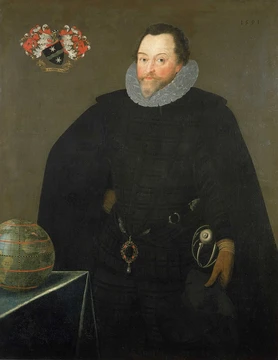
In the late 1500s, a cold war existed between England and Spain involving religious differences, economic pressure, and emerging navigational and colonisation desires. Sir Francis Drake developed a plan to plunder Spanish colonial settlements on the Pacific Coast of the New World. Gathering several investors, and likely with the backing of Queen Elizabeth I—which may have been in the form of a secret commission as a privateer—Drake embarked upon the voyage on 15 November 1577. After successfully taking considerable amounts of treasure from Spanish towns and ships along King Philip's eastern Pacific coast colonies, Drake sailed north to seek a shortcut back to England via the hypothetical Strait of Anián, a supposedly navigable shortcut connecting the Pacific and Atlantic speculated to exist at about 40 degrees north. Although Drake may have possibly reached a latitude as high as 48 degrees, his northward progress was ultimately stopped by foul weather in the northeast trade winds belt. Upon failing to locate the strait, Drake sought safe harbour to ready his ship, Golden Hind, before attempting a circumnavigation of the globe to return home. On 5 June 1579, the ship briefly made first landfall at South Cove, Cape Arago, just south of Coos Bay, Oregon. From there, Drake sailed south while searching for a suitable harbour to repair his ailing ship. On 17 June, Drake and his crew found a protected cove when they landed on the Pacific coast of what is now Northern California. While ashore, he claimed the area for Queen Elizabeth I as Nova Albion or New Albion, choosing this name for two reasons: first, the white banks and cliffs which he saw were similar to those found on the English coast and, second, because Albion was an archaic name by which the island of Great Britain was known. To document and assert his claim, Drake had an engraved plate of brass, one which contained a sixpence bearing Elizabeth's image, attached to a large post. After erecting a fort and tents ashore, the crew laboured for several weeks as they prepared for the circumnavigating voyage ahead by careening their ship, Golden Hind, so to effectively clean and repair the hull. Drake had friendly interactions with the Coast Miwok and explored the surrounding land by foot when crossing Inverness Ridge to visit a village and explore the country. When his ship was ready for the return voyage, Drake and the crew left New Albion on 23 July and paused his journey the next day when anchoring his ship at the Farallon Islands where the crew hunted seal meat. On 25 July, they sailed west to continue their Pacific crossing, and Golden Hind finally returned to England in September 1580.
The people and the land
By using detailed descriptions of the people encountered by Drake—particularly their houses, feathered baskets, ceremonies, and language—anthropologists have clearly identified the people as Coast Miwok, a people whose traditional homeland included the Point Reyes area. When Drake's crew landed, the Coast Miwok initially approached with bows and arrows but were soon reassured by Drake. Unarmed Miwok then visited the encampment daily. Early encounters included the Miwok wailing and engaging in self-laceration, which Drake misinterpreted as worship; this custom was actually one of mourning, likely because the Miwok regarded the English as returned dead relatives. On one occasion, a large assembly placed chains around Drake's neck, a sceptre in his hand, and a crown of feathers on his head, an act England later interpreted as a voluntary surrender of sovereignty. Drake and crew members explored inland, traversing the Inverness Ridge into the Olema Valley. Fletcher described round subterranean village structures with spire-like tops and watertight baskets shaped like deep bowls covered with colored feathers—baskets made only by the Coast Miwok and nearby peoples.
Historical influence
Drake's circumnavigation began a period of British maritime dominance that lasted until the 20th century. According to John Stow, Drake's 'name and fame became admirable in all places, the people swarming daily in the streets to behold him, vowing hatred of all that durst mislike him.' Not only were his investors and the queen richly rewarded, Drake was also allowed to keep £24,000 of the purloined treasure for himself and his crew. Drake quickly became a favorite at the queen's court and was knighted by the French ambassador on her behalf. Because the extent of Drake's New Albion was vague—essentially a classification of the territory north and west of Spanish territory—the designated location differs among maps. After Elizabeth's death in 1603, maps began to depict the area of North America above Mexico as Nova Albion. Drake's claim of land on the Pacific coast for England became a basis which influenced subsequent colonial charters issued by English monarchs that purported to grant lands from sea to sea, the area from the Atlantic where English colonies were first established all the way to the Pacific. Along with Martin Frobisher's claims in Greenland and Baffin Island and Humphrey Gilbert's 1583 claim of Newfoundland, New Albion was one of the earliest English territorial claims in the New World. These claims were eventually followed by settlement of the Roanoke Colony in 1584, and Jamestown in 1607.
Site recognition and identification
Over the years, numerous speculative sites along the North American Pacific coast were investigated as the area of Drake's New Albion claim. Through the following centuries, various cartographers and mariners identified the area near Point Reyes as Drake's likely landing place. In the 20th and 21st centuries, researchers gathered definitive evidence, particularly regarding Drake's contact with the Coast Miwok people and porcelain shards which were established to be remnants of Drake's cargo. The various avenues of research led to a National Historic Landmark designation by the United States Department of the Interior in October 2012 and a California Historical Landmark designation by California State Parks in October 2021.
More in Francis Drake
Spotted an error? Know more?
Reader corrections go straight into our review queue. Suggest an edit · How this site is sourced