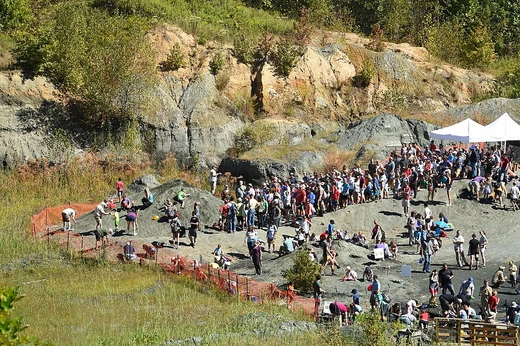
Edelman Fossil Park
Last updated

via Wikipedia: Edelman Fossil Park · see source
The Edelman Fossil Park & Museum, located in Mantua Township, New Jersey, features a 66-million-year-old bone bed set into a 65-acre former marl quarry. It is currently the only facility east of the Mississippi River that has an active open quarry for public Community Dig Days. Named after donors Jean and Ric Edelman, it is owned and operated by Rowan University in Glassboro, New Jersey, and opened on March 29, 2025.
Quick Facts
- Location
- Mantua Township, New Jersey
- Age of deposit
- 66 million years (end of Cretaceous Period)
- Area
- 65 acres
- Owner and operator
- Rowan University
- Glassboro
- New Jersey
- Named after
- Jean and Ric Edelman
- Opened
- March 29, 2025
Facts from the source article.
Geology
The bedrock of Gloucester County, where the park sits, is made of alternating sand, silt, and clay layers—called facies—formed by changing sea levels since the Cretaceous. These sedimentary rocks date from the Lower Cretaceous to the Miocene (145 to 5.3 million years ago). Southern New Jersey is part of the coastal plain, which lay under a shallow sea until the late Pliocene, when the ocean pulled back as the Greenland ice sheet formed about 3 million years ago.
The coastal plain starts on a southeast diagonal between Carteret and Trenton, with sediments overlapping the rockier Piedmont Formation to the northwest. The fossil layer is marl, a dark to light green, manganese-rich clay that forms when algae, aquatic plants, and animals decay over long periods in hard-water streams rich in calcium carbonate. This layer usually sits in swamps, topped by a dark organic-rich peat layer. Because marl forms from decaying plants and algae in soft sediment, it preserves many invertebrates and larger land animals whose bodies washed downstream.
Within the marl is the mineral vivianite (Fe2+3(PO4)2 · 8H2O), a deep blue to bluish-green crystal created by reduction-oxidation reactions. It starts to oxidize when exposed to oxygen, turning Fe2+ to Fe3+ until the blue becomes nearly black and opaque—so stable vivianite does not exist. Also embedded in these layers are schist dropstones, signs of ancient glaciations during glacial periods. As Dr. Kenneth Lacovara, the museum's executive director, put it: 'This is something that I personally and lots of other paleontologists have been looking for all around the world... And I found it behind the Lowe's in New Jersey.'
Museum
Key stakeholders broke ground on October 9, 2021, for the $73 million Jean and Ric Edelman Fossil Park & Museum, which opened in March 2025 and expects 200,000 visitors each year. The museum transports guests to the moments around Earth's fifth mass extinction—the die-off that killed non-avian dinosaurs and 75% of all species. Visitors are immersed in the Late Cretaceous coastal world of New Jersey, surrounded by land and aquatic creatures fighting for survival.
The 44,000-square-foot facility includes interactive hands-on learning stations, exploration zones, a paleo-themed playground, a Hall of Extinction & Hope, a Fossil Research Workshop, a virtual reality chamber, and the fossil dig experience. The Café serves sustainable food, and the gift shop offers items from local artisans. The museum is New Jersey's largest public net-zero facility, getting 100% of its energy from green grid power and on-site renewable sources.
Did You Know?
- The fossil deposit formed at the end of the Cretaceous Period during the Cretaceous-Paleogene extinction event, when the Chicxulub asteroid struck off the coast of what is now the Yucatán Peninsula.
- The first complete dinosaur skeleton ever mounted and exhibited—a Hadrosaurus—was discovered just a few miles away in Haddonfield, New Jersey, in 1858.
- The Inversand Company dredged the quarry for manganese greensand starting in the 1920s, selling it as organic fertilizer and water treatment product.
- Dr. Kenneth Lacovara, who described the titanosaurian sauropod Dreadnoughtus in 2014, found the fossil layer 'behind the Lowe's in New Jersey' after searching in Patagonia and the Himalayas.
More in Fossil Parks in the United States
Sources
Compiled from Wikipedia and the sources listed below. Text from Wikipedia is available under CC BY-SA 4.0; this entry is adapted from it.
- Wikipedia: Edelman Fossil Park (CC BY-SA 4.0).
- Word definitions: the Codexery glossary, each quoted from its Wikipedia article.
Spotted an error? Know more?
Reader corrections go straight into our review queue. Suggest an edit · How this site is sourced