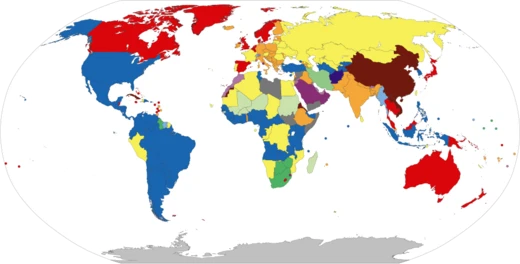
Parliamentary system
Government based on parliamentary confidence and fusion of powers.
Last updated
The system can be bicameral or unicameral, with the lower house typically determining the executive government.[1] A bicameral parliament has two chambers, while a unicameral one has only a single chamber.[1] A bicameral legislature typically includes a directly elected lower house that chooses the executive government, plus an upper house that may be appointed or elected differently.[1]
Quick Facts
- Type
- Form of government
- Key feature
- Fusion of powers; executive accountable to parliament
- Head of government
- Usually prime minister, almost always a member of parliament
- Head of state
- Constitutional monarch or ceremonial president (in parliamentary republics)
- Contrast
- Presidential or assembly-independent systems
- Earliest example
- Icelandic Althing (c. 930) or Cortes of León (1188)
Facts from the source article.
Key facts and history
The Icelandic Althing, consisting of prominent free landowners, first gathered around the year 930.[2] UNESCO states the Decreta of León of 1188 contain the oldest known written information regarding the European parliamentary system.[3] The Westminster system spread to older British dominions such as Australia, New Zealand, Canada, the Irish Free State and the Union of South Africa.[4] Assemblies that could be called parliaments first appeared in medieval Europe, but which one counts as the earliest depends on how the term "parliament" is defined.[2]
What the cited sources add
The UNESCO Memory of the World Programme notes that the Decreta of León reflect an original model where the common people participated in higher-level decision making through elected representatives for the first time.[3] Blick's account of the institution of Prime Minister notes that by 1805 The Times newspaper was beginning to use the phrase 'Prime Minister' in its modern sense.[5] The same source records that the list of government ministers printed in Hansard first used the title Prime Minister in 1885.[5] A legal analysis of anti-defection laws states that Article 70 of the Bangladesh Constitution requires a member to vacate their seat if they vote against party directions.[6]
The same source argues that anti-defection law makes parliamentary debate largely redundant by marginalizing dissent.[6] A 2019 meta-analysis based on 1,037 regressions in 46 studies finds that parliamentary systems rely more on fiscal expansion with higher spending before an election.[1] Political scientist R. Kent Weaver argues that in parliamentary systems, as long as a stable majority or coalition exists in parliament, the government can change legislation and policy quickly and faces fewer constraints on what it can do.[7]
References
- Wikipedia, "Parliamentary system" (CC BY-SA 4.0), which cites: Cazals, "Political Budget Cycles: Manipulation by Leaders versus Manipulation by Researchers? Evidence from a Meta-Regression Analysis.", Journal of Economic Surveys, 2019, p. 274–308 (original not read by us) en.wikipedia.org
- Wikipedia, "Parliamentary system" (CC BY-SA 4.0), which cites: "The Decreta of León of 1188 – The oldest documentary manifestation of the European parliamentary system", UNESCO Memory of the World Programme; Keane, "The Life and Death of Democracy", Simon & Schuster, 2009, p. 169–176; Sánchez, "La Diputació del General de Catalunya (1413-1479)", Institut d'Estudis Catalans, 2004, p. 92 (we also read that source) en.wikipedia.org
- "The Decreta of León of 1188 – The oldest documentary manifestation of the European parliamentary system", UNESCO Memory of the World Programme. facts only, no text reused. unesco.org
- Wikipedia, "Parliamentary system" (CC BY-SA 4.0), which cites: "How the Westminster Parliamentary System was exported around the World", University of Cambridge, 2 December 2013; Seidle, "Reforming parliamentary democracy", McGill-Queen's University Press, 2003, p. 3; "Constitutionalism and political reconstruction", Brill, 2007, p. 92–94; Johnston, "The Historical Foundations of World Order", Martinus Nijhoff Publishers, 2008, p. 571; Fieldhouse, "Settler Self-Government, 1840–1900: The Development of Representative and Responsible Government", Greenwood Press, 1990, p. xxi (original not read en.wikipedia.org
- Blick, "The Institution of Prime Minister", History of Government Blog, 1 January 2012. facts only, no text reused. history.blog.gov.uk
- "Anti-defection law the challenges", legalservicesindia.com. facts only, no text reused. legalservicesindia.com
- Wikipedia, "Parliamentary system" (CC BY-SA 4.0), which cites: Weaver, "Are Parliamentary Systems Better?", The Brookings Review, 1985, p. 16–25; Weaver, "Are Parliamentary Systems Better?", The Brookings Review, 1985, p. 16–25 (original not read by us) en.wikipedia.org
Each numbered sentence above was checked against the source it cites before publication. Sentences citing Wikipedia adapt text from the English Wikipedia article Parliamentary system (contributors), used under CC BY-SA 4.0; this entry is available under the same licence. Other sources were used for facts only; no text or images are copied from them.
More in Forms Of Government
Sources
Compiled from Wikipedia and the sources listed below. Text from Wikipedia is available under CC BY-SA 4.0; this entry is adapted from it.
- Wikipedia: Parliamentary system (CC BY-SA 4.0).
Spotted an error? Know more?
Reader corrections go straight into our review queue. Suggest an edit · How this site is sourced