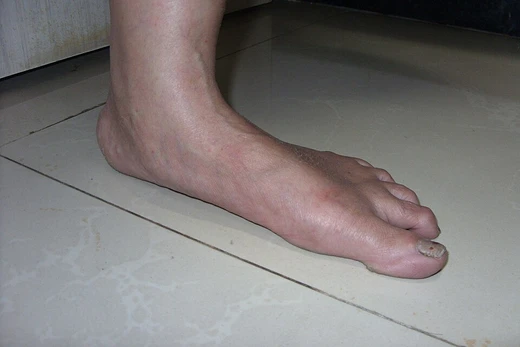
Corn (pathology)
A painful, cone-shaped callus formed by pressure on the skin.
A corn (also known as a clavus) is a cone-shaped, inwardly directed callus of dead skin that forms at a pressure point near a bone or on a weight-bearing part of the body. When located on the feet, corns can be painful enough to interfere with walking. The visible portion is round, but the defining feature is a hard tapering root that is driven deeper into the flesh by pressure.
Quick Facts
- Latin term
- clavus
- Modern medical term
- heloma
- Other term
- tyloma
Facts from the source article.
Did You Know?
- To exclude other differential diagnoses, a skin biopsy may be taken.
- Imaging studies such as plain radiograph or CT scanning can detect underlying bony abnormalities causing abnormal pressure.
Names
A corn is medically known as a heloma, from Greek, with the plural helomas or helomata. The Latin term clavus is older and less common. In the United States, tyloma, meaning callus, is often used instead. A hard corn is a heloma durum or clavus durus, while a soft corn is a heloma molle or clavus mollis. Other varieties include the heloma neurovasculare or clavus neurovascularis, which contains nerves or blood vessels in the epidermis because the dermal-epidermal border has been disrupted, making it very painful and sensitive to debridement. The clavus papillari is a painful corn with a white border of bruised or gelatinous tissue. The clavus neurofibrosus, also called clavus fibrosus, is an old, deep scarred corn sitting in a crater with a white, sometimes macerated border; it is crossed by nerves and connective tissue and is thought to result from scar tissue due to chronic low-grade inflammation. A clavus subungalis, or subungual heloma, forms under a nail. Heloma miliare refers to small, millet seed-sized corns that are often painless; their cause is unknown and is not believed to be solely from mechanical pressure. Though a removed corn looks like a barleycorn, the two words are not related. The word for the skin lesion comes from Latin cornus, meaning horn, linked to Greek keras, the root of keratin. The grain barleycorn comes from an Indo-European word for grain; the shape similarity is coincidental. Many languages use metaphors for corns involving eyes. German has Hühnerauge and Mandarin has jīyǎn, both meaning chicken eye. Japanese uo-no me, Malay mata ikan, and Thai taa plaa all mean fish eye. German also uses Krähenauge (crow's eye), Hornauge (horned eye), and Leichdorn (body thorn). Dutch has eksteroog (magpie eye) and likdoorn, while Swedish uses liktorn. Romance languages often use words related to callus, like French cal, Spanish callo, and Italian callo, or cornus, as in French cor and Italian corno. Catalan uses ull de poll, meaning chick's eye. Medically, the term hyperkeratosis applies.
Signs and symptoms
The central core of a corn is shaped like a funnel or cone, with a wide top and a narrow, pointed bottom, similar to a barleycorn or a shoe tack. This form focuses pressure downward, potentially causing deep tissue injury and ulcers. Hard corns are particularly dangerous for individuals with nerve damage and reduced skin sensation, such as those with diabetes, because they can become infected easily and may result in gangrene. For others, these corns can make walking painful, leading to health issues from reduced activity. Soft corns, which usually develop between the toes, remain damp and keep the nearby skin soft, but their center is hard, not soft.
Treatment
Treating pressure corns often starts with paring them down, which brings quick pain relief. Another common approach uses a corn plaster: a felt ring with salicylic acid at its center that both cushions the area and wears away the tough skin. But if the underlying cause of pressure isn't fixed, the corn usually comes back. Once that pressure source is identified, it can often be avoided by switching to more comfortable shoes, using inserts, or choosing footwear with a roomier toe box. In severe cases, correcting how a person walks might be needed. Surgery is an option when other treatments fail. Corns that develop from an acute injury sit deeper than pressure corns. They can typically be removed without going into the dermis, leaving just a thin layer of epidermis. However, the resulting hole in the foot's sole may develop its own internal callus, sparking a new corn before healing is complete. This may require repeated excision until the area returns to a normal plantar callus.
More in Foot Diseases
Spotted an error? Know more?
Reader corrections go straight into our review queue. Suggest an edit · How this site is sourced