Sarita Colonia
Last updated

via Wikipedia: Sarita Colonia · see source
Sara Colonia Zambrano (1 March 1914 – 20 December 1940), known as Sarita Colonia, is a Peruvian folk saint whose following grew among the poor and marginalized after her death. Born into poverty in Huaraz, she moved to Lima and worked a series of jobs before dying at age 26. Her common grave in Callao became a place of prayer and reported miracles, and by the 1980s a shrine had been built there. Her image was widely seen in Lima during that period, and she remains associated with migrants, sex workers, criminals, and the LGBT community.
Biography
Sara Colonia Zambrano was born on 1 March 1914 in the Belén neighborhood of Huaraz, Peru. Her father, Amadeo Colonia Flores, worked as a carpenter, and her mother was Rosalía Zambrano. The family moved to Lima in 1922, where Colonia attended a Catholic boarding school and began to wish to become a nun. When the family returned to Huaraz in 1926, she was taken out of school.
Her mother died soon after, and Colonia took on the responsibility of raising her younger siblings and later her half-siblings after her father remarried. For a time she worked at a bakery in Huaraz. In the early 1930s she moved back to Lima hoping to earn more money, and for the next three years she worked as a live-in maid. She then moved to Callao, where she lived in the market and sold fish.
She also sold clothes and worked in cafés. On 19 December 1940 she fell severely ill and was taken to the hospital; she died in Lima the following day. Her death was officially attributed to malaria, but her relatives disagreed, claiming she died from ingesting castor oil. She was buried in a common grave at the Baquijano cemetery in Callao.
Religious following
Colonia's grave was marked with a wooden cross and became a place where people gathered to mourn those who had no grave markers. Visitors began to report answered prayers and miracles attributed to her. After the common grave was exhumed, her family moved her remains. In 1983 a shrine made of concrete blocks was built on her burial site, containing a tomb, an image of Colonia, and a spot for lighting prayer candles.
Visitors often buy flowers before entering, and water from the tomb and from the flowers is used for spiritual healing and cleansing. Two festivals are held each year at the shrine: one in March for her birth and one in December for her death. Reverence for Colonia first appeared in the 1960s and 1970s, spreading as migrants to Lima became her main followers. They gathered at her grave as an alternative to orthodox religious practice, since she too had moved to Lima to escape poverty.
Followers
This led to her being seen as a patron saint for illegal immigration to the United States, and people crossing the Mexico–United States border sometimes wear her image for protection. Her following grew among groups who were treated poorly in churches, including the poor, dockworkers, maids, bus drivers, the unemployed, criminals, sex workers, and members of the LGBT community. Her relatively uneventful life in poverty resonated with followers who came from similar backgrounds.
During the 1970s and 1980s, bus and taxi drivers often displayed her image in their vehicles, and her grave had constant visitors at the height of her popularity. Colonia is also believed to protect thieves and prisoners, and some prisoners get tattoos of her image for protection. In 1994, police foiled a bank robbery plot by arresting the culprits when they visited her shrine to pray for success. The local prison of Callao is sometimes called Sarita Colonia because of her association with prisoners.
The Catholic Church has formally discouraged veneration of her, though it became more accommodating after her popularity increased. By the 21st century, her image was more widely accepted in Lima, and her status as a folk saint had become part of the city's culture. Her following remained steady in the early decades of the 21st century, still drawing thousands of adherents during festivals but not growing in number.
Image and media
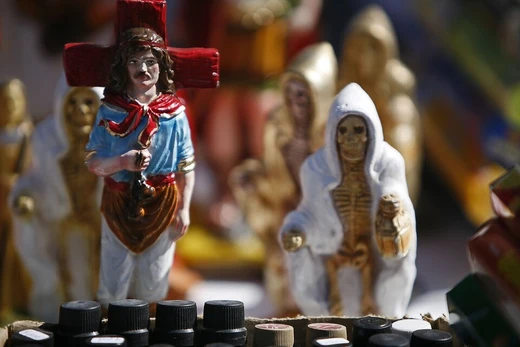
Sarita Colonia's name and image are recognized in Lima and appear on many kinds of merchandise. Almost all depictions of her are based on the only existing photograph, taken in 1926 when she was twelve years old, and these depictions often show her as white. She appears in fiction, such as Eduardo González Viaña's 1990 book Sarita Colonia viene volando. The debut album of the band Los Mojarras, titled Sarita Colonia, features cover art showing a tattoo of her.
A 1980s episode of the crime procedural Gamboa involved police infiltrating a cult of thieves devoted to Sarita Colonia. In 1980, the artist group E. P. S. Huayco created a large painting of her from 12,000 empty tin cans, placed on a hill in Lima where migrants gathered, and it became another meeting point for devotees to leave offerings. In 2017, two Peruvian students painted a mural of her in Milan, Italy, on a railway embankment at the edge of an ethnically diverse neighborhood, but it was painted over in the following years.
More in Folk Saints
Test yourself
Three questions drawn from this entry’s sources. Pick an answer to check it.
Answers checked against the source article
Sources
Compiled from Wikipedia and the sources listed below. Text from Wikipedia is available under CC BY-SA 4.0; this entry is adapted from it.
- Wikipedia: Sarita Colonia (CC BY-SA 4.0).
Spotted an error? Know more?
Reader corrections go straight into our review queue. Suggest an edit · How this site is sourced