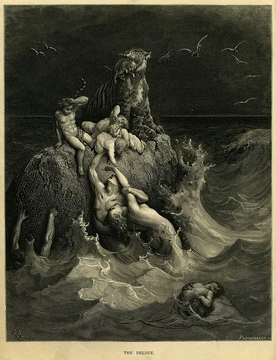
Utnapishtim
Mesopotamian flood hero granted eternal life after surviving the deluge.
Utnapishtim is a legendary figure known as the Flood Hero in Mesopotamian narratives, tasked by the god Enki to build a giant ship called Preserver of Life to survive a world-destroying flood.[1]
Quick Facts
- First
- Sumerian King List; c. 2000 BC
- Last
- Epic of Gilgamesh; c. 1200 BC
- Occupation
- King of Shuruppak (c. 2900 BC)
- Family
- Ubara-Tutu (father)
Facts from the source article.
Key facts and history
Utnapishtim is called by different names in different traditions, including Ziusudra in Sumerian versions and Atra-hasis in early Akkadian sources.[2] The ship was made of solid timber with equal dimensions in length and width, so the sun's rays would not shine in.[3] Its frame was 200 feet in length, width, and height, with a floor-space of one acre and seven floors divided into nine sections each.[3] After the flood, the gods granted Utnapishtim and his wife immortality and a place among the heavenly gods because he preserved the seed of life.[4]
In the Epic of Gilgamesh, the hero Gilgamesh searches for Utnapishtim at the mouth of the rivers to learn the secret of eternal life.[5] Utnapishtim's father was the ruler named Ubar-Tutu.[2] The deity Enki commanded Utnapishtim to give up his material goods and construct a huge vessel named Preserver of Life.[6] Aboard the ship, Utnapishtim placed his spouse, his children, his kin, village artisans, young animals, and various seeds.[3]
Utnapishtim advises Gilgamesh to stop pursuing eternal life, yet offers him a challenge to stay awake as a test.[7] After Gilgamesh lost that challenge, Utnapishtim informed him of a rejuvenating plant.[7]
What the cited sources add
The Open Library record for "World Mythology" confirms the 1994 publication by NTC Pub. Group, which is the source for the ship's dimensions and construction details.[8][3]
References
- Wikipedia, "Utnapishtim" (CC BY-SA 4.0), which cites: George, "The Babylonian Gilgamesh Epic, Volume 1", Oxford University Press, 2003, p. 70, 152–155; George, "The Babylonian Gilgamesh Epic, Volume 1", Oxford University Press, 2003, p. 70, 152–155 (original not read by us) en.wikipedia.org
- Wikipedia, "Utnapishtim" (CC BY-SA 4.0), which cites: William W. Hallo and William Kelly Simpson, "The Ancient Near East: A History", 1971 (original not read by us) en.wikipedia.org
- Wikipedia, "Utnapishtim" (CC BY-SA 4.0), which cites: Rosenberg, "World Mythology: An Anthology of the Great Myths and Epics", National Textbook Company, 1994, p. 196–200 (we also read that source) en.wikipedia.org
- Wikipedia, "Utnapishtim" (CC BY-SA 4.0), which cites: Gardner, "Gilgamesh: translated from the Sin-leqi-unninni version", Random House, Inc, 1984, p. 240 (we also read that source) en.wikipedia.org
- Wikipedia, "Utnapishtim" (CC BY-SA 4.0), which cites: "The Epic of Gilgamesh Tales of Earth", 15 April 2019 (original not read by us) en.wikipedia.org
- Wikipedia, "Utnapishtim" (CC BY-SA 4.0), which cites: "Erra and Ishum - www.GatewaysToBabylon.com", www.gatewaystobabylon.com (original not read by us) en.wikipedia.org
- Wikipedia, "Utnapishtim" (CC BY-SA 4.0), which cites: "In The Epic of Gilgamesh, what does Gilgamesh gain from his epic quest? Does it change him?", eNotes (original not read by us) en.wikipedia.org
- Open Library record, ISBN 0844257656 ("World mythology"). CC0 (metadata); book content not read. openlibrary.org
Each numbered sentence above was checked against the source it cites before publication. Sentences citing Wikipedia adapt text from the English Wikipedia article Utnapishtim (contributors), used under CC BY-SA 4.0; this entry is available under the same licence. Other sources were used for facts only; no text or images are copied from them.
More in Flood Myths
Spotted an error? Know more?
Reader corrections go straight into our review queue. Suggest an edit · How this site is sourced