Flag of Pakistan
National flag of Pakistan, adopted 11 August 1947.
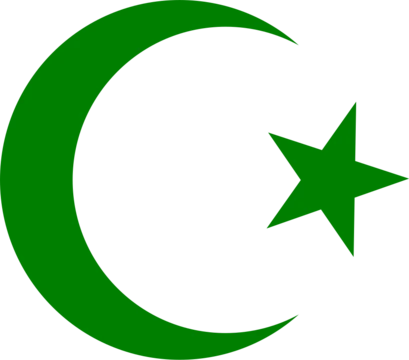
The national flag of Pakistan, known as the Flag of the Star and Crescent (Parcham-e-Sitāra-o-Hilāl), consists of a dark green field with a stylized white descending crescent and five-pointed star at its centre, and a vertical white stripe at the hoist. It was adopted by the Constituent Assembly of Pakistan on 11 August 1947 and became the official flag of the Dominion of Pakistan on 14 August 1947, following independence from the British Empire. The flag was retained as that of the Islamic Republic of Pakistan in 1956 and remains in use as the national flag.
Quick Facts
- Nickname
- ('Flag of the Star and Crescent')
- Use
- 111000
- Proportion
- 2:3
- Adoption
- 11 August 1947
- Design
- A white star and crescent on a dark green field, with a vertical white stripe at the hoist
- Designer
- Syed Amir-uddin Kedwaii
Facts from the source article.
Did You Know?
- The flag is referred to in the third verse of Pakistan's national anthem.
- The Islamic green represents the Muslim-majority populace, while the white stripe represents religious minorities such as Hindus, Christians, Sikhs and Zoroastrians.
History
In 1942, the Pakistan National Movement published a pamphlet by Choudhry Rahmat Ali, founder of the Pakistan Movement, depicting on its cover a flag of a proposed Pakistan with a thin white crescent and five white stars on a green field. A graphic illustration from 1946 more clearly shows the stars in a pentagonal arrangement, each star apparently representing a constituent nation: Punjab, Afghania (NWF), Kashmir, Sindh, and Balochistan. Ali also designed a flag for an envisioned association of independent Muslim states, featuring a smaller crescent and ten stars. The design eventually adopted as the Flag of Pakistan was based on the flag of the Muslim League, which in 1937 began using a solid green banner charged with white descending crescent and star. During the Khilafat Movement in the early 1920s, Muslims had begun using a green banner with crescent and star as a religious symbol. By the 1940s, Muhammad Ali Jinnah declared the League's flag the 'national flag of Muslim India', and by 1944 he publicly stated they intended it to be the flag of Pakistan. The resulting flag bears a striking resemblance to various iterations of the Saudi flag from 1744 to 1937, which featured a white heraldic side at the hoist and a green field charged with white calligraphic text.
Design
The official design was adopted by the Constituent Assembly together with a definition of features and proportions. The flag is a dark green rectangular flag in the proportion of length to width as 3:2, with a white vertical bar at the mast, the green portion bearing a white crescent in the centre and a five-pointed white heraldic star. The width of the white portion is one quarter the length of the flag, nearest the mast, so the green portion occupies the remaining three quarters. A diagonal is drawn from the top right-hand corner to the bottom left corner of the green portion, on which two points are established: P1 at the centre of the green portion, and P2 at the intersection of the diagonal and an arc created from the top right-hand corner equal to 13/20 the height of the flag. With centre at P1 and radius 3/10 the height of the flag, the first circle is described; with centre at P2 and radius 11/40 the height of the flag, a second circle is described; the enclosures of these two circles form the crescent. The five-pointed star is determined by drawing a circle with radius 1/10 the height of the flag positioned between P2 and P3 on the diagonal; the star lies with one point on the diagonal at P3 where circle C1 intersects the diagonal. The flag is coloured in Pakistan green with standard RGB values (0, 64, 26) or hex triplet #00401A. The left strip, star and crescent are white. The Interior Ministry provides dimensions for different circumstances, including ceremonial flags of 24′ × 16′ and car flags of 24″ × 16″.
National flag protocols
No other flag must fly higher, except the United Nations Flag at United Nations buildings. When displayed alongside other national flags, the National Flag must be at the same height, never lower; when alongside provincial, military or corporate flags, it must be higher. When tied to a mast, it must be tied only at the left and left to fly freely. It must not touch the ground, shoes or anything unclean, and must never be flown in darkness; it must be raised at dawn and lowered at dusk, except on the Parliament of Pakistan, where it is never lowered and must remain alit with artificial light at night. The flag must not be marked with anything. When raising, uniformed personnel must salute and others must stand in attention. It must never be displayed vertically; when displayed horizontally, the white strip must be at the left. It must not be flown upside down or with the crescent and star facing left, nor displayed where likely to get dirty. It must not be set on fire, trampled upon, or buried; when burying a flag-bearing casket, the flag must be detached and held above the grave.
Milestones
In 2019, the largest balloon mosaic (flag) of 180.172 m² was achieved by Pakistan Hindu Council in Islamabad, setting a Guinness World Record. In 2017, on 14 August, people of Balochistan hoisted a 2-mile-long flag of Pakistan in Quetta. In 2014, 29,040 people gathered in a stadium in Lahore to form the flag of Pakistan, setting a new world record for the largest national flag comprising humans, certified by Guinness World Records. In 2012, 24,200 people gathered in a stadium in Lahore for the same feat. In 2004, a 340 × 510 ft (173,400 square foot) flag was unfurled at the National Stadium Karachi, setting the world record for the largest flag. On the night of 14 August 1947, a group of Indian Boy Scouts in France learned of independence; Mohammad Iqbal Qureshi, a Muslim boy scout, turned a green turban into a Pakistani flag and unfurled it, marking the first time the Pakistani flag flew on foreign soil.
More in Flags with Star and Crescent
Spotted an error? Know more?
Reader corrections go straight into our review queue. Suggest an edit · How this site is sourced