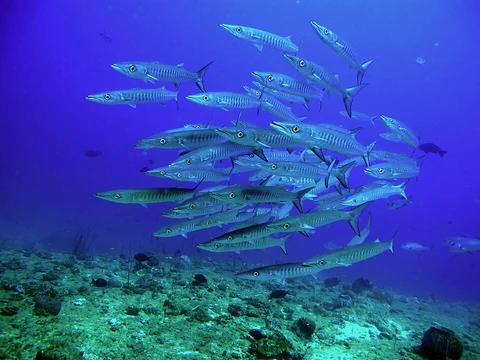
Antarctic fishes
Cold-adapted fish with unique blood and antifreeze adaptations.
Last updated
Antarctic fishes are a limited but highly specialized group adapted to extreme cold in the Southern Ocean.[1] The mackerel icefish was once the most abundant species found near shore in waters less than 400 m.[2]
Last updated 2026-10-20 from the source article.
Quick Facts
- Field
- Marine biology, evolutionary biology
- Known for
- Antifreeze glycoproteins
- hemoglobin loss
- adaptive radiation
- Largest species
- Antarctic toothfish (up to 2 meters)
- Smallest species
- Harpagifer (10 cm)
- Dominant family
- Nototheniidae (cod icefishes)
Facts from the source article.
Biology and range
The majority of these fish are benthic, meaning they live out their lives on the ocean floor.[3] Even though they lack swim bladders, some species have successfully moved into the water column.[4] Neutral buoyancy was achieved through evolutionary reductions in skeletal mineral content and increases in lipid stores.[3] Antifreeze glycoproteins (AFGPs) enable Antarctic notothenioids to endure water temperatures as low as -1.86 °C.[5]
Ice crystals that enter a fish's body from food, water, or the environment are bound by antifreeze glycoproteins.[6] As Antarctic waters cooled, AFGPs originated from a gene that previously coded for pancreatic trypsinogen.[6] The absence of red blood cells is the most notable characteristic of Channichthyids.[7] According to genetic analyses, crocodile icefish once possessed erythrocytes but later lost the ability to use hemoglobin through a reversal in evolution.[7]
Notothenioids are estimated to live for about ten years, becoming sexually mature between 3 and 4 years of age.[8] The incubation period for eggs is lengthy, approximately five months.[9]
What the specialist sources record
The Australian Antarctic Program notes that toothfish can grow up to 2 m long and weigh 100 kg when fully grown.[2] The same source lists two species of toothfish: the Antarctic toothfish and the Patagonian toothfish.[2] The Antarctic toothfish is found in the high latitude region close to the Antarctic continent.[2] The Patagonian toothfish is found in sub-Antarctic waters on shelves around islands and submarine banks.[2]
The Antarctic toothfish has antifreeze proteins in its tissues and blood.[2] Careful regulation and enforcement have seen illegal fishing for toothfish fall to near-zero levels in waters under national jurisdiction.[2]
References
- Wikipedia, "Antarctic fishes" (CC BY-SA 4.0), which cites: "Antarctic fish – Australian Antarctic Program", www.antarctica.gov.au, 2012-12-13 (we also read that source) en.wikipedia.org
- "Antarctic fish – Australian Antarctic Program", www.antarctica.gov.au, 2012-12-13. facts only, no text reused. antarctica.gov.au
- Wikipedia, "Antarctic fishes" (CC BY-SA 4.0), which cites: Fernández, "Buoyancy of sub-Antarctic notothenioids including the sister lineage of all other notothenioids (Bovichtidae)", Polar Biology, 2012, p. 99–106 (original not read by us) en.wikipedia.org
- Wikipedia, "Antarctic fishes" (CC BY-SA 4.0), which cites: Rutschmann, "Parallel ecological diversification in Antarctic notothenioid fishes as evidence for adaptive radiation", Molecular Ecology, 15 July 2011, p. 4707–4721 (original not read by us) en.wikipedia.org
- Wikipedia, "Antarctic fishes" (CC BY-SA 4.0), which cites: Matschiner, "Extremophile Fishes", 2015, p. 35–57 (we also read that source) en.wikipedia.org
- Wikipedia, "Antarctic fishes" (CC BY-SA 4.0), which cites: Evans, "Synthesis and recycling of antifreeze glycoproteins in polar fishes", Antarctic Science, 2 April 2012, p. 259–268; Matschiner, "Extremophile Fishes", 2015, p. 35–57; Evans, "Synthesis and recycling of antifreeze glycoproteins in polar fishes", Antarctic Science, 2 April 2012, p. 259–268; Matschiner, "Extremophile Fishes", 2015, p. 35–57; Evans, "Synthesis and recycling of antifreeze glycoproteins in polar fishes", Antarctic Science, 2 April 2012, p. 259–268; Evans, "Synthesis and recycling of antifreeze glycoproteins in polar f en.wikipedia.org
- Wikipedia, "Antarctic fishes" (CC BY-SA 4.0), which cites: Prisco, "Biogeography and adaptation of Notothenioid fish: Hemoglobin function and globin-gene evolution", Gene, 1 May 2007, p. 143–55; Near, "A Genomic Fossil Reveals Key Steps in Hemoglobin Loss by the Antarctic Icefishes", Molecular Biology and Evolution, 26 July 2006, p. 2008–16; Near, "A Genomic Fossil Reveals Key Steps in Hemoglobin Loss by the Antarctic Icefishes", Molecular Biology and Evolution, 26 July 2006, p. 2008–16 (original not read by us) en.wikipedia.org
- Wikipedia, "Antarctic fishes" (CC BY-SA 4.0), which cites: Kock, "Reproduction in Antarctic notothenioid fish", Antarctic Science, 26 February 1991, p. 125–150; Kock, "Reproduction in Antarctic notothenioid fish", Antarctic Science, 26 February 1991, p. 125–150; Kock, "Reproduction in Antarctic notothenioid fish", Antarctic Science, 26 February 1991, p. 125–150; Kock, "Reproduction in Antarctic notothenioid fish", Antarctic Science, 26 February 1991, p. 125–150; Kock, "Reproduction in Antarctic notothenioid fish", Antarctic Science, 26 February 1991, p. 125–150 (we also read that source) en.wikipedia.org
- Wikipedia, "Antarctic fishes" (CC BY-SA 4.0), which cites: Kock, "Reproduction in Antarctic notothenioid fish", Antarctic Science, 26 February 1991, p. 125–150 (we also read that source) en.wikipedia.org
Each numbered sentence above was checked against the source it cites before publication. Sentences citing Wikipedia adapt text from the English Wikipedia article Antarctic fishes (contributors), used under CC BY-SA 4.0; this entry is available under the same licence. Other sources were used for facts only; no text or images are copied from them.
More in Fish And Marine Life
Sources
Compiled from Wikipedia and the sources listed below. Text from Wikipedia is available under CC BY-SA 4.0; this entry is adapted from it.
- Wikipedia: Antarctic fishes (CC BY-SA 4.0).
- Word definitions: the Codexery glossary, each quoted from its Wikipedia article.
Spotted an error? Know more?
Reader corrections go straight into our review queue. Suggest an edit · How this site is sourced