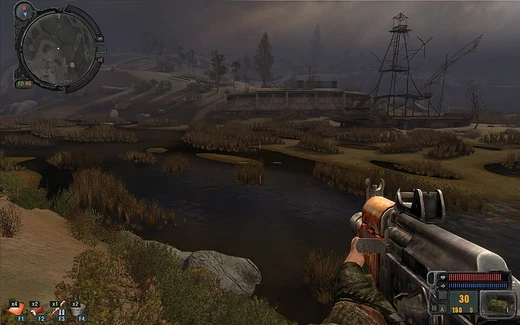
Metro 2033 (video game)
Survive the Moscow Metro after nuclear war.

Metro 2033 is a 2010 first-person shooter survival horror video game developed by 4A Games and published by THQ. Based on Dmitry Glukhovsky's novel of the same name, it follows the silent protagonist Artyom as he navigates the Moscow Metro tunnels to save his home station from mutant and human threats. Notable as the debut title for 4A Games, whose founders previously worked on S.T.A.L.K.E.R.: Shadow of Chernobyl, the game was praised for its horror elements, detailed environments, and plot, while criticized for bugs and artificial intelligence.
Quick Facts
- Title
- Metro 2033
- Developer
- 4A Games
- Publisher
- THQ · Deep Silver (Redux)
- Director
- Andrew Prokhorov
- Designer
- Viacheslav Aristov
- Programmer
- Oles Shyshkovstov · Alexander Maximchuk · Alexei Buinitskiy
- Artist
- Andrey Tkachenko
- Writer
- Dmitry Glukhovsky · Andrew Prokhorov · Viacheslav Aristov
- Composer
- Alexei Omelchuk · Georgiy Beloglazov
- Series
- Metro
- Engine
- 4A Engine
- Platforms
- Microsoft Windows · Xbox 360 · PlayStation 4 · Xbox One · Nintendo Switch · Linux · macOS · Stadia
Facts from the source article.
Lore & Background
Metro 2033 is set in Moscow, Russia, 20 years after a global nuclear holocaust in 2013. The city has become a wasteland filled with killer mutants and irradiated air, forcing survivors to live in the Moscow Metro—a labyrinth of railways, tunnels, and bunkers. Inside, scarce supplies have led to factions like the Hanza, Red Line, and Rangers of the Order. The player controls Artyom, a 24-year-old survivor from the Exhibition station, who must save his home from the mysterious Dark Ones. The story involves a journey through haunted tunnels, encounters with Stalinists and Nazis, and a plan to destroy the Dark Ones' hive using a missile silo called D6.
Reader's Guide
Metro 2033 was the debut title for 4A Games, a studio founded by developers with experience on S.T.A.L.K.E.R.: Shadow of Chernobyl. Author Dmitry Glukhovsky chose the studio due to its location in Ukraine and its expertise in first-person shooters, granting them creative freedom. The developers focused on storytelling and atmosphere, intentionally omitting multiplayer. The game was powered by the proprietary 4A Engine and first announced in 2006 as Metro 2033: The Last Refuge. Critics gave positive reviews for its horror elements, detailed environments, and plot, but criticized bugs and AI. It was profitable for THQ, selling over 1.5 million copies by June 2012, though the publisher felt marketing was rushed. A sequel, Metro: Last Light, released in 2013, with Deep Silver acquiring publishing rights after THQ's bankruptcy. A remastered version, Metro 2033 Redux, released in 2014 for Windows, PlayStation 4, and Xbox One, and was included in the Metro Redux compilation. A third installment, Metro Exodus, released in 2019.
Did You Know?
- Pre-war 5.45×39mm ammunition serves as both stronger bullets and the main currency in the game.
- The player can make moral choices that affect the ending cutscene, such as giving homeless people military grade ammunition.
- The gas mask can be damaged in combat, forcing the player to find a replacement.
A Studio Forged Under Pressure
Metro: Last Light was crafted by 4A Games, a team of roughly eighty developers working under what can only be described as punishing circumstances. The project was originally backed by THQ, whose stingy budget forced the studio to stretch every resource to its breaking point. When THQ collapsed into bankruptcy, Koch Media stepped in to acquire the franchise rights, and Deep Silver ultimately took on the publishing role. The creative vision was anchored by Dmitry Glukhovsky, the franchise's original creator, who penned both the dialogue and the overarching story outline. The developers had initially planned multiplayer modes, but those were cut entirely so the team could pour everything into a single-player experience they hoped would evoke the feeling of Half-Life 2. A Wii U port was also in the pipeline before being quietly dropped. The finished product landed in May 2013 across Windows, PlayStation 3, and Xbox 360, a direct sequel to Metro 2033 that carried the weight of a franchise born from literary roots.
Immersive Design and Survival Mechanics
The gameplay of Metro: Last Light blends first-person shooting with stealth and survival horror, all filtered through the silent eyes of Artyom in a ruined Moscow. Compared to its predecessor, the levels are noticeably larger and offer multiple routes, granting players genuine tactical freedom. Destructible elements like collapsing pillars add a layer of physicality to combat. The weapon system is a standout: three unrestricted slots let players load any combination of firearms, while four secondary options—throwing knives, incendiary grenades, and hand grenades—round out the arsenal. Melee takedowns and stealth takedowns of human foes are fully viable, and the clever trick of extinguishing oil lamps to blind enemies in the darkness rewards creative thinking. Ammunition doubles as currency, making scavenging a constant survival loop. There is no minimap, no objective marker, no traditional HUD; instead, a wristwatch tracks gas-mask filter life and light exposure, and partially visible bullets warn of dwindling ammo. On the irradiated surface, a day-night cycle, dynamic weather, and the need to periodically wipe grime from a gas mask keep tension high. Scattered diary entries and subtle moral choices with a karma system deepen the narrative texture.
Critical Acclaim and Commercial Triumph
Critics largely embraced Metro: Last Light, singeing its atmosphere, world design, tonal consistency, visual presentation, and core gameplay loop as the game's greatest strengths. The oppressive darkness of the tunnels, the weight of every bullet, and the sense of isolation in a broken world resonated strongly with reviewers. However, the game was not without its flaws. Enemy artificial intelligence drew particular criticism for feeling reactive and predictable, and a scattering of technical issues marred the experience for some players. A notable controversy erupted around the pre-order bonus, a Ranger difficulty mode that the marketing team positioned as the definitive way to experience the game, which many felt undermined the carefully balanced standard difficulty. Despite these blemishes, the title was a clear commercial victory. In the United States alone, its first-week retail sales outpaced the entire lifetime retail sales of its predecessor, Metro 2033, signaling that the franchise had found a much wider audience and that the post-apocalyptic metro setting had genuine mainstream appeal.
Enduring Legacy and Franchise Growth
Metro: Last Light proved to be a pivotal turning point for the entire franchise. In 2014, a remastered edition called Metro: Last Light Redux arrived on Windows, PlayStation 4, and Xbox One, bringing the experience to next-generation hardware. That same remaster was later bundled alongside Metro 2033 Redux into a single compilation titled Metro Redux, giving new players a streamlined entry point into the series. The narrative scope continued to expand beyond the screen as well: Glukhovsky authored a novelization of the game's story, published in 2015 under the title Metro 2035, extending the narrative into his broader literary canon. The commercial and critical momentum generated by Last Light set the stage for the franchise's next chapter. In 2019, Metro Exodus arrived as a sequel, continuing the survival-horror-first-person-shooter formula that Last Light had refined. The journey from a budget-constrained sequel developed under THQ's shadow to a series with a novelized canon and a full sequel underscores how far the Metro franchise has traveled since those dark tunnels first opened beneath Moscow.
Frequently Asked Questions
What is Metro 2033 (video game)?
Metro 2033 is a 2010 first-person shooter blending survival-horror mechanics with a narrative-driven plot, built by 4A Games and shipped by THQ. It adapts Dmitry Glukhovsky's post-apocalyptic novel into an interactive experience set in the irradiated tunnels beneath Moscow.
What is the premise of Metro 2033 (video game)?
Players control Artyom, a silent resident of the Dark station, who must travel through the Metro network to neutralize a threat to his community. Along the way he encounters mutated creatures, hostile human factions, and the long-term consequences of the nuclear war that destroyed the surface.
Who developed Metro 2033 (video game) and what engine powers it?
4A Games created the title as their studio debut, with several key members having previously worked on S.T.A.L.K.E.R.: Shadow of Chernobyl. The game runs on the in-house 4A Engine and launched for Microsoft Windows and Xbox 360 in March 2010.
Why is Metro 2033 (video game) important to the FPS genre?
It proved that a tightly scripted, atmosphere-heavy shooter could sell well, moving more than 1.5 million copies by mid-2012. Its focus on resource scarcity, environmental storytelling, and horror pacing helped shape the survival-FPS subgenre that followed.
More in First-Person Shooters, Further Titles 1-21
Spotted an error? Know more?
Reader corrections go straight into our review queue. Suggest an edit · How this site is sourced