Calico Light Weapons Systems
American manufacturer of helical-feed firearms with high-capacity magazines.
Last updated

M.O. Stevens · CC BY-SA 3.0
Calico Light Weapons Systems (CLWS) was a privately owned American manufacturer of semiautomatic firearms. The company was founded in 1982 in Bakersfield, California, and its first production weapon came out in 1985. In 1998, operations shifted to Sparks, Nevada, where only replacement parts for existing guns were made.
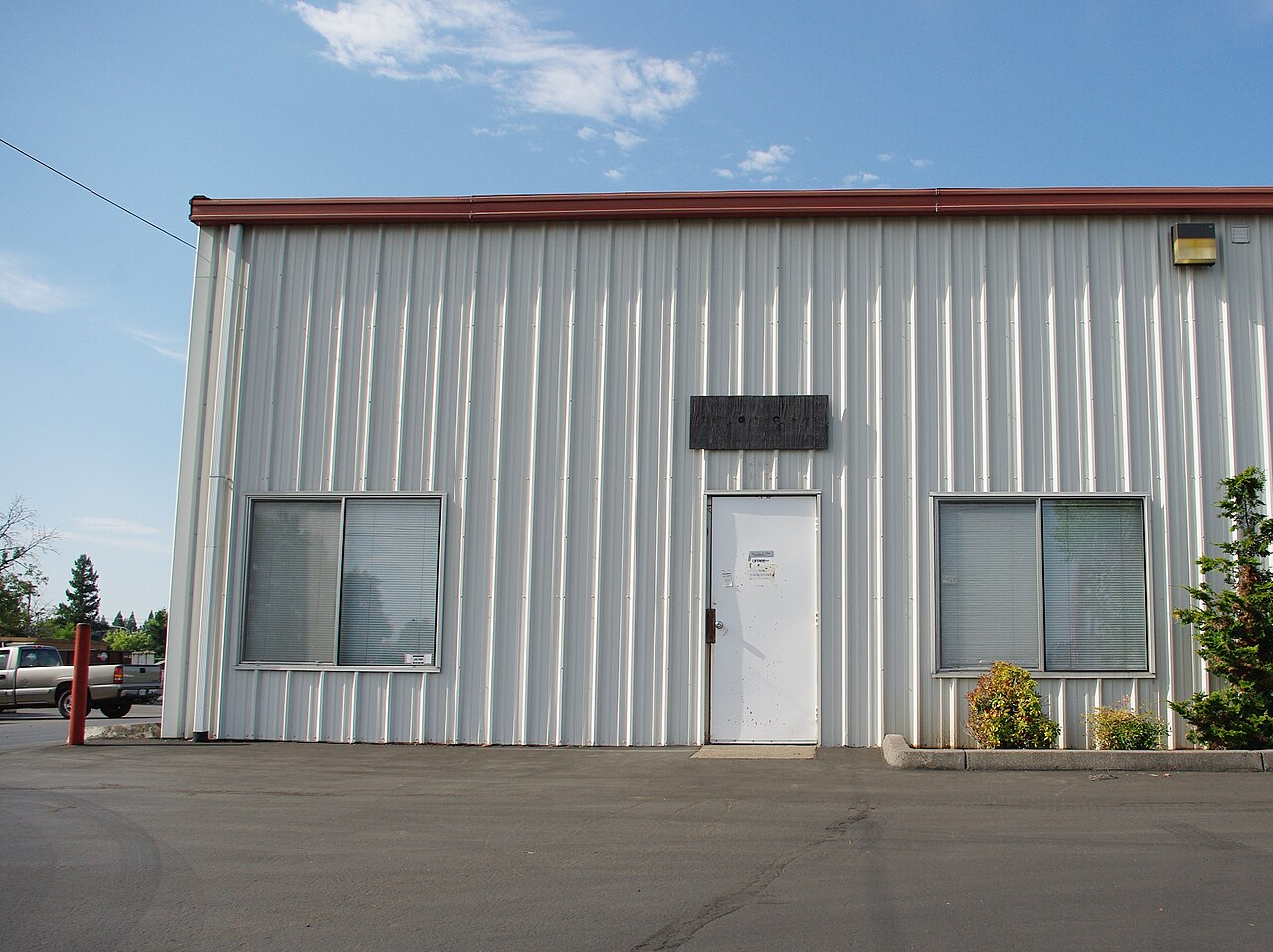
After another sale in 2006, the company moved to Hillsboro, Oregon, and resumed full firearm production. There, it introduced CNC machining and upgraded materials, along with minor redesigns of some models to improve durability and reliability. CLWS went out of business in 2024.
Projects and operations
The company was one of the largest producers of large-capacity magazines—50 and 100 rounds—for automatic and semiautomatic weapons in 2011. Its signature line included pistols and pistol-caliber carbines that used a top-mounted helical-feed magazine in 50- or 100-round capacities. Spent casings ejected downward from a bottom port, making a brass catcher practical. The 9 mm pistols, carbines, and submachine guns operated on the roller-delayed blowback principle also used in Heckler & Koch firearms.
The Calico M950 was a pistol whose main feature, shared with all Calico guns, was feeding from a proprietary helical magazine mounted on top. Factory sights provided accuracy out to about 60 meters (197 feet). The Calico Liberty line included a roller-delayed blowback semiautomatic rifle (Liberty II) and pistol (Liberty III), both chambered for 9 mm Parabellum.
Their 50- or 100-round helical magazines held many rounds in a compact package, and spent cartridges ejected downward ahead of the trigger guard, allowing easy use of a case catcher. A full-automatic version was available for military, police, and other government agencies. At the 2012 SHOT Show, Calico showed a prototype 12-gauge shotgun with a top-mounted helical magazine.
Current products included .22 LR pistols (Calico M110), .22 LR rifles (M100S, M-100 tactical, M-100FS, M-100FS tactical), 9 mm pistols (Liberty III, Liberty III tactical), and 9 mm rifles (Liberty I and II, Liberty I and II tactical, Calico M960 and M960A for military and law enforcement only). Discontinued models included the .22 LR pistol M-100P, the 9 mm pistol M950, carbines M-900 and M-951, and submachine guns M-750, M-900A, and M-950A. A 12-gauge shotgun was cancelled.
Lore & Background
Calico Light Weapons Systems was established in 1982 in Bakersfield, California, and released its first production weapon in 1985. In 1998, operations were moved to Sparks, Nevada, where replacement parts for existing weapons were produced.
In 2006, the company was sold again and moved to Hillsboro, Oregon, where full firearm production resumed. At that time, it implemented a CNC machining process and upgraded materials used in manufacture, along with minor redesigns of some production models to increase durability and reliability. The company went out of business in 2024.
The company's firearms, including the M950 pistol and the Liberty series, use a roller-delayed blowback principle similar to that used in the Heckler & Koch series of firearms. The helical magazine is mounted on top of the weapon and is available in 50- or 100-round capacities.
Spent cartridges are discharged downward, ahead of the trigger guard, making it practical to fit a brass catcher. A full-automatic version was available for military, police, and other government agencies. At the 2012 SHOT Show, Calico exhibited a prototype 12-gauge shotgun with a top-mounted helical magazine, though it was never produced.

A Restless Corporate Journey
Calico Light Weapons Inc. traces its origins to 1982, when it was founded in Bakersfield, California, as a privately held American manufacturer focused on semiautomatic firearms. The company hit its first major milestone three years later in 1985, when it released its inaugural production weapon to the market. Over the following decades, CLWS proved to be a restless entity, repeatedly uprooting its operations. In 1998, the company relocated to Sparks, Nevada, where its primary focus shifted to producing replacement parts for weapons already in circulation rather than building new firearms.
Then in 2006, a sale sent the operation once again to a new location—this time Hillsboro, Oregon—where full-scale firearm manufacturing resumed. During that Oregon chapter, the company invested in CNC machining processes, upgraded the materials it used in production, and carried out minor redesigns on several models aimed at improving durability and reliability. After more than four decades of existence, Calico Light Weapons Inc. ultimately ceased operations in 2024.
The Helical Magazine Revolution
The single most distinctive element of every Calico firearm is its proprietary top-mounted helical magazine, available in either 50- or 100-round capacities. This spiral-feed design sets the entire product line apart from conventional firearms, which typically rely on straight box magazines. Because the magazine sits on top of the weapon, the ejection port is relocated to the bottom, discharging spent casings downward and slightly ahead of the trigger guard.
This unconventional ejection path has a practical upside: it makes it straightforward to attach a brass catcher, allowing shooters to collect and potentially reload spent cartridges in the field. The helical magazine concept was applied across a broad range of platforms, from compact 9 mm pistols like the M950 to pistol-caliber carbines and submachine guns. Even at the 2012 SHOT Show, Calico displayed a prototype 12-gauge shotgun that incorporated the same top-mounted helical magazine principle, suggesting the company saw the design as a universal solution rather than a niche feature.
Product Range and Operating Principles
Calico's catalog spanned multiple calibers and form factors. In the 9 mm Parabellum category, the company offered pistols such as the Liberty III and the now-discontinued M950, alongside carbines and rifles including the Liberty I and Liberty II in both standard and tactical variants. The M960 and M960A were reserved exclusively for military and law-enforcement buyers. In the .22 LR segment, the M110 pistol and the M100S, M-100 tactical, M-100FS, and M-100FS tactical rifles filled out the lineup.
Discontinued submachine guns like the M-750, M-900A, and M-950A had previously served the full-auto market. Mechanically, the 9 mm firearms employed a roller-delayed blowback system borrowed from the design philosophy of the Heckler & Koch family of weapons. The M950 pistol, for instance, featured factory sights calibrated for accuracy out to roughly 60 meters. Full-automatic machine-gun versions of the Liberty platform were available to government agencies, while the civilian market received semi-automatic variants.
Market Position and Final Chapter
By 2011, Calico had established itself as one of the largest producers of large-capacity magazines—specifically 50- and 100-round units—for both automatic and semi-automatic weapons, a niche that underscored the company's core engineering identity. The decision to resume full production in Hillsboro, Oregon, after the 2006 sale marked a period of modernization, with the introduction of CNC machining and upgraded manufacturing materials designed to enhance the durability and reliability of existing models.
The company's product strategy clearly targeted multiple markets: civilian shooters interested in high-capacity semi-automatic pistols and carbines, and government or law-enforcement agencies seeking full-automatic versions of the Liberty platform. Yet despite this broad reach and the distinctive engineering that set Calico apart from competitors, the company could not sustain its operations indefinitely. In 2024, Calico Light Weapons Inc. went out of business, ending a four-decade run that had carried it from a small California workshop to a recognized name in the firearms industry.
Reader's Guide
Calico Light Weapons Systems was one of the largest manufacturers of large (50- and 100-round) magazines for automatic and semi-automatic weapons in 2011. Its helical-feed design allowed for a large number of rounds in a relatively compact and convenient package, a feature that distinguished its firearms from conventional box-magazine designs. The downward ejection of spent cartridges facilitated the use of brass catchers, which was unusual among semi-automatic firearms.
The company's product line included .22 LR pistols and rifles, 9 mm pistols and rifles, carbines, and sub-machineguns, with some models designated for military and law enforcement only. The Calico M950 and Liberty series became the most recognized models. Despite its innovative magazine system, the company ceased operations in 2024, ending over four decades of production.
More in Firearm Manufacturers
Sources
Compiled from Wikipedia and the sources listed below. Text from Wikipedia is available under CC BY-SA 4.0; this entry is adapted from it.
- Wikipedia: Calico Light Weapons Systems (CC BY-SA 4.0).
- Word definitions: the Codexery glossary, each quoted from its Wikipedia article.
Spotted an error? Know more?
Reader corrections go straight into our review queue. Suggest an edit · How this site is sourced