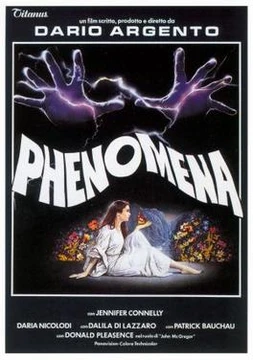
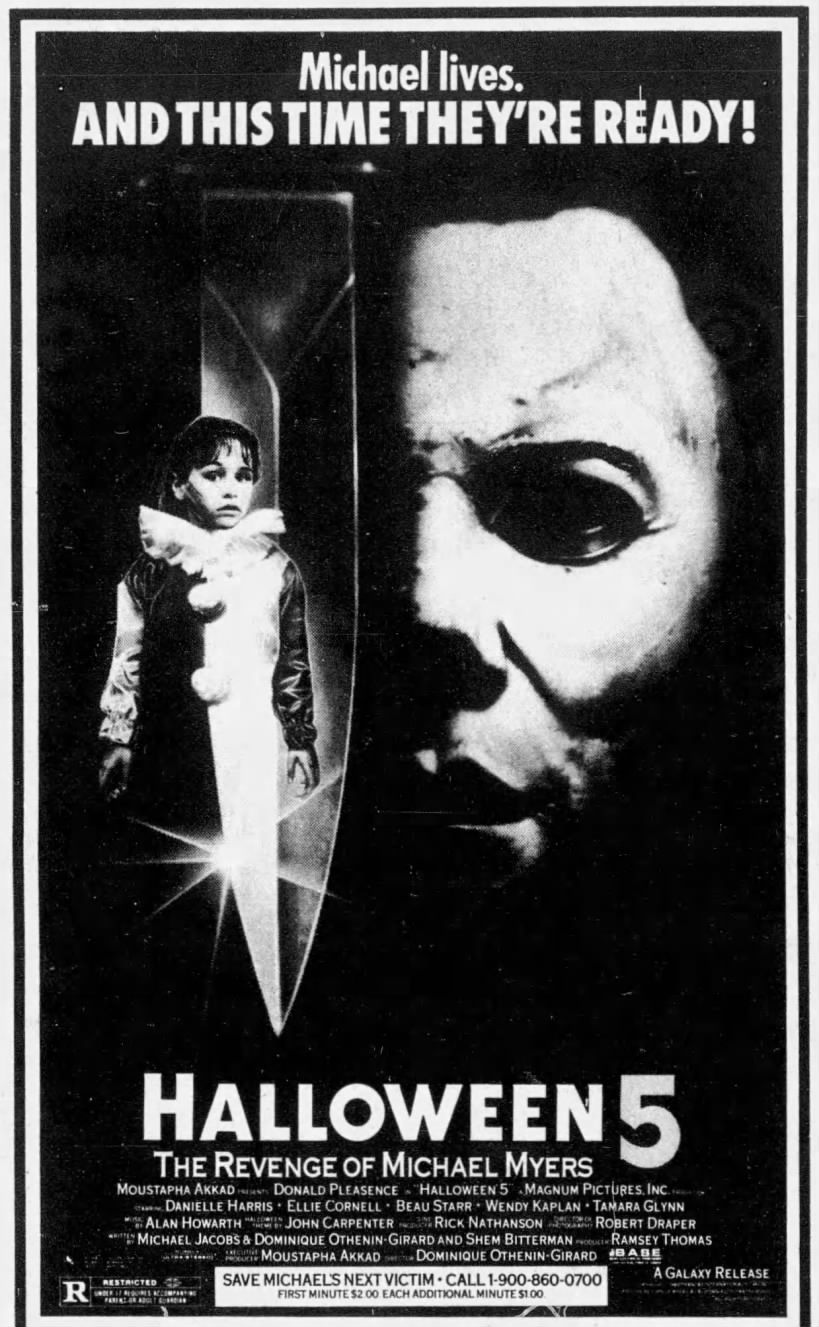
Halloween 5: The Revenge of Michael Myers
A slasher sequel featuring a telepathic link and a mysterious Man in Black.

Mr.ちゅらさん · CC BY-SA 4.0
Halloween 5: The Revenge of Michael Myers is a 1989 American slasher film co-written and directed by Dominique Othenin-Girard. It follows Halloween 4: The Return of Michael Myers as the fifth movie in the Halloween franchise. The story centers on serial killer Michael Myers returning to Haddonfield to kill his traumatized niece, Jamie Lloyd, who now shares a telepathic bond with him.
The film was rushed into production after the success of the previous installment, driven by executive producer Moustapha Akkad. Filming began while the screenplay was still being revised, introducing supernatural horror elements such as Jamie’s telepathic link to Michael and a subplot involving a cult centered on the ancient rune of Thorn, which compels Michael to kill his own bloodline. The final cut minimized this “Curse of Thorn” storyline, leaving only a mysterious “Man in Black” character, which confused audiences and critics; the subplot was later expanded in Halloween: The Curse of Michael Myers (1995).
Shot in Salt Lake City in mid-1989, the film was released in North America in October by independent studio Galaxy Releasing. It was a box office disappointment, grossing only $11.6 million domestically against a $5.5 million budget—the lowest in the franchise—and received generally negative reviews. Critics commonly faulted the screenplay, acting, and story choices, though some praised its artistic, gothic visuals, which marked a stylistic shift from the previous film.
**Plot**
On October 31, 1988, Michael Myers is shot down a mine shaft by Sheriff Ben Meeker and Illinois state police, but crawls out before dynamite is dropped to ensure his death. He floats down a river and reaches the shack of an elderly hermit, who nurses him back to health. A year later, Michael awakens, kills the hermit, and returns to Haddonfield to hunt his niece, Jamie.
Jamie has been admitted to the Haddonfield Children’s Clinic after attacking her foster mother. She is mute from psychological trauma and shows signs of a telepathic link with her uncle. Dr. Sam Loomis learns of this connection and wants to use it to defeat Michael. Meanwhile, Michael kills Jamie’s foster sister Rachel and begins stalking her friend Tina Williams. Jamie senses when loved ones are in danger, triggering convulsions.
Quick Facts
- Director
- Dominique Othenin-Girard
- Writer
- Michael Jacobs / Dominique Othenin-Girard / Shem Bitterman
- Producer
- Ramsey Thomas
- Based On
- Characters · John Carpenter · Debra Hill
- Starring
- Donald Pleasence / Danielle Harris / Ellie Cornell / Beau Starr / Wendy Kaplan / Tamara Glynn
- Music
- Alan Howarth
- Cinematography
- Robert Draper
- Editing
- Charles Tetoni / Jerry Brady
- Production Companies
- Magnum Pictures / Trancas International
- Released
- 13 October 1989
- Country
- United States
- Language
- English
Facts from the source article.
Lore & Background
After the success of the previous installment, Halloween 5 was rushed into production by executive producer Moustapha Akkad. The original screenplay, still under revision when filming began, introduced supernatural elements including Jamie's telepathic link to Michael Myers and a subplot involving a cult centered on the ancient rune of Thorn. While the final cut features a mysterious 'Man in Black' character, the 'Curse of Thorn' subplot was largely minimized, causing confusion among audiences and critics. Filmed in Salt Lake City in mid-1989, the film was released theatrically in North America in October 1989 by Galaxy Releasing.
Reader's Guide
Halloween 5: The Revenge of Michael Myers was a box office disappointment, grossing only $11.6 million domestically against a $5.5 million budget, becoming the lowest-grossing film in the franchise. It received generally negative reviews, with common criticism directed at the screenplay, acting, and story decisions, though some praised its artistic and gothic visuals, which marked a stylistic shift from the previous film. The film's minimized 'Curse of Thorn' subplot was expanded upon in the following film, Halloween: The Curse of Michael Myers (1995). The 'Man in Black' character, created by Othenin-Girard without a defined origin, was intended to give freedom of interpretation to future filmmakers.
Did You Know?
- The film was rushed into production to meet a pre-set release deadline of October 1989.
- Director Dominique Othenin-Girard threw the original screenplay by Shem Bitterman into a trashcan in front of producer Moustapha Akkad.
- The 'Man in Black' character was created without knowing his exact origin, to allow freedom for the next team of creators.
- The film's original closing scene, in which Jamie is approached by a black-cloaked figure, was later attached to the beginning of the Producer's Cut of Halloween: The Curse of Michael Myers.
Rushed Into Existence: The Production Saga
When the fourth Halloween proved commercially viable, executive producer Moustapha Akkad moved quickly to lock in a fifth installment for an October 1989 theatrical window. His first instinct was to rehire the writer-director duo behind the previous entry, but both Alan B. McElroy and Dwight H. Little turned down the offer. Producing duties shifted to Ramsey Thomas, who brought in playwright Shem Bitterman to draft a screenplay. Bitterman delivered a first version, titled Halloween 5: The Killer Inside Me, in a mere three days; it positioned Jamie Lloyd as a dark, potentially evil force and featured a resurrected Myers. Akkad overruled that direction, insisting Michael remain the film's sole antagonist. A second draft landed by February 1989, and director Jeff Burr was being courted to helm the project. That trajectory changed when series co-creator Debra Hill crossed paths with Dominique Othenin-Girard at the 1989 Sundance Film Festival, ultimately placing him behind the camera. By the time cameras rolled in Salt Lake City, the screenplay was still being revised, a fact that would echo through the finished product.
The Thorn Curse: A Subplot Lost in Translation
The earliest drafts of the fifth Halloween leaned heavily into supernatural horror, weaving in a mythology that would never fully materialize on screen. Bitterman's original vision included a cult organized around the ancient rune of Thorn, a force that compelled Michael Myers to systematically destroy his own bloodline. Jamie Lloyd's telepathic bond with her uncle was also a central supernatural element from the start. In the final theatrical cut, however, the Thorn cult was stripped back to the point of near-invisibility. What remained was a shadowy figure known only as the Man in Black, who appears in the closing sequence and whose motivations are never explained within the film itself. Audiences and reviewers alike reported feeling disoriented by the half-realized mythology, with many criticizing the narrative for introducing a mystical framework only to abandon it. The Thorn storyline was not entirely abandoned, though; it was expanded and given proper narrative weight in the 1995 sequel, Halloween: The Curse of Michael Myers, which effectively served as the follow-up the fifth film had promised but never delivered.
The Telepathic Bond and the Hunt for Jamie
At the heart of the fifth film is a relationship that transforms the slasher formula: Michael Myers and his niece Jamie Lloyd share a psychic connection that allows her to sense danger before it strikes. After surviving the mine-shaft ambush and being nursed back to health by an elderly hermit in the wilderness, Myers kills his caretaker and returns to Haddonfield with a single target. Jamie, now mute from psychological trauma, is confined to the Haddonfield Children's Clinic, where her episodes of convulsions—triggered whenever someone she loves is threatened—alarm the staff. Dr. Sam Loomis recognizes the bond as a tactical weapon and seeks to exploit it. The narrative escalates as Michael eliminates Jamie's foster sister Rachel and stalks her friend Tina Williams, who attends a Halloween party at the Tower Farm. Tina ultimately sacrifices herself to shield Jamie, and the grieving girl agrees to help Loomis set a trap at the abandoned Myers house. The climax in the attic, where Jamie calls him 'Uncle' and he briefly removes his mask before a fit of rage resumes, remains the film's most emotionally charged sequence.
A Stylistic Gamble That Missed Its Mark
Shot in Salt Lake City during the middle of 1989 and delivered to North American theaters in October of that same year by the independent distributor Galaxy Releasing, the fifth Halloween arrived with modest expectations and left with a box office result that underscored them. Domestic takings of $11.6 million against a production budget of $5.5 million made it the lowest-grossing entry in the franchise to that point. Critical reception was broadly unfavorable; reviewers consistently singled out the screenplay, the quality of the acting, and what they perceived as incoherent story decisions. Yet a recurring thread of praise emerged around the film's visual design. Othenin-Girard's direction introduced a markedly more gothic and painterly aesthetic, a deliberate departure from the leaner, more conventional horror look of the 1988 predecessor. That artistic ambition, combined with the unresolved Thorn mythology and the enigmatic Man in Black, gave the film a strange, unfinished quality that divided audiences. For many fans, it remains the franchise's most polarizing chapter—a work whose visual boldness could not fully compensate for its narrative fragmentation.
Gallery



Frequently Asked Questions
What is the telepathic element in Halloween 5: The Revenge of Michael Myers?
Jamie Lloyd, the young girl at the heart of the story, shares a psychic link with Michael Myers that lets her sense his location and murderous intent from any distance. This bond serves as the film's central supernatural mechanism and drives nearly every plot beat.
Who is the Man in Black and what is his role in the telepathy plot?
The Man in Black is a hooded, enigmatic figure who appears to mentor Jamie in controlling her psychic connection to Michael. His true identity and ultimate purpose are never fully revealed within the film, leaving him as a deliberately mysterious guide to her abilities.
How does the telepathic bond affect Jamie Lloyd day to day?
Jamie receives vivid, often terrifying psychic visions of Michael's movements and attacks, which let her anticipate his actions and warn others in Haddonfield. The constant link also causes her deep emotional anguish, as she feels his killing impulses as though they were her own.
Why is the telepathy in Halloween 5 significant to the broader franchise?
It is the first entry in the Halloween series to explicitly tie a living character to Michael through a supernatural psychic channel rather than mere coincidence. This mystical layer sets the film apart from the more conventional slasher installments and deepens the mythology surrounding Myers.
How does the telepathic storyline resolve by the end of the film?
Jamie ultimately uses her own will to sever the psychic bond that has linked her to Michael since childhood, cutting off her ability to sense his presence. The film closes with that connection broken, though Michael's final fate is left deliberately ambiguous.
More in Films about telepathy 1-24
Spotted an error? Know more?
Reader corrections go straight into our review queue. Suggest an edit · How this site is sourced