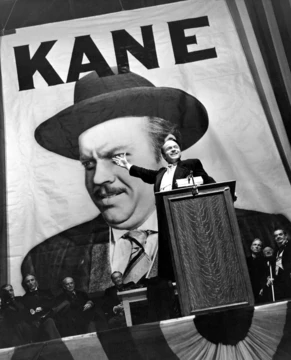
Citizen Kane
The greatest film ever made, according to decades of critics' polls.
Last updated
Citizen Kane, released in 1941, is an American drama and the first feature film directed by Orson Welles, who also produced, starred in, and co-wrote it with Herman J. Mankiewicz. The story is a fictionalized look at the life of Charles Foster Kane, a character played by Welles that blends traits from newspaper magnates William Randolph Hearst and Joseph Pulitzer, Chicago businessmen Samuel Insull and Harold McCormick, and even elements from the screenwriters' own experiences.
Development
Welles came to Hollywood after his Mercury Theatre success on Broadway and the infamous 1938 "War of the Worlds" radio broadcast. In 1939, he signed with RKO Pictures, which gave him unusual creative control for a first-time director: he could develop his own story, choose his cast and crew, and have final cut. After two earlier projects fell through, he and Mankiewicz wrote the script for Citizen Kane. Filming happened in 1940, with an innovative trailer released that same year, and the movie came out in 1941.
When it debuted, Hearst banned his newspapers from mentioning it. Though critics praised it, the film didn't earn back its production costs. It then faded from view until French critics like André Bazin championed it, leading to a 1956 re-release. In 1958, it ranked ninth on the Brussels 12 list at the World Expo.
Legacy
Today, Citizen Kane is often called the greatest film ever made. For five decades—in 1962, 1972, 1982, 1992, and 2002—it topped the British Film Institute's Sight and Sound poll. It also led the American Film Institute's 1998 and 2007 lists of the best American movies.
Accolades
In 1989, the Library of Congress chose it as one of the first 25 films for the National Film Registry, citing its cultural, historical, and aesthetic significance. The movie earned nine Academy Award nominations and won Best Original Screenplay for Mankiewicz and Welles. Critics especially note Gregg Toland's cinematography, Robert Wise's editing, Bernard Herrmann's score, and the innovative narrative structure.
Plot
The plot begins with elderly newspaper publisher Charles Foster Kane dying in his Florida mansion, Xanadu, whispering "Rosebud." A newsreel producer assigns reporter Jerry Thompson to find out what the word means. Thompson interviews Kane's associates but is initially turned away by Kane's second wife, Susan Alexander Kane, now an alcoholic nightclub owner.
Thompson first visits the archive of banker Walter Parks Thatcher. There, he learns that Kane's mother, Mary, hired Thatcher to manage a trust after gold was discovered on her land in 1871. The trust provided for Kane's education and guardianship, separating him from his abusive father. As a boy playing in the snow with his sled, Kane was introduced to Thatcher and, angry, hit him with the sled before trying to run away.
At 25, Kane took control of his trust, becoming one of the world's richest men thanks to the mine's profits and Thatcher's investments. He bought the New York Inquirer and turned it into a yellow journalism machine, publishing scandalous stories that attacked Thatcher's business interests. Thompson interviews Kane's business manager, Mr. Bernstein, who recalls Kane hiring top journalists to boost the paper's circulation. Kane manipulated public opinion during the Spanish–American War, married Emily Norton (the President's niece), and eventually sold the paper to Thatcher after the 1929 stock market crash.
Next, Thompson speaks with Kane's former best friend, Jedediah Leland, in a retirement home. Leland describes how Kane's marriage to Emily fell apart over time, despite them having a son. While running for Governor of New York as a "fighting liberal," Kane began an affair with amateur singer Susan Alexander. His opponent, Jim W. Gettys, exposed the affair, ending Kane's political career.
Kane then married Susan and forced her into an opera career she had no talent or desire for, building a Chicago opera house for her. After Leland wrote a negative review of Susan's disastrous debut, Kane fired him—finishing and printing the review himself. Susan protested she never wanted to sing, but Kane made her continue the season.
Susan eventually agrees to talk to Thompson. She describes how, after her opera career ended (Kane allowed it following her suicide attempt), the couple lived unhappily at Xanadu. Their relationship turned bitter and violent, and Susan left.
Kane's butler, Raymond, recalls that after Susan moved out, Kane trashed her bedroom. When he found a snow globe, he calmed down and tearfully said "Rosebud." Thompson, having exhausted all leads, concludes he cannot solve the mystery. As Kane's possessions are catalogued or discarded, the meaning of his last word remains unknown.
Lore & Background
After the Broadway success of Welles's Mercury Theatre and the controversial 1938 radio broadcast 'The War of the Worlds' on The Mercury Theatre on the Air, Welles was courted by Hollywood. He signed a contract with RKO Pictures in 1939. Although it was unusual for an untried director, he was given freedom to develop his own story, to use his own cast and crew, and to have final cut privilege.
Following two abortive attempts to get a project off the ground, he wrote the screenplay for Citizen Kane with Herman J. Mankiewicz. Principal photography took place in 1940, the same year that its innovative trailer was shown, and the film was released in 1941. Upon its release, Hearst prohibited any mention of the film in his newspapers.
Although it was a critical success, Citizen Kane failed to recoup its costs at the box office. The film faded from view after its release, but returned to public attention when it was praised by French critics such as André Bazin and re-released in 1956. In 1958, the film was voted number nine on the prestigious Brussels 12 list at the 1958 World Expo.
Reader's Guide
The film's plot begins on a vast palatial estate in Florida, where elderly wealthy newspaper publisher and industry magnate Charles Foster Kane dies uttering his last word, 'Rosebud'. A reporter, Jerry Thompson, is tasked with discovering the meaning of 'Rosebud' and interviews Kane's friends and associates.
Through these interviews, the story reveals Kane's early years in a Colorado boarding house, his rise to power as a newspaper publisher, his failed marriages, his political scandal, and his eventual isolation. The mystery of 'Rosebud' is never solved by Thompson, but the audience sees that it is the trade name of the sled Kane was playing with on the day he was taken from his home. The cast includes Orson Welles as Charles Foster Kane, Joseph Cotten as Jedediah Leland, Dorothy Comingore as Susan Alexander Kane, Agnes Moorehead as Mary Kane, Ruth Warrick as Emily Monroe Norton Kane, Ray Collins as Jim W. Gettys, Erskine Sanford as Herbert Carter, Everett Sloane as Mr. Bernstein, William Alland as Jerry Thompson, Paul Stewart as Raymond, George Coulouris as Walter Parks Thatcher, and others.
Did You Know?
- For 50 years (five decennial polls: 1962, 1972, 1982, 1992 and 2002), it stood at number one in the British Film Institute's Sight and Sound decennial poll.
Frequently Asked Questions
What is Citizen Kane about?
It is a 1941 American drama that traces the rise and fall of Charles Foster Kane, a powerful newspaper publisher whose life is examined through the eyes of a reporter. The film was directed by and starred Orson Welles in his feature-film debut.
What Academy Award did Citizen Kane win?
The film took home the Oscar for Best Writing (Original Screenplay), credited to Herman J. Mankiewicz and Orson Welles.
More in Film History & Milestones
Sources
Compiled from Wikipedia and the sources listed below. Text from Wikipedia is available under CC BY-SA 4.0; this entry is adapted from it.
- Wikipedia: Citizen Kane (CC BY-SA 4.0).
Spotted an error? Know more?
Reader corrections go straight into our review queue. Suggest an edit · How this site is sourced