ʻAhu ʻula
Last updated
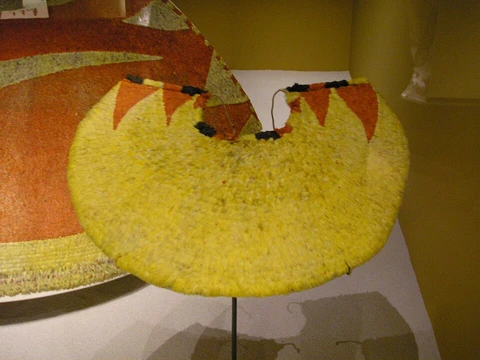
The ʻahu ʻula is a feather cloak or cape from ancient Hawaii, whose name literally means "red/sacred garment for the upper torso." Along with the mahiole (feather helmet), it served as a symbol of the highest rank among the chiefly aliʻi class. Over 160 examples exist in museums worldwide, with at least thirty collected during Captain Cook's voyages.
Quick Facts
- Number of known examples
- over 160
- Surviving cook-era capes
- sixteen
Facts from the source article.
Construction
The netting base of Hawaiian feather cloaks was made from olonā (Touchardia latifolia), a nettle-family plant. Feathers were gathered into small bundles called ʻuo or ʻuwo and tied into the netting, with bundles placed close together to create a uniform surface. Yellow plumage came from the ʻōʻō (Moho nobilis) and mamo (Drepanis pacifica), both now-extinct honeycreepers; these birds were caught and released due to their scarcity. Mamo feathers were described as yellow by some and orange by others; Kamehameha I's cloak of pure mamo was called the "Golden Cloak," though Brigham noted mamo feathers are actually orange while ʻōʻō feathers are pale yellow, with fading making them hard to distinguish.
Red feathers were primarily taken from the ʻiʻiwi (Vestiaria coccinea), with some from the ʻapapane (Himatione sanguinea); these birds were killed and skinned due to their abundance. Black feathers from the ʻōʻō were also used. Only three green feather cloaks survive; green plumage came from the ʻōʻū and possibly the ʻakialoa. David Malo included the amakihi among birds whose feathers were used for gods, helmets, cloaks, and lei.
Captain James Cook collection
During his third voyage, James Cook visited Hawai‘i on 26 January 1779 and was received by high chief Kalaniʻōpuʻu of Hawaii Island. At the meeting's end, Kalaniʻōpuʻu placed his own feather helmet and cloak on Cook, made him clutch his kāhili, and laid several other cloaks at his feet along with pigs and food. This set entered the Leverian collection and was displayed under glass in the rotunda at Blackfriars Bridge. After the Leverian collection was liquidated in 1806, the objects passed into Bullock's collection and were purchased by Charles Winn on 7 May 1819 as lot 34.
In 1912, Winn's grandson Rowland Winn, 2nd Baron St Oswald, donated them to the Dominion Museum of Wellington, New Zealand (now Te Papa Tongarewa). These items (museum numbers FE 327 and FE 328) were repatriated to Hawaii in March 2016 on long-term loan to the Bishop Museum. A green cloak from the expedition was acquired when its Hawaiian owner, initially unwilling to trade, saw a Wedgwood "Queen's ware" bottle and basin and exchanged the cape for the porcelain.
ʻAhu ʻula in current museums
The Bishop Museum in Honolulu held about fifteen ʻahu ʻula in 1918, including Kamehameha I's full-length mamo cloak (450,000 feathers from 80,000 birds), later trimmed with ʻiʻiwi red feathers when Kamehameha IV wore it. The cloak of Kīwalaʻō, son of Kalaniʻōpuʻu, is also at the Bishop; Beaglehole claimed Kīwalaʻō wore it when Cook was killed, and Kamehameha I obtained it after killing Kīwalaʻō. The Bishop also houses a mahiole and cloak given to Kaumualiʻi of Kauaʻi when he became Kamehameha I's vassal in 1810.
The de Young Museum in San Francisco displayed several cloaks in a 2015–2016 exhibition with the Bishop Museum. Early small or rectangular capes are all outside Hawaii. War capes include one from the Cook expedition at the Australian Museum and four similar ones in the British Museum.
Anecdotes
King David Kalākaua inherited Kamehameha I's mamo feather cloak and used it at his coronation in 1883, nine years into his reign. During his world tour, Kalākaua brought a feather cloak but was advised not to wear it with Western attire, so his valet Robert von Oehlhoffen, a German baron-turned-cook, wore it.
In Tokyo, Robert was instructed not to appear royal but confused the Japanese into thinking he was high-ranking; he later was found drunk and asleep on the king's sofa wearing the cloak. Kalākaua refused to give the heirloom to the Emperor of Japan. Robert was appointed "Groom of the Feather Cloak," a new office, but was removed after getting drunk and losing the cloak during a visit to the maharaja of Johore.
Did You Know?
- The use of ʻahu ʻula was restricted to aliʻi royals and high chiefs, though they could be conferred to warriors of special distinction.
- Feather cloaks were believed to provide spiritual protection, and the mana of the wearer could pass to heirs via the cape.
More in Featherwork
Sources
Compiled from Wikipedia and the sources listed below. Text from Wikipedia is available under CC BY-SA 4.0; this entry is adapted from it.
- Wikipedia: ʻAhu ʻula (CC BY-SA 4.0).
Spotted an error? Know more?
Reader corrections go straight into our review queue. Suggest an edit · How this site is sourced