
Ambopteryx
Last updated

纳瓦拉的亨利 · CC BY-SA 4.0
Ambopteryx, whose name translates to "both wing," is a genus of scansoriopterygid dinosaur that lived during the Oxfordian stage of the Late Jurassic in what is now China. It represents only the second dinosaur known to have possessed both feathers and bat-like membranous wings; the first, Yi, was identified in 2015 and is considered the closest relative of Ambopteryx. The single recognized species is Ambopteryx longibrachium.
Discovery and naming
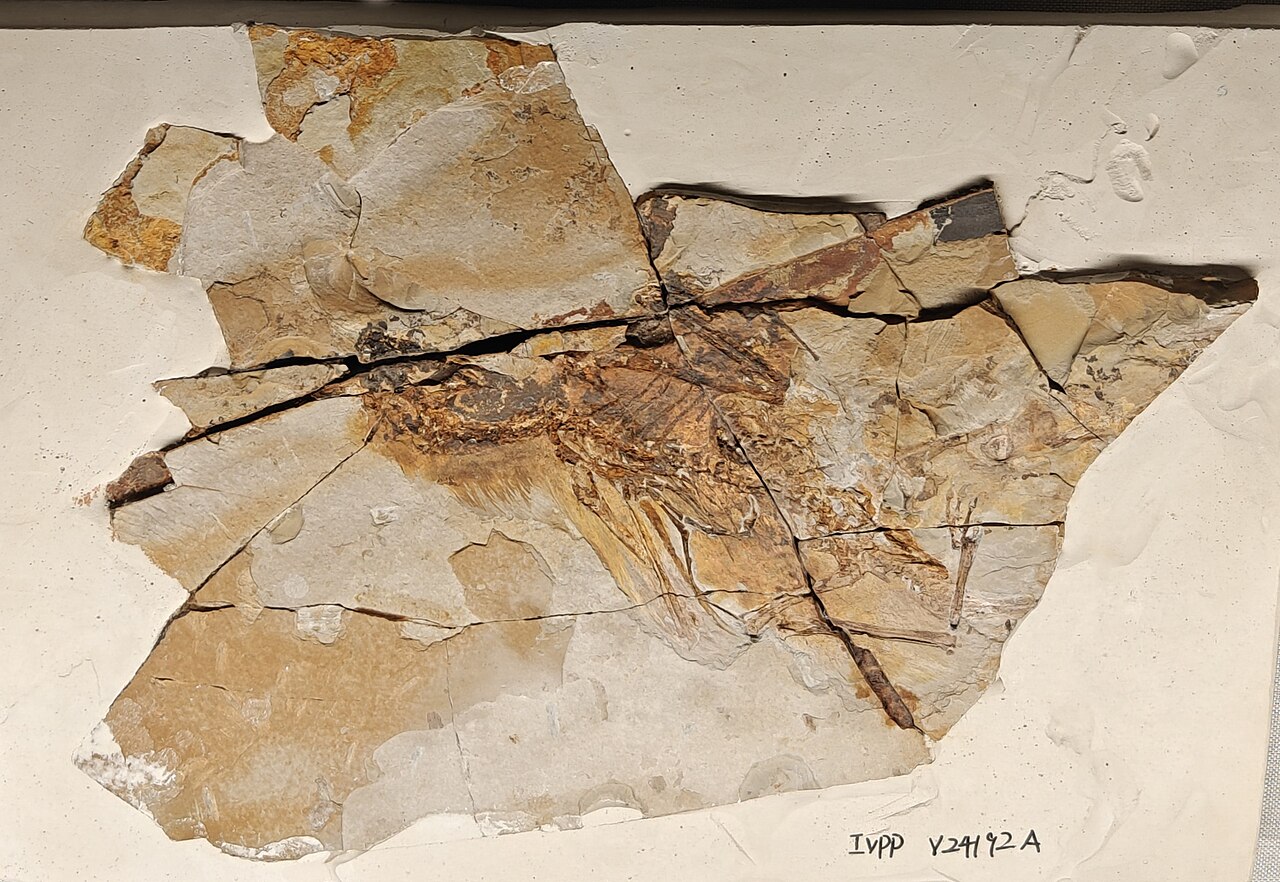
The holotype specimen, cataloged as IVPP V24192, consists of an articulated and nearly complete skeleton preserved on a slab and counter slab, along with associated soft tissue. It was unearthed in 2017 from a layer equivalent to the Haifanggou Formation near Wubaiding Village in Liaoning Province, part of the Yanliao Biota.
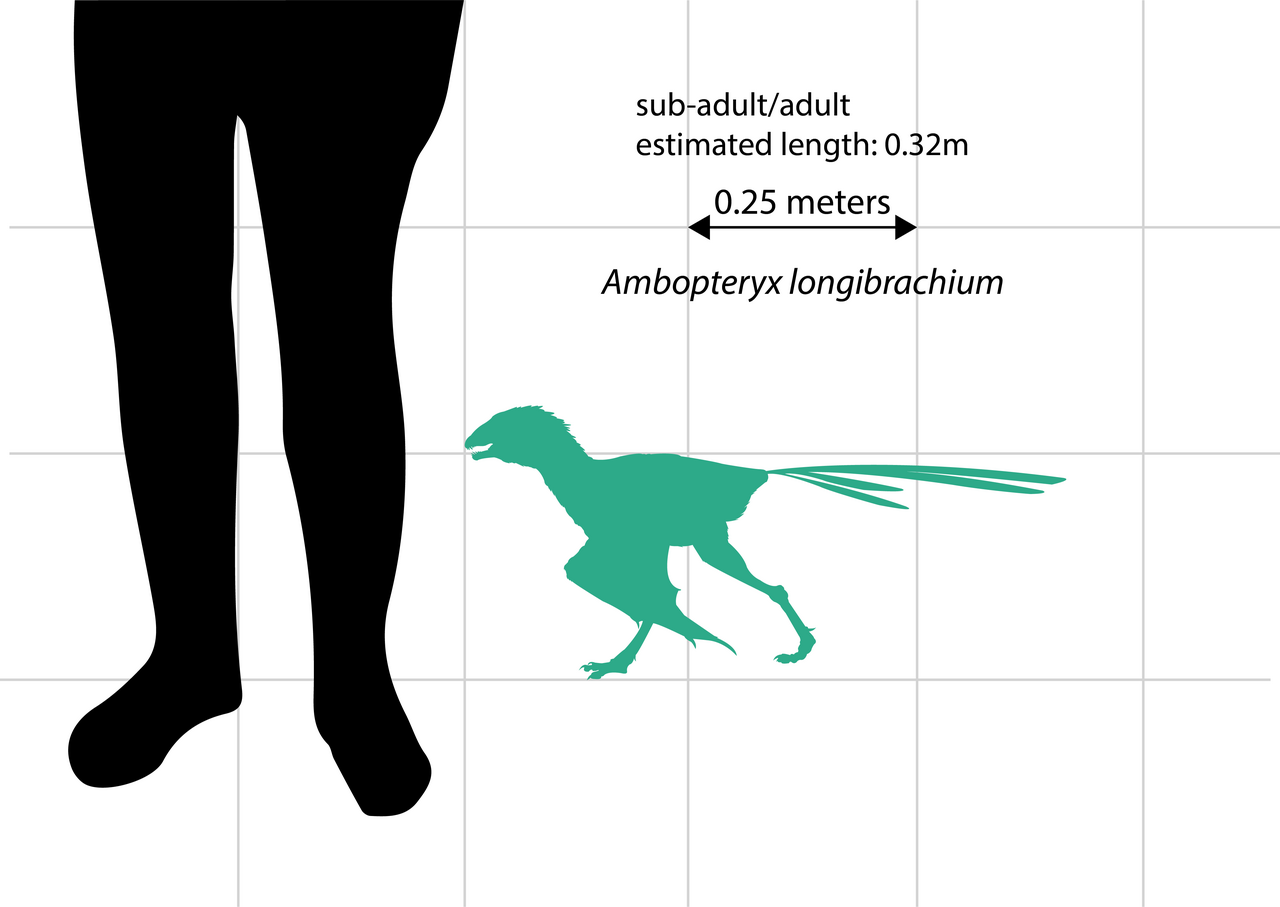
Based on the fusion of its pygostyle, the specimen is thought to be either a sub-adult or adult. Its body length is estimated at 32 centimeters (13 inches), with a weight of about 306 grams (10.8 ounces). A continuous brownish layer on the matrix around the left hand, right forelimb, and abdomen preserves the wing membrane, while dense feathers cover the head, neck, and shoulders.
The generic name combines the Latin "ambo" (both) and the Ancient Greek "pteryx" (wing), referencing the animal’s membranous wings and bird-like body. The specific name "longibrachium" comes from the Latin "longus" (long) and "brachium" (upper arm). Like other scansoriopterygids, Ambopteryx had a short, blunt head and an unusually elongated third finger. Earlier ideas that this finger helped extract grubs from wood, similar to the aye-aye, have been challenged; Wang and colleagues instead argue its main role was supporting the wing membrane, or patagium, since the finger was likely encased in membranous tissue with limited movement.
Description
Among scansoriopterygids, Ambopteryx is most closely related to Yi, sharing a "styliform element"—an elongate, slightly curved bone tapering toward the tip that extended from the far end of the ulna. This bone helped support the wing membrane, which stretched from the third finger down to the abdomen. The forelimbs were about 1.3 times longer than the hindlimbs, with the ulna shorter than the humerus and nearly twice as wide as the radius. Unlike most non-avian theropods, Ambopteryx had a short tail lacking a transitional point and ending in a pygostyle—a fused set of tail vertebrae.
Scientific classification
- KingdomAnimalia
- PhylumChordata
- ClassReptilia
- CladeDinosauria
- CladeSaurischia
- CladeTheropoda
- Family†Scansoriopterygidae
- Genus†Ambopteryx
- SpeciesAmbopteryx longibrachium
Named by Wang et al., 2019
Sources: Wikipedia taxobox: Ambopteryx (CC BY-SA 4.0)
Quick Facts
- Species
- longibrachium
Facts from the source article.
The Holotype and Its Recovery
In 2017, paleontologists uncovered a remarkable articulated skeleton near Wubaiding Village in China's Liaoning Province, embedded in rock from the stratigraphic equivalent of the Haifanggou Formation. Catalogued as IVPP V24192 and assigned to the Yanliao Biota of the Oxfordian stage of the Late Jurassic, this nearly complete specimen represents the sole known member of the genus Ambopteryx and its single species, A. longibrachium. What makes the find extraordinary is the preservation of soft tissue on both the slab and its counter slab, offering a rare window into the animal's integument.
Researchers interpret the holotype as either a subadult or an adult, a judgment based on the degree of fusion in the pygostyle. The creature was small by dinosaur standards, with an estimated body length of roughly thirty-two centimetres and a mass of about three hundred and six grams. Its compact size and the quality of preservation together make this specimen a cornerstone for understanding scansoriopterygid anatomy.
Feathers and Membrane: A Dual Integument
Ambopteryx earned its name from the Latin ambo, meaning both, paired with the Greek pteryx for wing, a direct nod to the fact that this small theropod carried two fundamentally different kinds of flight surface on its body. The holotype slab reveals a continuous brownish layer of membrane preserved around the left hand, the right forelimb, and the abdominal region, while the head, neck, and shoulders are draped in dense layers of true feather. This combination of avian-style plumage alongside a bat-like patagium makes Ambopteryx only the second dinosaur ever documented with both structures; the first, Yi, was described in 2015 and occupies the sister-taxon position to Ambopteryx within the scansoriopterygid clade.
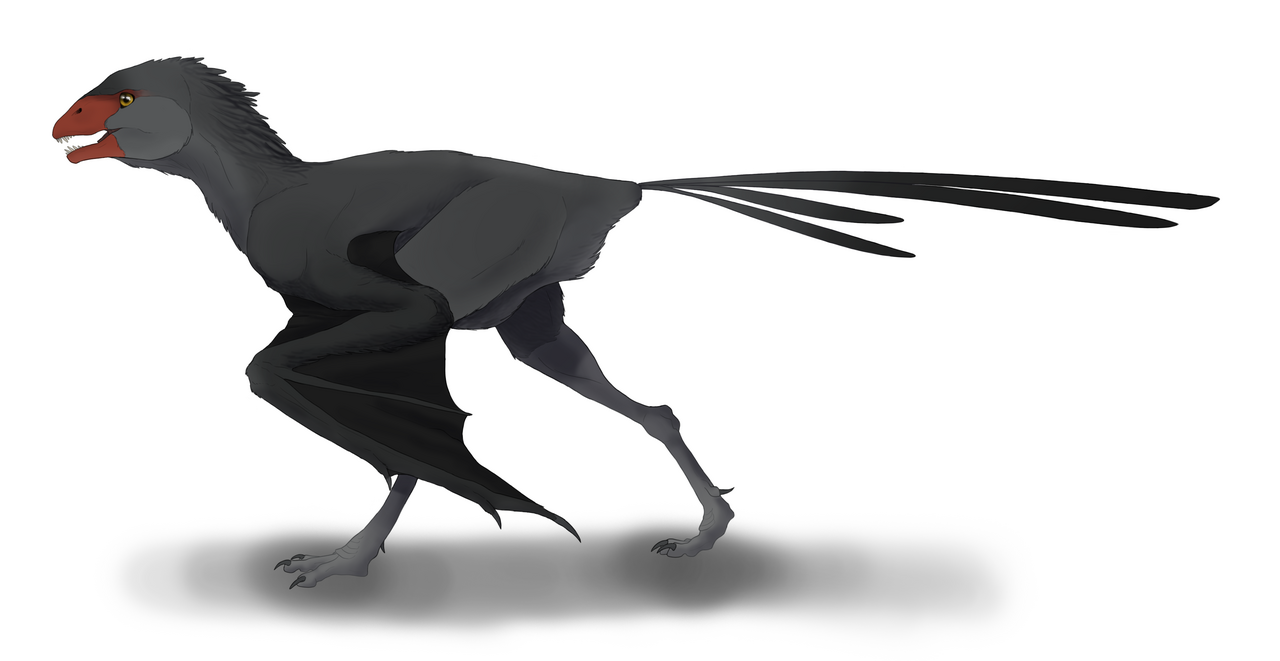
The specific epithet longibrachium, drawn from Latin longus and brachium, highlights the notably elongated upper arm that helped anchor the membranous wing. Together, these two integumentary systems paint a picture of a creature whose locomotor strategy was far more complex than a simple feathered runner.
Skeletal Innovations and the Styliform Element
The skeleton of Ambopteryx reveals several anatomical departures from typical non-avian theropods. Its forelimbs measured roughly one and a third times the length of the hindlimbs, with the ulna shorter than the humerus yet nearly twice as wide as the radius. Perhaps most striking is the short tail, which terminates in a pygostyle, a cluster of fused caudal vertebrae previously known in non-avian theropods only among certain oviraptorosaurs and therizinosaurs.
The hyper-elongate third finger, long interpreted as a grub-extraction tool analogous to the aye-aye's middle digit, is now thought by Wang and colleagues to have served primarily as an anchor for the wing membrane, given that the fingers were likely encased in membranous tissue with limited independent mobility. A key shared feature with its close relative Yi is the styliform element, a slightly curved, distally tapered bone projecting from the far end of the ulna.
This structure provided the posterior support for the patagium, which stretched from the third finger down to the belly, completing the aerodynamic frame.
Clues to a Mixed Diet
For a long time, the feeding ecology of scansoriopterygids remained an open question, with no direct evidence of what these small, oddly built theropods actually consumed. The Ambopteryx holotype changed that picture. Within the abdominal region of the specimen, researchers identified a small collection of gastroliths, smooth stones swallowed to aid digestion, alongside large fragments of what appears to be bone, almost certainly representing the contents of the stomach at the time of death.
When these findings are combined with the group's unusual dental morphology, the evidence points toward an omnivorous lifestyle rather than a strictly carnivorous or herbivorous one. The presence of bone fragments suggests Ambopteryx was capable of processing animal material, while the gastroliths hint at a digestive strategy more commonly associated with animals that also processed plant matter or hard-shelled invertebrates. This mixed dietary signal, preserved in a single small specimen from the Late Jurassic of Liaoning, offers the most concrete window yet into the foraging habits of scansoriopterygids.
More in Feathered dinosaurs
Sources
Compiled from Wikipedia and the sources listed below. Text from Wikipedia is available under CC BY-SA 4.0; this entry is adapted from it.
- Wikipedia: Ambopteryx (CC BY-SA 4.0).
- Word definitions: the Codexery glossary, each quoted from its Wikipedia article.
Spotted an error? Know more?
Reader corrections go straight into our review queue. Suggest an edit · How this site is sourced