Hugag
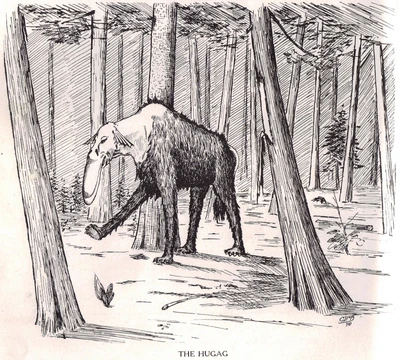
A moose-like critter that cannot lie down or graze.
Last updated
The hugag is a fearsome critter from American folklore, resembling a moose with an extensive upper lip and jointless legs.[1] Its jointless legs prevent it from lying down, so it rests by bracing itself against a tree.[1][2]
Quick Facts
- Field
- Folklore
- Nationality
- American
- Primary source
- William T. Cox's Fearsome Creatures of the Lumberwoods (1910)
Facts from the source article.
Key facts and history
The first mention of the hugag as an imaginary animal, established as a logger myth, is in S.W. Brown's 1900 book In the Limestone Valley.[3] The only way to capture a hugag is to notch the tree it leans against for rest.[2] Before it was used for a mythical beast, "hugag" was an alternate spelling of "hewgag," a kazoo-like woodwind instrument.[4] In the June 20, 1846 edition of the American Republican and Baltimore Daily Clipper, the phrase "blow the hugag" appears.[4]
Brown's account, which spells the creature "hew-gag," describes its round feet as having claws on all sides to hide which way it is traveling.[5] Brown provides scant additional information, only noting that the "hew-gag" is less ferocious than other forest beasts.[5]
What the cited sources add
Tryon also describes the hugag as having pine needles instead of hair and subsisting on pine knots that make pitch ooze from its pores.[6] Folklorist Richard Dorson and author Daniel Cohen note the hugag's inability to lie down mirrors legendary creatures from classical antiquity.[7] Dorson cites Horace Beck's article "The Animal that Cannot Lie Down," noting Aristotle opposed the idea that an elephant cannot sit.[7] Daniel Cohen's 1975 book references Pliny the Elder's account of a creature called the Achlis with equivalent attributes.[7]
References
- Wikipedia, "Hugag" (CC BY-SA 4.0), which cites: Cox, "Fearsome Creatures of the Lumberwoods", Judd & Detweiler Inc., 1910, p. 9; Tryon, "Fearsome Critters", Idlewild Press, 1939, p. 9; Dorson, "Man and Beast in American Comic Legend", Indiana Univ. Press, 1982, p. 36–37; Wyman, "Mythical Creatures of the USA and Canada", Univ. of Wisconsin Riverfalls Press, 1978, p. 69–70 (original not read by us) en.wikipedia.org
- Wikipedia, "Hugag" (CC BY-SA 4.0), which cites: Tryon, "Fearsome Critters", Idlewild Press, 1939, p. 9; Dorson, "Man and Beast in American Comic Legend", Indiana Univ. Press, 1982, p. 36–37 (original not read by us) en.wikipedia.org
- Wikipedia, "Hugag" (CC BY-SA 4.0), which cites: S.Hirzel Verlag, "Abhandlungen der philologisch-historischen Classe der Königlich-sächsischen Gesellschaft der Wissenschaften", Breitkopf & Härtel, 1861, p. 288; "The Rocky Mountain Directory and Colorado Gazetteer for 1871", S. S. Wallihan & Company, 1871, p. 192 & 194 (original not read by us) en.wikipedia.org
- Wikipedia, "Hugag" (CC BY-SA 4.0), which cites: "Dow, Jr. on the Mexican War", American Republican and Baltimore Daily Clipper, 1846-06-20 (original not read by us) en.wikipedia.org
- Wikipedia, "Hugag" (CC BY-SA 4.0), which cites: Brown, "In the Limestone Valley: Pen Pictures of Early Days in Western Wisconsin", 1900, p. 179–180 (original not read by us) en.wikipedia.org
- Wikipedia, "Hugag" (CC BY-SA 4.0), which cites: Tryon, "Fearsome Critters", Idlewild Press, 1939, p. 9; Cox, "Fearsome Creatures of the Lumberwoods", Judd & Detweiler Inc., 1910, p. 9; Tryon, "Fearsome Critters", Idlewild Press, 1939, p. 9 (original not read by us) en.wikipedia.org
- Wikipedia, "Hugag" (CC BY-SA 4.0), which cites: Dorson, "Man and Beast in American Comic Legend", Indiana Univ. Press, 1982, p. 36–37; Cohen, "Monsters, Giants, and Little Men from Mars", Doubleday, 1975, p. 14–15 (original not read by us) en.wikipedia.org
Each numbered sentence above was checked against the source it cites before publication. Sentences citing Wikipedia adapt text from the English Wikipedia article Hugag (contributors), used under CC BY-SA 4.0; this entry is available under the same licence. Other sources were used for facts only; no text or images are copied from them.
More in Fearsome critters
Sources
Compiled from Wikipedia and the sources listed below. Text from Wikipedia is available under CC BY-SA 4.0; this entry is adapted from it.
- Wikipedia: Hugag (CC BY-SA 4.0).
Spotted an error? Know more?
Reader corrections go straight into our review queue. Suggest an edit · How this site is sourced