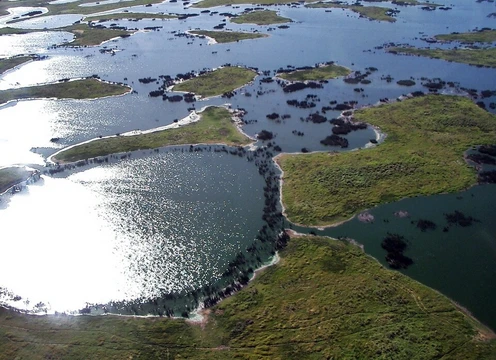
Broad-snouted caiman
Last updated
The broad-snouted caiman, known scientifically as Caiman latirostris, is a member of the alligator family. It lives in freshwater wetlands across eastern and central South America, from the Pantanal in Bolivia, Brazil, and Paraguay down to northern Argentina and Uruguay.
This reptile is the second-largest caiman species, smaller only than the black caiman, and ranks as the third-largest alligatorid overall, behind the American alligator and the black caiman. It favors still or slow-moving water in floodplains, marshes, swamps, mangroves, streams, rivers, lakes, and ponds. It also adapts to man-made environments like cow ponds, stock tanks, canals, and ditches.
Scientific classification
- KingdomAnimalia
- PhylumChordata
- ClassReptilia
- FamilyAlligatoridae
- GenusCaiman
- SpeciesCaiman latirostris
Named by Daudin, 1801
Close relatives
Other species of Caiman with a Codexery entry.
- Yacare caiman Caiman yacare
- Caiman venezuelensis Caiman venezuelensis
- Caiman wannlangstoni Caiman wannlangstoni
Sources: Wikipedia taxobox: Broad-snouted caiman (CC BY-SA 4.0) · order, family and genus agree with WoRMS AphiaID 1478602 (CC BY 4.0)
Conservation status
Least Concern (LC)
- LC▲ this species
- NT
- VU
- EN
- CR
- EW
- EX
Source: IUCN Red List assessment · GBIF copy of the Red List category
How big is it?
Largest length in the source, 2.5 m, next to a 1.8 m person.
Diagram: drawn by Codexery, schematic shapes to scale (not a likeness). Length: Wikipedia: Broad-snouted caiman
Where the broad-snouted caiman has been recorded
Each dot is a place where the species has been observed and reported (4,882 records, half-degree grid) — not a modelled range. 176 inland records left out (institution coordinates).
Map: drawn by Codexery. Data: GBIF occurrence search (records CC0 / CC BY) · Natural Earth basemap (public domain)
Characteristics
Adults in the wild normally grow to 2 to 2.5 m in length, though a few old males have reached up to 3.5 m. Captive adults have weighed 23 to 65 kg, and a large adult male of 2.6 m would weigh around 80 kg. Most individuals are light olive-green, with some having spots on their faces. The broad snout, which gives the species its name, is adapted to rip through dense marsh vegetation, and the caiman swallows some of this vegetation while foraging.
Biology and behavior
The broad-snouted caiman is ectothermic, relying on its external environment to regulate body temperature. Its heart rate rises with increasing temperature and falls when temperature drops. Heat from the sun is absorbed through the skin into the blood, maintaining body temperature, and an elevated heart rate helps transfer this heat throughout the body more quickly; when the air cools, the need for a high heart rate diminishes. Young caimans depend heavily on finding shelter to avoid predation, a behavior that decreases as they age.
Hunting and diet
Upon hatching, their diet consists mainly of small invertebrates such as beetles or arachnids. As they reach adolescence, they learn to crush shells with their jaws, enabling them to feed on turtles and snails, including ampullarid snails. As C. latirostris matures, prey size tends to increase; young adults still eat mostly invertebrates, but older animals greatly vary their diet, increasing intake of small mammals, birds, larger fish, amphibians, and reptiles.
Captive specimens have been documented devouring the mildly sweet fruits of split-leaf philodendron (Philodendron bipinnatifidum) without external stimulation, though it is unclear whether this is due to being housed with omnivorous reptiles such as tegu or a genuinely natural behavior. A later study concluded that C. latirostris and its relatives are obligate omnivores and play an important role in seed dispersal in their habitats. Females lay 18 to 50 eggs at a time, though up to 129 eggs have been found in a single nest, presumably from several layings.
Reproduction
Eggs are laid in two layers with a slight temperature difference, resulting in a more even ratio of males and females. The caiman lacks sex chromosomes and depends on temperature to determine offspring sex: eggs at 32°C or higher develop into males, and those at 31°C or lower develop into females. Estrogen and stress levels of the mother can also affect sex ratio, and nests reared at the same temperature can differ in sex ratio, indicating other contributing factors.
Did You Know?
- Larger-scale hunting of C. latirostris began in the 1940s because its skin was valued for leather production due to its smoother texture compared to other crocodilians.
- An eventual ban on hunting helped the species regain its population; the newest threat is habitat destruction from deforestation and pollution run-off.
More in Fauna of the Pantanal
Sources
Compiled from Wikipedia and the sources listed below. Text from Wikipedia is available under CC BY-SA 4.0; this entry is adapted from it.
- Wikipedia: Broad-snouted caiman (CC BY-SA 4.0).
- Classification: the source article's taxobox; order, family and genus checked against WoRMS, the World Register of Marine Species (CC BY 4.0).
- Conservation status: IUCN Red List assessment.
- Occurrence records: GBIF (CC0 / CC BY). Basemap: Natural Earth (public domain).
- Word definitions: the Codexery glossary, each quoted from its Wikipedia article.
Spotted an error? Know more?
Reader corrections go straight into our review queue. Suggest an edit · How this site is sourced