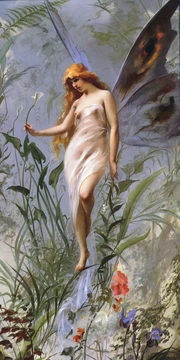
Fairy-lock
A tangled knot blamed on fairies.
A fairy-lock is a tangled knot in hair or a horse's mane, often attributed to the work of fairies or similar beings. The term is notable for its long history in English literature, appearing in works by Shakespeare and later authors.
English tradition
The concept first appears in English in Shakespeare's Romeo and Juliet, where Mercutio's speech about Queen Mab describes her plaiting horses' manes at night and baking elflocks in foul sluttish hairs, implying that combing them out brings misfortune. In King Lear, Edgar impersonates a madman by tangling his hair into knots. Jane Eyre also references elf-locks in a description of Rochester disguised as a gypsy, with bristled hair beneath a band.
German tradition
German counterparts include Alpzopf, Drutenzopf, Wichtelzopf, Weichelzopf, Mahrenlocke, and Elfklatte, named after beings such as the alp, drude, mare, and wight. Grimm noted a similarity to Frau Holle, who entangled hair and had matted hair herself.
More in Fairies
Spotted an error? Know more?
Reader corrections go straight into our review queue. Suggest an edit · How this site is sourced