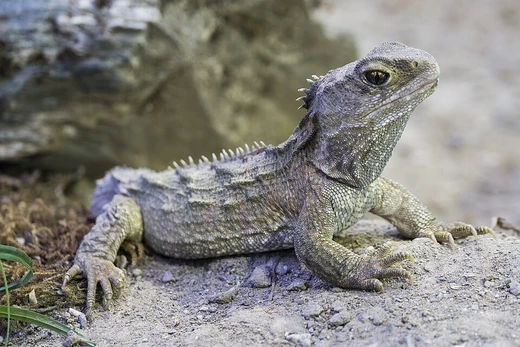
Iguana
A genus of herbivorous lizards native to tropical areas of Mexico, Central America, South America, and the Caribbean.

Wikipedia / Wikimedia Commons
Iguana is a genus of herbivorous lizards native to tropical areas of Mexico, Central America, South America, and the Caribbean. The genus was first described by Austrian naturalist J.N. Laurenti in 1768. Two species are placed in the genus: the green iguana and the Lesser Antillean iguana. The word "iguana" is derived from the original Taino name for the species, iwana.
- First described
- 1768
- Described by
- Josephus Nicolaus Laurenti
- Number of species
- 2 (Iguana iguana, Iguana delicatissima)
Quick Facts
- Taxon
- Iguana
- Type Species
- Lacerta iguana
- Type Species Authority
- Linnaeus, 1758
- Subdivision
- Lesser Antillean iguana, I. delicatissima / Green iguana, I. iguana
Facts from the source article.
Lore & Background
The genus Iguana was first described by Austrian naturalist J.N. Laurenti in 1768. Genetic analysis indicates that the green iguana may comprise a complex of multiple species, some of which have been recently described, but the Reptile Database considers all of these as subspecies of the green iguana. The Reptile Database synonymizes I. rhinolopha with I. iguana, only considering it a distinctive population, and recognizes I. insularis and I. melanoderma as subspecies of I. iguana.
Reader's Guide
Iguanas are large lizards that can range from 4 to 6.5 ft in length, including their tails. They possess a dewlap and a row of elongated scales running from the midline of their necks down to their tails. They have a large, round scale on their cheeks known as a subtympanic shield. Iguanas have keen vision and can see shapes, shadows, colors, and movement at long distances. The tympanum is located above the subtympanic shield behind each eye (though the Lesser Antillean iguana lacks this shield). Like most reptiles, an iguana has a three-chambered heart. The muscles of an iguana are very light in color due to the high proportion of fast-twitch, glycolytic muscle fibers. Several species of lizards, including iguanas, have a pale scale towards the back of their heads marking the parietal eye. Iguanas have developed an herbivorous lifestyle, foraging exclusively on vegetation and foliage. Their teeth are acrodontal, small, and serrated. Male iguanas have two hemipenes. A female can store sperm from previous mates for several years. Clutch size within Iguana iguana has been recorded up to 71 eggs, whilst maximum clutch size for Iguana delicatissima is 30. Iguanas tend to follow a promiscuous or polygynandrous mating style during the dry season. After copulation, eggs are laid within a nest underground from which the hatchlings emerge after >85 days of incubation.
Did You Know?
- The word "iguana" is derived from the original Taino name for the species, iwana.
- The green iguana is widespread throughout its range and a popular pet.
- The Lesser Antillean iguana is native to the Lesser Antilles.
- Non-native iguanas have been introduced into Ishigaki Island, the Florida Peninsula, Hawaii, Singapore, Thailand, Taiwan, and numerous islands in the Lesser Antilles.
Frequently Asked Questions
What is Iguana?
Iguana is a genus of large, herbivorous lizards belonging to the family Iguanidae. It was first formally described in 1768 by the Austrian naturalist J.N. Laurenti.
Where do Iguanas live in the wild?
These lizards are native to tropical regions spanning Mexico, Central America, South America, and the Caribbean. They are not found outside the Americas in their natural range.
What do Iguanas eat?
Iguanas are strictly herbivorous, feeding on leaves, flowers, and fruit. They do not consume meat as part of their natural diet.
How big can Iguanas grow?
Adults in the genus typically reach lengths between 1.2 and 2.0 meters (roughly 4 to 6.5 feet), measured from snout to tail tip. This makes them among the largest lizards in the Western Hemisphere.
How many species are recognized in the genus Iguana?
The Reptile Database currently recognizes two main species: the green iguana and the Lesser Antillean iguana. However, genetic research suggests the green iguana may actually represent several distinct species that have only recently been split.
More in Extant Reptiles & Amphibians 1-22
Spotted an error? Know more?
This is a living reference — every entry is fact-audited, and reader corrections feed straight into our audit queue. Suggest an edit · See this site's audit record