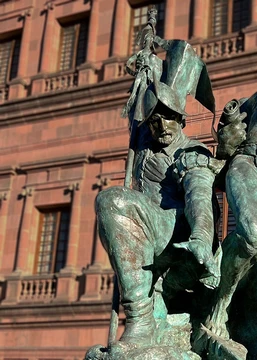
William Dampier
English explorer, pirate, and naturalist who bridged two eras of exploration.
Last updated
William Dampier (1651 – March 1715) was an English explorer, pirate, privateer and naturalist. He became the first Englishman to explore parts of what is today Australia, and the first person to circumnavigate the world three times. He has been described as Australia's first natural historian and one of the most important British explorers of the period between Sir Francis Drake and James Cook, bridging those two eras with a mix of piratical derring-do and scientific inquiry.
Background
William Dampier was born at Hymerford House in East Coker, Somerset, in 1651, and was baptised on 5 September, though his precise date of birth is not recorded. He was educated at King's School, Bruton, and sailed on two merchant voyages to Newfoundland and Java before joining the Royal Navy in 1673, taking part in the two Battles of Schooneveld. His service was cut short by a catastrophic illness, and after recuperation he tried plantation management in Jamaica and logging in Mexico before joining another sailing expedition. He married Judith around 1679, only to leave for the sea a few months later.
First circumnavigation
In 1679, Dampier joined the crew of buccaneer Captain Bartholomew Sharp on the Spanish Main, leading to his first circumnavigation. He accompanied a raid across the Isthmus of Darién in Panama and took part in capturing Spanish ships on the Pacific coast. After a failed raid on Arica, he left the group in April 1681 and re-crossed the Isthmus. He later engaged with privateer John Cooke, raiding Spanish possessions in Peru, the Galápagos Islands, and Mexico.
Dampier transferred to Charles Swan's ship Cygnet, and on 31 March 1686 they set out across the Pacific to raid the East Indies. On 5 January 1688, Cygnet anchored on the northwest coast of Australia near King Sound, where Dampier made notes on fauna, flora, and indigenous peoples, describing Aboriginal Australians as the 'miserablest' people he had ever seen. Later, he and two shipmates were marooned on the Nicobar Islands, eventually reaching Aceh in Sumatra. He returned to England in 1691 with only his journals and a tattooed slave named Jeoly, whom he later sold.
Roebuck expedition
After the publication of A New Voyage Round the World in 1697, Dampier was given command of HMS Roebuck in 1699 with a commission from King William III to explore the east coast of New Holland. The expedition set out on 14 January 1699, but due to the season, it went via the Cape of Good Hope instead of Cape Horn. Dampier landed at Shark Bay on 6 August 1699, producing the first known detailed record of Australian flora and fauna.
He followed the coast north-east, reaching the Dampier Archipelago and Lagrange Bay, then sailed to Timor and rounded New Guinea, charting the Dampier Strait. The Roebuck foundered at Ascension Island on 21 February 1701, and Dampier's crew was marooned for five weeks before being rescued. He saved some charts and specimens, many of which were later donated to the Fielding-Druce Herbarium.
More in Explorers & Conquistadors
Sources
Compiled from Wikipedia and the sources listed below. Text from Wikipedia is available under CC BY-SA 4.0; this entry is adapted from it.
- Wikipedia: William Dampier (CC BY-SA 4.0).
Spotted an error? Know more?
Reader corrections go straight into our review queue. Suggest an edit · How this site is sourced