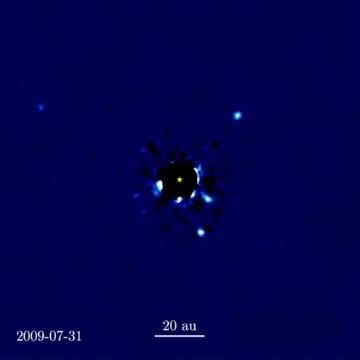
TRAPPIST-1 system
A rocky exoplanet in the habitable zone, considered one of the best candidates for an Earth-like ocean world.
Last updated
The system is named after the TRAPPIST telescope that discovered its first two planets.[1] In the constellation Aquarius, about five degrees south of the celestial equator, lies the star TRAPPIST-1, which is 40.66 light-years from Earth and has no companion stars.[2]
Key facts and history
Its planetary system was discovered in 2016 by a team led by Belgian astronomer Michaël Gillon using the TRAPPIST telescope at La Silla Observatory, Chile.[3] TRAPPIST-1 is a red dwarf of spectral class M8.0, with a radius 12% of the Sun's and a mass about 9% of the Sun's.[4] During a survey of nearby ultra-cool dwarf stars in June 1999, astronomer John Gizis and his colleagues discovered the star now known as TRAPPIST-1.[5] Anomalies in light curves measured by the TRAPPIST telescope in 2015 formed the basis of the discovery, which was first understood to indicate three planets.[6]
The Spitzer Space Telescope, along with ground-based facilities including TRAPPIST–South, TRAPPIST–North at Oukaïmeden Observatory in Morocco, the South African Astronomical Observatory, the Liverpool Telescopes, and the William Herschel Telescopes in Spain, were all involved in the observations.[6] By analyzing the star's composition and movement, scientists have estimated TRAPPIST-1's age at roughly 7.6 billion years, which is older than the 4.5-billion-year-old Solar System.[7]
What the research sources say
The discovery drew widespread attention in major world newspapers and led to the largest single-day web traffic to the NASA website.[8] The role of EU funding in the discovery has been cited as an example of the importance of EU projects.[9] The TRAPPIST-1 planets are seen as a model system for studying the habitability of M dwarf stars.[10] The team that originally discovered the system included members from universities in Africa, Europe, and North America.[11]
References
- Wikipedia, "TRAPPIST-1" (CC BY-SA 4.0), which cites: Gizis Monet Reid Kirkpatrick 2000, p. 1088; Turbet Bolmont Bourrier Demory 2020, p. 2; Goldsmith 2018, p. 118 (original not read by us) en.wikipedia.org
- Wikipedia, "TRAPPIST-1" (CC BY-SA 4.0), which cites: Angosto Zaragoza Melón 2017, p. 85; Gaia EDR3 2021; Barstow Irwin 2016, p. 95; Howell Everett Horch Winters 2016, p. 1; Gaia EDR3 2021; Howell Everett Horch Winters 2016, p. 1; Howell Everett Horch Winters 2016, p. 1 (original not read by us) en.wikipedia.org
- Wikipedia, "TRAPPIST-1" (CC BY-SA 4.0), which cites: Rinaldi Núñez Ferrer 2017, p. 1; Angosto Zaragoza Melón 2017, p. 85; Angosto Zaragoza Melón 2017, p. 85; Marov Shevchenko 2020, p. 865; Linsky 2019, p. 105 (original not read by us) en.wikipedia.org
- Wikipedia, "TRAPPIST-1" (CC BY-SA 4.0), which cites: Gillon Jehin Lederer Delrez 2016, p. 225; Cloutier Triaud 2016, p. 4019; Lienhard Queloz Gillon Burdanov 2020, p. 3790–3808; Gillon Jehin Lederer Delrez 2016, p. 225; Lienhard Queloz Gillon Burdanov 2020, p. 3790–3808; Goldsmith 2018, p. 118; Fischer Saur 2019, p. 2; Gillon Meadows Agol Burgasser 2020, p. 10; Delrez Murray Pozuelos Narita 2022, p. 2; Miles-Páez Zapatero Osorio Pallé Metchev 2019, p. 38; Davoudi Rackham Gillon Wit 2024, p. 12 (original not read by us) en.wikipedia.org
- Wikipedia, "TRAPPIST-1" (CC BY-SA 4.0), which cites: Gizis Monet Reid Kirkpatrick 2000, p. 1088; Gillon Jehin Lederer Delrez 2016, p. 225; Gizis Monet Reid Kirkpatrick 2000, p. 1088; Gizis Monet Reid Kirkpatrick 2000, p. 1088; Gillon Jehin Lederer Delrez 2016, p. 225 (original not read by us) en.wikipedia.org
- Wikipedia, "TRAPPIST-1" (CC BY-SA 4.0), which cites: Turbet Bolmont Bourrier Demory 2020, p. 2; Gillon Triaud Demory Jehin 2017, p. 461 (original not read by us) en.wikipedia.org
- Wikipedia, "TRAPPIST-1" (CC BY-SA 4.0), which cites: Burgasser Mamajek 2017, p. 7; Acton Slavney Arvidson Gaddis 2017, p. 32; Snellen 2017, p. 423; Acton Slavney Arvidson Gaddis 2017, p. 32; Snellen 2017, p. 423 (original not read by us) en.wikipedia.org
- Wikipedia, "TRAPPIST-1" (CC BY-SA 4.0), which cites: Short Stapelfeldt 2017, p. 1, 28; Díaz 2017, p. 185–186; Short Stapelfeldt 2017, p. 1, 28; Physics World 2017, p. 1; Riber 2018, p. 1; Howell 2020, p. p. 3–34; McKay 2021, p. 14; Janjic 2017, p. 61; Kanas 2019, p. 488; Gibb 2022, p. 2 (original not read by us) en.wikipedia.org
- Wikipedia, "TRAPPIST-1" (CC BY-SA 4.0), which cites: Rinaldi Núñez Ferrer 2017, p. 1 (original not read by us) en.wikipedia.org
- Wikipedia, "TRAPPIST-1" (CC BY-SA 4.0), which cites: Madhusudhan 2019, p. 652; Turbet Bolmont Bourrier Demory 2020, p. 2; Deming Knutson 2020, p. 459; Kral Wyatt Triaud Marino 2018, p. 2650; Ih Kempton Whittaker Lessard 2023, p. 1; Lingam Loeb 2018a, p. 122; Madhusudhan 2020, p. p. 6-5; Zúñiga-Fernández 2025; Linsky 2019, p. 105; Delrez Murray Pozuelos Narita 2022, p. 2; Kopparla Natraj Crisp Bott 2018, p. 1; Sleator Smith 2017, p. 1–2; Wang Lu Liu Chen 2025, p. 7; Wang 2022, p. 10; Lingam Loeb 2018c (original not read by us) en.wikipedia.org
- Wikipedia, "TRAPPIST-1" (CC BY-SA 4.0), which cites: Malik Determann 2024, p. 1; Determann 2019, p. 168–169; Gutiérrez Arnold Copley Copperwheat 2019, p. 41; Guridi Pertuze Pfotenhauer 2020, p. 5 (original not read by us) en.wikipedia.org
Each numbered sentence above was checked against the source it cites before publication. Sentences citing Wikipedia adapt text from the English Wikipedia article TRAPPIST-1 (contributors), used under CC BY-SA 4.0; this entry is available under the same licence. Other sources were used for facts only; no text or images are copied from them.
More in Exoplanets
Sources
Compiled from Wikipedia and the sources listed below. Text from Wikipedia is available under CC BY-SA 4.0; this entry is adapted from it.
- Wikipedia: TRAPPIST-1 (CC BY-SA 4.0).
- Word definitions: the , each quoted from its Wikipedia article.
Spotted an error? Know more?
Reader corrections go straight into our review queue. Suggest an edit · How this site is sourced