Ross 128 b
Nearby Earth-sized exoplanet orbiting a quiet red dwarf star.
Last updated

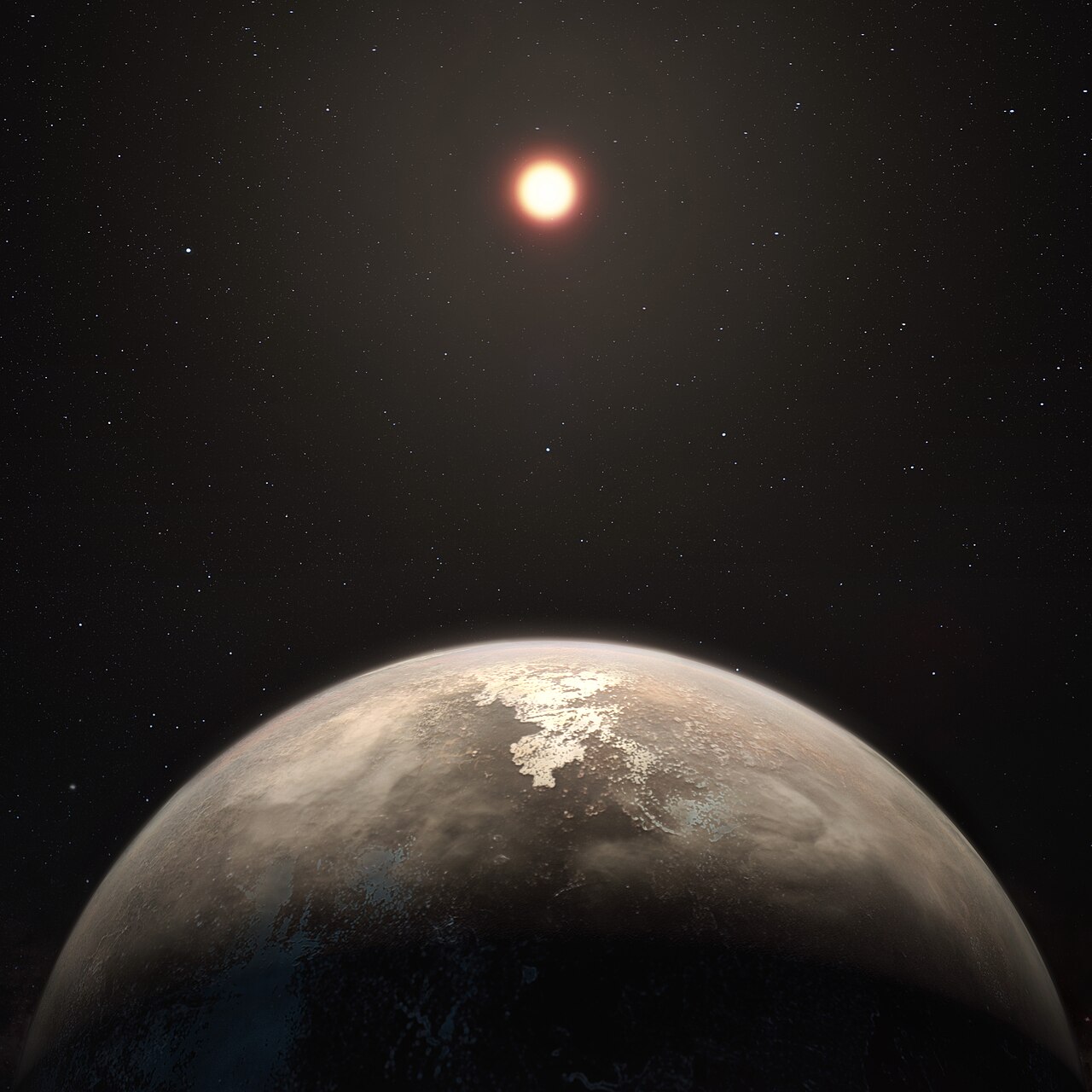
ESO/M. Kornmesser · CC BY 4.0
Ross 128 b is a confirmed Earth-sized exoplanet, likely rocky, orbiting near the inner edge of the habitable zone of the red dwarf star Ross 128. Located 11.007 light-years from Earth in the constellation Virgo, it is the nearest exoplanet around a quiet red dwarf and is considered one of the best candidates for habitability. The planet does not transit its host star, making atmospheric characterization very difficult.
Lore & Background
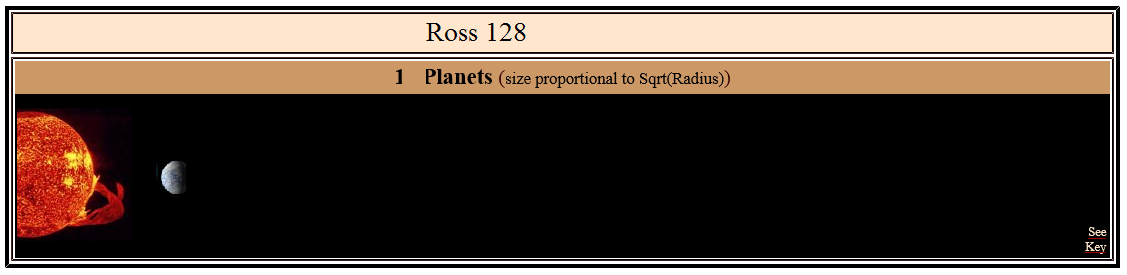
Ross 128 b was discovered using a decade's worth of radial velocity data from the European Southern Observatory's HARPS spectrograph at La Silla Observatory in Chile. The planet's only known physical parameter is its minimum possible mass of 1.35 Earth masses, implying a rocky composition. Its radius and density remain unknown due to the lack of transits; for an Earth-like composition the radius would be about 1.1 times Earth's, giving a surface gravity roughly 1.12 times that of Earth. A 2019 study predicted a true mass of about 1.8 Earth masses and a radius of about 1.6 Earth radii, with large margins of error.
The planet orbits its host star every 9.9 days at a distance of 0.0496 AU, about 20 times closer than Earth's orbit. Its orbit is likely circular with an eccentricity around 0.03, though some models suggest a higher eccentricity of about 0.116, both with large error ranges. A 2024 study found an eccentricity of about 0.21, similar to Mercury, which would significantly decrease its potential for habitability. At such close distance, the planet is most likely tidally locked, with one side in perpetual daylight and the other in darkness.

Ross 128 b receives 38% more starlight than Earth and has an equilibrium temperature of 280 K for an Earth-like albedo of 0.3, about 8 K cooler than Earth's average. Its actual temperature depends on unknown atmospheric parameters. The host star Ross 128 is an evolved, quiet red dwarf with near-solar metallicity, producing flares much less common and less powerful than those of Proxima Centauri or TRAPPIST-1.
Discovery Through Radial Velocity
Ross 128 b was identified through a decade of radial velocity measurements collected by the HARPS spectrograph at ESO's La Silla Observatory in Chile. Because the planet does not transit its host star, astronomers could not directly measure its radius or probe its atmosphere through transit spectroscopy, leaving atmospheric characterization extremely challenging. The discovery relied entirely on detecting the tiny gravitational tugs the planet exerts on Ross 128, revealing a minimum mass of 1.35 Earth masses.

This detection method means the true mass could be higher depending on the orbital inclination, and the planet's radius remains unknown. The team modeled equilibrium temperatures using three albedo values—0.100, 0.367, and 0.750—yielding temperatures ranging from 294 K down to 213 K. For an Earth-like albedo of 0.3, the equilibrium temperature settles at 280 K, roughly 8 kelvins cooler than Earth's mean. All of these figures carry the caveat that the planet's actual surface conditions depend on whether it retains an atmosphere at all, a question the non-transiting geometry makes nearly impossible to answer with current technology.
Physical Profile and Composition
The only directly measured property of Ross 128 b is its minimum mass of 1.35 Earth masses, approximately 8.06 × 10²⁴ kg, slightly exceeding the 1.27 Earth-mass minimum of Proxima Centauri b. Because no transits have been observed, the planet's radius and density remain unknown. Theoretical bounds are extreme: a pure-iron body would be just 0.5 Earth radii, while a pure hydrogen-helium sphere would balloon to 3.0 Earth radii—both physically implausible for a rocky world. A more realistic Earth-like composition places the radius near 1.10 Earth radii, roughly 7,008 km, making the planet slightly denser than Earth due to gravitational compression at higher mass.
Surface gravity would be about 10.945 m/s², roughly 12 percent stronger than Earth's. A 2019 study proposed a true mass around 1.8 Earth masses and a radius near 1.6 Earth radii, though with large error margins. The low mass strongly suggests a solid, rocky surface rather than a gaseous envelope, reinforcing its classification as a super-Earth candidate.

Orbital Dynamics and the Eccentricity Debate
Ross 128 b completes one orbit in approximately 9.9 days at a semi-major axis of 0.0496 AU, or about 7.42 million kilometers—roughly one-twentieth of Earth's mean distance from the Sun. At this proximity, the planet is almost certainly tidally locked, presenting one hemisphere in perpetual daylight and the other in permanent night. The orbital eccentricity has been a point of ongoing revision. Early models suggested a nearly circular orbit with eccentricity around 0.03, while combined analyses pushed the estimate to roughly 0.116, both with wide error bars.
A 2024 reanalysis of the radial velocity data yielded an eccentricity near 0.21, comparable to Mercury's orbit. This higher value is significant because, given the planet's position at the inner edge of the habitable zone, a more elongated orbit would subject it to greater temperature swings between periastron and apastron, substantially reducing its long-term habitability potential. The true eccentricity remains uncertain, but the 2024 finding has tempered earlier optimism about the planet's climatic stability.
A Quiet Star and the Habitability Question
Ross 128 b circles a red dwarf in the constellation Virgo, just 11 light-years from Earth, making it one of the 20 nearest stars known. The host is 17 percent the Sun's mass, 20 percent its radius, and a cool 3,192 K, with a luminosity of just 0.00362 solar luminosities. At 9.45 billion years old, the star is more than twice the Sun's age, and 2018 APOGEE spectroscopy confirmed near-solar metallicity across carbon, oxygen, magnesium, aluminum, potassium, calcium, titanium, and iron. Crucially, Ross 128 is classified as a quiet star with stable activity, unlike flare-prone red dwarfs such as Proxima Centauri or TRAPPIST-1, whose repeated stellar eruptions can strip planetary atmospheres over billions of years.
Ross 128 does produce flares, but they are currently less extreme, making this the nearest exoplanet around a quiet red dwarf. The planet receives about 38 percent more stellar flux than Earth, placing it at the inner edge of the habitable zone and raising concerns about water loss on the star-facing hemisphere. However, an Earth-like atmosphere could redistribute heat globally, and significant cloud cover on the dayside—suggested by study author Xavier Bonfils—could reflect enough incoming energy to moderate temperatures and preserve liquid water.
Reader's Guide
Ross 128 b is notable as the nearest exoplanet orbiting a quiet red dwarf, making it one of the best candidates for habitability among known exoplanets. Its Earth-like mass and size, combined with a relatively stable host star, position it as a prime target for future atmospheric studies. Although the planet does not transit, the James Webb Space Telescope and upcoming ground-based telescopes like the Thirty Meter Telescope and the Extremely Large Telescope could analyze its potential atmosphere without the need for transits, searching for biosignatures such as oxygen, ozone, and methane. The planet's location near the inner edge of the habitable zone means it is more prone to water loss, especially on the star-facing side, but an Earth-like atmosphere could distribute energy and allow liquid water.
Significant cloud cover on the star-facing side might also block incoming stellar energy and help keep the planet cool. The discovery team modeled equilibrium temperatures using albedos of 0.100, 0.367, and 0.750, yielding values of 294 K, 269 K, and 213 K respectively. The planet's legacy lies in its potential to inform the search for life beyond the Solar System, as it represents a nearby, accessible world around a calm red dwarf, contrasting with more active hosts like Proxima Centauri and TRAPPIST-1.
Frequently Asked Questions
Is Ross 128 b considered habitable?
The planet orbits near the inner edge of its star's habitable zone and receives about 38% more stellar flux than Earth, yielding an equilibrium temperature of roughly 280 K under an Earth-like albedo assumption. That places it among the strongest candidates for potentially sustaining liquid water, though a full atmospheric assessment is still beyond our reach.
How was Ross 128 b discovered if it never transits its star?
Astronomers confirmed the planet by measuring tiny periodic wobbles in Ross 128's radial velocity caused by the planet's gravitational tug. Because the planet's orbital plane never aligns to produce a transit from our vantage point, direct atmospheric spectroscopy remains extremely difficult.
More in Exoplanets Found by Radial Velocity
Sources
Compiled from Wikipedia and the sources listed below. Text from Wikipedia is available under CC BY-SA 4.0; this entry is adapted from it.
- Wikipedia: Ross 128 b (CC BY-SA 4.0).
- Word definitions: the Codexery glossary, each quoted from its Wikipedia article.
Spotted an error? Know more?
Reader corrections go straight into our review queue. Suggest an edit · How this site is sourced