BD+60 1417b
A directly imaged exoplanet discovered by a citizen scientist.
Last updated
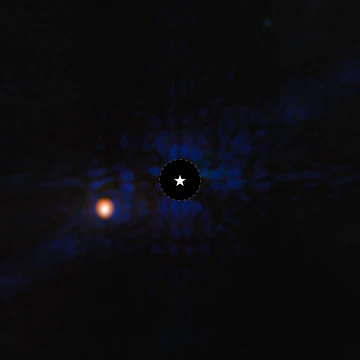
BD+60 1417b is a confirmed exoplanet discovered in 2021 via direct imaging, orbiting the young K0 star BD+60 1417 about 45 parsecs from Earth. It is the only known exoplanet in its system and may be the first directly imaged exoplanet found by a citizen scientist, a rare achievement as amateur discoveries typically involve transiting exoplanets.
Discovery
Previous direct imaging surveys with Gemini, Keck, and Palomar did not detect an exoplanet around BD+60 1417. The co-moving source was first spotted using the WiseView Tool by Backyard Worlds citizen scientist Jörg Schümann, which relies on data from the Wide-Field Infrared Survey Explorer (WISE). Optical spectroscopy at Lick Observatory and infrared spectroscopy at NASA IRTF confirmed a young star with a planetary-mass companion. BD+60 1417b is the second directly imaged exoplanet discovered by WISE, after COCONUTS-2b.
Host star
BD+60 1417 is a young K0 star, roughly the same mass as the Sun but with a radius of 0.797 ± 0.051 solar radii and a visual magnitude of 9.37. Its youth is evident from X-ray emissions detected by ROSAT and the presence of lithium absorption lines, placing its age between 50 and 150 million years.
The star spins once every 7.50 ± 0.86 days, a rotation rate tracked through evolving starspots in TESS light curves. In 2023, the Large Binocular Telescope’s PEPSI instrument measured its chemical makeup, finding an iron abundance of 0.27 ± 0.03 dex, a carbon-to-oxygen ratio of 0.23 ± 0.12, and a magnesium-to-silicon ratio of 1.41 ± 0.19. This star is unique: it is the only main-sequence star of about one solar mass with a planetary-mass companion orbiting at a distance greater than 1,000 astronomical units.
Physical properties
BD+60 1417b appears as a red L8γ-type object in infrared light, with an atmosphere containing water vapor, carbon monoxide, iron(I) hydride, and potassium iodide. It ranks among the reddest substellar objects ever found in the near-infrared. Its spectrum matches objects thought to have low surface gravity, which usually indicates youth, and also resembles the exoplanets 2M1207b and those in the HR 8799 system.
A 2024 analysis strongly favored a cloudy atmospheric model over a clear one. Forsterite and enstatite clouds are likely, but quartz clouds are not. The planet is considered a spectroscopic twin of WISEP J004701.06+680352.1.
Did You Know?
- The planet has an orbital period of about 95,000 years.
- If formed in its wide orbit, it likely formed similarly to isolated brown dwarfs; alternatively, it could have formed closer and been dynamically scattered.
- According to the NASA Exoplanet Archive, BD+60 1417b is an exoplanet, but it may exceed the IAU's 13-Jupiter-mass limit for exoplanets.
More in Exoplanets Detected by Direct Imaging
Sources
Compiled from Wikipedia and the sources listed below. Text from Wikipedia is available under CC BY-SA 4.0; this entry is adapted from it.
- Wikipedia: BD+60 1417b (CC BY-SA 4.0).
- Word definitions: the , each quoted from its Wikipedia article.
Spotted an error? Know more?
Reader corrections go straight into our review queue. Suggest an edit · How this site is sourced