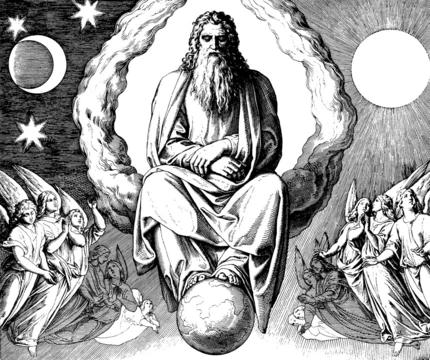
Musica universalis
The cosmic harmony of celestial proportions as music.
Musica universalis, also known as the music of the spheres or harmony of the spheres, is a philosophical concept that interprets the proportions in the movements of celestial bodies as a form of music. Originating in ancient Greece, it was a central tenet of Pythagoreanism and later developed by Johannes Kepler, who believed this harmony could be perceived by the soul rather than heard. The idea influenced scholarly thought through the end of the Renaissance, including humanism.
Quick Facts
- Origin
- Ancient Greece
- Key proponent
- Pythagoras
- Later developer
- Johannes Kepler
- Kepler's key work
- Harmonices Mundi (1619)
- Categories by boethius
- musica mundana
- musica humana
- musica quae in quibusdam constituta est instrumentis
- Modern reference
- Orbital resonance in celestial mechanics
Facts from the source article.
History
The concept holds that mathematical relationships express qualities or tones of energy that appear in numbers, visual angles, shapes, and sounds, all linked by proportion. Pythagoras first observed that a musical note's pitch is inversely proportional to the string length producing it, and that harmonious intervals correspond to simple numerical ratios. He proposed that the Sun, Moon, and planets each emit a unique hum based on their orbital revolution, and that earthly life reflects these celestial sounds, which are imperceptible to human ears.
Plato described astronomy and music as twinned studies of sensual recognition—astronomy for the eyes, music for the ears—both requiring knowledge of numerical proportions. Aristotle rejected the idea, arguing that excessive noises shatter solid bodies, so planetary sounds would exert tremendous physical force. Boethius, in De Musica, defined three categories: musica mundana (or musica universalis), musica humana (the internal music of the human body), and musica quae in quibusdam constituta est instrumentis (sounds from singers and instrumentalists).
He held that musica mundana could be discovered only through intellect, yet its order matched that of audible music, both reflecting divine beauty.
Harmonices Mundi
Musica universalis, a metaphysical concept since Greek times, was often taught in the quadrivium. Johannes Kepler, after publishing Mysterium Cosmographicum, spent much time examining tables to fit data to what he believed was the true cosmic nature related to musical sound. In 1619, he published Harmonices Mundi, expanding on earlier ideas and positing that musical intervals and harmonies describe the motions of the six known planets. He believed this harmony, though inaudible, could be heard by the soul and gave a feeling of bliss in imitation of God.
Kepler, disagreeing with Pythagorean observations, argued for a Christian-centric creator who connected geometry, astronomy, and music, with the planets intelligently arranged. The work has five books. The first two discuss regular polyhedra and their congruences, reiterating that the five regular solids define planetary orbits and distances from the sun. Book three defines musical harmonies, consonance, dissonance, intervals, just tuning, and their relation to string length as discovered by Pythagoras, along with what makes music pleasurable.
Book four presents a metaphysical basis, arguing why the harmony of the worlds appeals to the intellectual soul as music appeals to the human soul, and uses this harmony as an argument for heliocentrism. Book five details planetary orbital motion and its near-perfect match to musical harmonies, then after discussing astrology, describes Kepler's third law: for any planet, the cube of the semi-major axis of its elliptical orbit is proportional to the square of its orbital period.
Orbital resonance
In celestial mechanics, orbital resonance occurs when orbiting bodies exert regular, periodic gravitational influence on each other, typically because their orbital periods are related by a ratio of small integers. This phenomenon has been described as a modern take on the theory of musica universalis. An artist at the European Southern Observatory created a musical animation of the planetary system TOI-178, which has five planets locked in a chain of orbital resonances.
Cultural influence
William Shakespeare references the music of the spheres in The Merchant of Venice. In the 1910s, Danish composer Rued Langgaard composed a pioneering orchestral work titled Music of the Spheres. Paul Hindemith used the concept in his 1957 opera Die Harmonie der Welt, based on Johannes Kepler's life. Other modern compositions inspired by musica universalis include Harmony of the Spheres by Neil Ardley, La musique des sphères by Magma/VanderTop, Music of the Spheres by Mike Oldfield, The Earth Sings Mi Fa Mi by The Receiving End of Sirens, Music of the Spheres by Ian Brown, Cosmogony by Björk, and the Coldplay album Music of the Spheres.
Music of the Spheres was also the title of a companion piece to the video game Destiny, composed by Martin O'Donnell, Michael Salvatori, and Paul McCartney. A concert band arrangement by Philip Sparke uses the name Music of the Spheres and is often a set test piece, with a notable studio performance by the YBS Band under maestro Professor David King. H. P. Lovecraft's short story The Horror in the Museum references the music of the spheres. In the video game Overwatch, the character Sigma claims the universe is singing to him.
The MMORPG Final Fantasy XIV includes a sightseeing log and an area called Musica Universalis, described as the largest marketplace in the Crystarium. During the 2008 BBC Proms Doctor Who segment, a short interactive mini-episode titled Music of the Spheres featured David Tennant, with the Doctor composing Ode to the Universe based on the music of the spheres, arguing that the audience themselves are part of the composition.
More in Esoteric Cosmology
Spotted an error? Know more?
Reader corrections go straight into our review queue. Suggest an edit · How this site is sourced