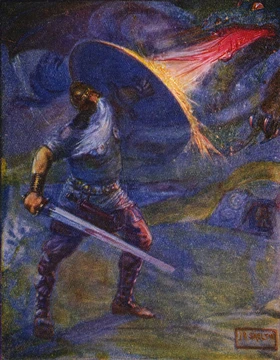
Blackbeard
English pirate known for his fearsome image and blockade of Charles Town.
Last updated
Edward Teach, also called Thatch and better known as Blackbeard, was an English pirate active near the West Indies and the eastern coast of Britain's North American colonies. He is one of history's most famous pirates. His nickname came from his thick black beard and frightening look, and he reportedly tied burning fuses under his hat to scare his enemies.
Early life
The pirate known as Blackbeard was likely born around 1680, as he was thought to be between 35 and 40 when he died. His real name remains uncertain. Records from the time call him Blackbeard, Edward Thatch, or Edward Teach, with the latter coming from the Boston News-Letter. However, people who actually met him wrote his name as Thatch or something similar.
Other spellings include Thach, Thache, Thack, Tack, Thatche, and Theach. One unsupported claim gives his surname as Drummond. Because pirates often used false names to protect their families, his birth name may never be known. He was almost certainly raised in Bristol, then England’s second-largest city, and could read and write.
He corresponded with merchants and, at his death, had a letter from Tobias Knight, a Carolina official. Author Robert Lee thought this suggested a respectable, wealthy background.
Blackbeard may have reached the Caribbean near the end of the 1600s on a merchant or slave ship. According to Charles Johnson, he once served as a privateer from Jamaica during the War of the Spanish Succession, noted for his boldness and courage. Exactly when he joined that war is unclear, like much of his life before piracy.
Life as a pirate
The West Indies, with its history of colonialism, trade, and piracy, was the setting for many maritime incidents. Early in the 18th century, privateer-turned-pirate Henry Jennings and his followers used the uninhabited island of New Providence as a base, as it was near the Florida Strait and its busy shipping lanes. New Providence's harbour could accommodate hundreds of ships but was too shallow for larger Royal Navy vessels. Teach moved there from Jamaica, probably shortly after the Treaty of Utrecht, and along with most former privateers became involved in piracy.
Around 1716 he joined the crew of Captain Benjamin Hornigold, a renowned pirate operating from New Providence. Hornigold placed Teach in charge of a captured sloop.
In early 1717, Hornigold and Teach set out for the mainland, capturing a boat with 120 barrels of flour from Havana, then 100 barrels of wine from a Bermuda sloop. Days later they stopped a vessel from Madeira to Charles Town. On 29 September near Cape Charles, they took only the Madeira cargo from the Betty of Virginia before scuttling her.
Legacy
After the battle, Maynard spent several days at Ocracoke fixing his ship and burying the dead. The goods taken from Teach—sugar, cocoa, indigo, and cotton—were auctioned off, along with more sugar and cotton found in Tobias Knight’s barn, bringing in £2,238. Governor Spotswood used some of that money to cover the operation’s costs. The reward for capturing Teach was supposed to be around £400, but it ended up divided between the crews of HMS Lyme and HMS Pearl.
Maynard felt cheated, since Brand’s troops hadn’t actually fought, but any sympathy he might have had vanished when it came out that he and his men had pocketed about £90 of Teach’s loot. The prize money didn’t reach the two crews for four more years, and Maynard never got a promotion. Brand later rounded up the rest of Teach’s crew and associates in Bath and shipped them to Williamsburg, Virginia, where they were jailed for piracy. Some of the prisoners were Black, leading Spotswood to ask his council whether they should be exempt from the same trial as the others.
They were tried anyway, alongside their comrades, on March 12, 1719. No record of the trial survives, but 14 of the 16 accused were convicted.
One man got off by showing he’d only been at a drinking party on Teach’s ship the night before, not a pirate. Israel Hands wasn’t at the fight either; he claimed Teach had shot him in the knee during a drinking session and that he was still protected by a royal pardon. The rest were hanged and left to rot in gibbets along Capitol Landing Road, later known as Gallows Road.
Modern view
Official views on pirates sometimes differed from those of contemporary authors, who often described them as despicable rogues. Privateers who became pirates were considered by the English government as reserve naval forces and sometimes given encouragement; Francis Drake was knighted by Queen Elizabeth in 1581 after returning with plunder worth an estimated £1,500,000. Royal pardons were regularly issued, often when England was near war, and public opinion of pirates was often favourable.
Economist Peter Leeson believes pirates were generally shrewd businessmen, far from the modern romanticised view. With no easy outlet to fence stolen goods, pirates were reduced to subsistence. Following almost a century of naval warfare, lone privateers were outnumbered by powerful British ships defending merchant fleets. The popularity of the slave trade helped end the frontier condition of the West Indies, and piracy could no longer flourish.
Also in the Codexery
More in English folklore
Sources
Compiled from Wikipedia and the sources listed below. Text from Wikipedia is available under CC BY-SA 4.0; this entry is adapted from it.
- Wikipedia: Blackbeard (CC BY-SA 4.0).
Spotted an error? Know more?
Reader corrections go straight into our review queue. Suggest an edit · How this site is sourced