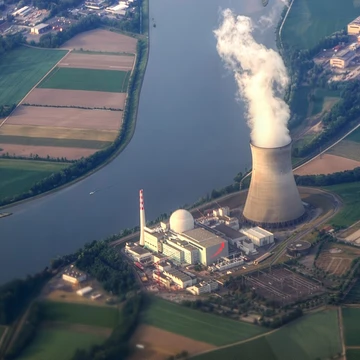
Desalination
Artificial conversion of salt water to fresh water.

Desalination is a human-made process that turns salty water—usually seawater—into fresh water. More broadly, it involves removing salts and minerals from a substance. The main driver behind desalination is finding a cost-effective way to supply fresh water for people. Alongside recycled wastewater, it stands out as one of the few water sources that does not depend on rainfall. As global pressure on freshwater supplies grows, desalination has become a central element in plans to secure water worldwide. The process generally costs more than getting fresh water from rivers, lakes, or underground sources, and it is also pricier than water recycling or conservation efforts. This is largely because it consumes a lot of energy. Still, those cheaper alternatives are not always an option, and depleting natural reserves is a serious issue globally. Desalination works through either thermal methods, like distillation, or membrane-based methods, such as reverse osmosis. Around 2019, a review in *Science of the Total Environment* noted that about 95 million cubic meters of desalinated water were produced each day worldwide, with demand expected to rise significantly to help bridge the global water supply gap. By 2020, the world’s desalination capacity had reached roughly 97 million cubic meters per day from over 16,800 active plants, and contracted projects pushed the potential total beyond 114 million cubic meters daily. In 2018, the energy needed to desalinate water averaged about 3 kilowatt-hours per cubic meter—a tenfold improvement from the 20–30 kilowatt-hours per cubic meter in 1970. Even so, desalination accounted for about 25% of the energy used by the water sector in 2016. Major companies in the field include Acciona, Dow, Evoqua Water Technologies, Siemens AG, DuPont, Doosan Enerbility, Toray Industries Inc., and Xylem. **History**
**Ancient times** Early ideas about desalination go back to Aristotle, who noted in *Meteorology* that seawater turns into sweet vapor when it evaporates, and that this vapor does not become salty again when it condenses. He also described how a wax vessel could keep water drinkable after being submerged in seawater, hinting at an early form of filtration. References to desalination also appear in ancient Chinese texts from the Warring States period and the Eastern Han dynasty, which mention bamboo mats used in rice steaming developing a thin outer layer thought to absorb salt. Throughout antiquity and the Middle Ages, experiments with desalination occurred but remained small in scale. Large-scale desalination only became possible in modern times. **Middle Ages and Renaissance (5th–17th century)** During the Middle Ages, desalination was limited and mostly relied on distillation—heating seawater to create vapor, then condensing it into fresh water. These methods were small-scale and used mainly at sea. In the Renaissance, Leonardo da Vinci suggested that distilled water could be made more efficiently by attaching a still to a cookstove. Distillation techniques also advanced in Central Europe during this time, though not always for desalination. Sixteenth-century accounts mention desalination devices used in emergencies. For example, in 1560, a Spanish garrison besieged on an island off Tunisia reportedly built a still to produce fresh water, though the details of the device are unknown. **Pre-industrial and early modern period (16th–18th century)** Before the Industrial Revolution, desalination was mostly used on oceangoing ships, where fresh water was critical for long voyages. Shipboard distillation helped supplement stored water when needed. Interest grew in the 17th century: Francis Bacon and Walter Raleigh discussed water purification methods, and Sir Richard Hawkins reported distilling seawater to supply his crew. This led to the first patents for desalination devices, granted in 1675 and 1683 to William Walcot and Robert Fitzgerald and others, but neither saw widespread use due to scaling difficulties. Progress remained slow, with no major improvements to basic distillation between the mid-17th and late 18th centuries. When the frigate *Protector* was sold to Denmark in the 1780s and renamed *Hussaren*, its distillation apparatus was studied and documented. In the United States, Thomas Jefferson later compiled earlier heat-based desalination methods and issued practical guidance for maritime use. **Industrial era (19th century)** Desalination changed significantly from the early 1800s, driven by the spread of the steam engine and advances in thermodynamics. The need for pure water in steam boilers, along with European colonial expansion into arid regions, spurred further development. More efficient thermal systems, such as multiple-effect evaporators, were introduced, allowing heat to be reused across several stages.
- global capacity (2020)
- 97 million m³/day
- energy intensity (2018)
- about 3 kWh/m³
- energy share of water sector (2016)
- about 0.5-1%
- dominant technology
- reverse osmosis
- earliest known reference
- Aristotle, Meteorology
Lore & Background
Early concepts related to desalination can be traced to Aristotle, who observed in Meteorology that when seawater evaporates, the resulting vapor condenses as fresh water rather than salt water. References also appeared in ancient China, where bamboo mats used in rice steaming were believed to have salt-absorbing properties. During the Middle Ages, desalination remained limited and primarily based on distillation, with a notable Renaissance contribution from Leonardo da Vinci, who proposed adapting a still to a cookstove. In the 16th century, a besieged Spanish garrison reportedly constructed a still to produce fresh water on an island off the coast of Tunisia. Before the Industrial Revolution, desalination was mainly used aboard oceangoing ships. Interest increased during the 17th century, with figures such as Francis Bacon and Walter Raleigh discussing water purification, and Sir Richard Hawkins reporting distilling seawater aboard ship. In the 19th century, the spread of the steam engine and advances in thermodynamics led to more efficient thermal systems, including multiple-effect evaporators. Desalination technology advanced significantly after World War II. One of the most important developments was reverse osmosis (RO), a membrane-based process. Research was carried out at universities in California and by companies including Dow Chemical Company and DuPont. In 1975, the first seawater reverse osmosis desalination plant came into operation. Since the early 21st century, desalination capacity has expanded rapidly, with reverse osmosis becoming the dominant technology.
Reader's Guide
Desalination is significant as a key technology for global water security, providing fresh water independent of rainfall. According to a 2019 review in Science of the Total Environment, around 95 million cubic meters per day of desalinated water is produced worldwide, and demand is expected to grow significantly to help close the global water supply gap. In 2018, the global energy intensity of desalination was about 3 kWh/m³, improved by a factor of 10 from 20–30 kWh/m³ in 1970. Nevertheless, desalination represented about 25% of the energy consumed by the water sector in 2016. Due to its energy consumption, desalinating sea water is generally more costly than fresh water from surface water or groundwater, water recycling and water conservation, but these alternatives are not always available and depletion of reserves is a critical problem worldwide. Research in the 21st century has focused on efficiency and sustainability, including integration of renewable energy sources and development of advanced membranes.
Did You Know?
- Aristotle observed in Meteorology that when seawater evaporates, the resulting vapor condenses as fresh water rather than salt water.
- The global energy intensity of desalination improved by a factor of 6–10 from about 10–20 kWh/m³ in 1970 (for reverse osmosis) to about 3 kWh/m³ in 2018.
Ancient Curiosity and Maritime Necessity
The story of desalination stretches back further than most modern technologies. Aristotle, writing in his treatise Meteorology, noted through direct experimentation that seawater, once vaporized and then condensed, yields sweet water rather than salty. He also described a wax vessel that could hold drinkable water after being submerged in the sea, hinting at a rudimentary filtration concept. Centuries later, Chinese texts from the Warring States and Eastern Han periods recorded observations about bamboo mats used in rice steaming developing a thin outer coating that was thought to absorb salt. Through the Middle Ages, distillation remained the dominant approach, typically on a small scale aboard ships or in isolated settings. Leonardo da Vinci suggested adapting a still to a cookstove for more efficient production. Thomas Jefferson later compiled earlier heat-based methods and circulated practical guidance for maritime use.
The Industrial Transformation
The arrival of the steam engine and advances in thermodynamics at the start of the 19th century fundamentally reshaped desalination. Two converging forces drove this shift: the growing need for pure water to feed steam boilers, and the expansion of European colonialism into arid regions where freshwater was scarce. Engineers responded with more efficient thermal systems, notably multiple-effect evaporators that reused heat across several stages, dramatically reducing fuel requirements. By the 1860s, the U.S. Army had installed Normandy evaporators at Key West and Dry Tortugas, marking some of the earliest land-based desalination installations in the United States. In the 1880s, a similar plant was erected at Suakin to supply fresh water to British troops stationed in the region. These developments signaled a decisive break from the small-scale, shipboard distillation that had dominated for centuries. For the first time, desalination was being engineered as a fixed infrastructure solution, capable of serving entire garrisons and settlements rather than individual vessels at sea.
A Global Water Security Pillar
Today, desalination has evolved from a maritime survival tool into a cornerstone of global water security. Because it is independent of rainfall, it stands alongside recycled wastewater as one of the few freshwater sources not tied to weather patterns, making it indispensable as freshwater stress intensifies worldwide. A 2019 review published in Science of the Total Environment estimated that roughly 95 million cubic meters of desalinated water are produced daily across the globe, with demand projected to climb sharply to help close the widening gap between supply and need. The industry is supported by a constellation of major firms, including Acciona, Dow, Evoqua Water Technologies, Siemens AG, DuPont, Doosan Enerbility, Toray Industries, and Xylem. The process itself splits into two broad families: thermal methods such as distillation, and membrane-based techniques like reverse osmosis. In either case, the output is potable or irrigation water, while the by-product is concentrated brine, a challenge that continues to shape environmental policy around coastal installations.
The Energy Equation
The central economic and environmental tension in desalination is its energy appetite. Because the process demands substantial power, treating seawater is generally more expensive than drawing from surface water, groundwater, recycling, or conservation. Yet those alternatives are not universally available, and the depletion of freshwater reserves remains a critical problem in many parts of the world, which is why desalination continues to expand despite its cost premium. The good news is a dramatic efficiency trajectory. In 1970, the global energy intensity of desalination sat at roughly 20 to 30 kilowatt-hours per cubic meter. By 2018, that figure had fallen to about 3 kilowatt-hours per cubic meter, a tenfold improvement driven largely by advances in membrane technology and system design. Even so, the sector's footprint is significant. In 2016, desalination accounted for approximately 25 percent of all energy consumed by the water sector.
Frequently Asked Questions
What is Desalination?
Desalination is the engineered process of stripping dissolved salts and minerals out of saline water—most commonly seawater—to yield potable fresh water. The concept has been referenced as far back as Aristotle's Meteorology.
What technology drives most Desalination plants?
Reverse osmosis is the dominant method used in modern desalination facilities worldwide. It pushes seawater through semi-permeable membranes so that salt is rejected while clean water passes through.
How energy-intensive is Desalination?
A typical plant consumes roughly three kilowatt-hours per cubic metre of product water. Across the entire water sector, that accounts for only about half a percent to one percent of total energy demand.
Why does Desalination matter for global water security?
Because it is one of the very few freshwater sources that does not depend on local rainfall or river flow, it provides a critical buffer as climate change intensifies water stress. Paired with recycled wastewater, it anchors long-term strategies for supplying populations in arid regions.
More in Energy & Power 1-24
Spotted an error? Know more?
This is a living reference — every entry is fact-audited, and reader corrections feed straight into our audit queue. Suggest an edit · See this site's audit record