Frequently Asked Questions
The most-asked questions about elliptical and irregular galaxies.
What exactly are elliptical and irregular galaxies?
Elliptical galaxies are smooth, featureless spheroids of old stars with very little interstellar gas, while irregular galaxies lack any defined symmetry and are typically rich in young stars, gas, and dust. Together they represent two of the three major morphological classes (alongside spirals) in the Hubble tuning-fork scheme.
Who are the key figures in this story?
Edwin Hubble is the central figure who established the classification system in 1926, while the Large Magellanic Cloud and M87 serve as the iconic protagonists of the irregular and elliptical categories respectively. Modern teams at the Hubble and JWST space telescopes act as the ongoing narrators, revealing new structural details about these objects.
Where should a newcomer start?
Begin with any introductory astronomy chapter on galaxy morphology to grasp the Hubble sequence, then browse the Hubble Heritage image gallery to build visual intuition. From there, pick one famous example—M87 for ellipticals or the LMC for irregulars—and follow its discovery history.
What is the single most important fact about elliptical galaxies?
They are dominated by old, metal-rich population-II stars and contain very little interstellar gas, meaning they have essentially ceased forming new stars. Their smooth light profiles range from nearly spherical (type E0) to highly elongated (type E7) on Hubble's numerical scale.
What defines an irregular galaxy?
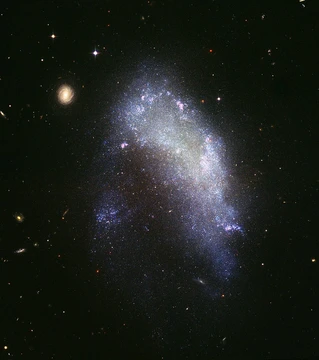
An irregular galaxy is any galaxy that fits neither the spiral nor elliptical categories, often showing chaotic star-forming regions, patchy dust lanes, and no central bulge or coherent disk. Many are the product of gravitational interactions or collisions that disrupted a once-ordered structure.
What are the most famous discovery moments?
Hubble's 1926 classification scheme is the foundational moment, while the detection of a supermassive black hole jet in M87 and the 2022 Event Horizon Telescope shadow image are modern highlights. For irregulars, the 1987 observation of Supernova 1987A in the Large Magellanic Cloud remains a landmark event.
How do ellipticals and irregulars differ from spiral galaxies?
Ellipticals lack the rotating disk and spiral arms that define spirals, appearing instead as smooth, three-dimensional blobs of light. Irregulars share some gas-rich star-forming regions with spirals but have no coherent rotational structure, making them look more like scattered clouds than organized pinwheels.
What causes a galaxy to end up elliptical or irregular?
Ellipticals likely form through major mergers of disk galaxies that randomize orbital directions, erasing the original spiral structure. Irregulars often result from ongoing tidal interactions, gas-rich environments, or simply being small and dynamically unstable, never settling into a disk.
Can a galaxy change from one type to another over time?
Yes—galaxy morphology is not fixed; a spiral can become an elliptical after a major merger, and an elliptical can be stripped of its outer stars until it looks irregular. This means the Hubble sequence is better read as a snapshot of present structure than a strict evolutionary ladder.
What is a common misconception fans should avoid?
It is a mistake to treat ellipticals as simply 'old spirals that ran out of gas' in a linear sense, since many formed through multiple mergers and some still harbor residual gas. Similarly, not every irregular is a 'failed' spiral; many are small, gas-rich dwarfs that never possessed a disk to begin with.