Frequently Asked Questions
The most-asked questions about elliptical and irregular galaxies, part 4.
What does Part 4 of the fan encyclopedia focus on?
Part 4 dives into the internal dynamics of giant ellipticals and the star-formation chaos inside irregulars, covering topics like tidal disruption events, gas-rich mergers, and the physics behind blue-straggler populations. It is the most data-dense installment in the series.
Which astrophysicists or research teams get the most spotlight in Part 4?
The entries center heavily on the work of teams studying the Sombrero Galaxy's central bar and the ALMA observations of the Antennae Galaxies' starburst cores. A dedicated sidebar also profiles the late 1990s Hubble Deep Field survey group whose imaging reshaped irregular-classification debates.
Where should a complete newcomer begin reading Part 4?
Start with the 'Reading Ellipticals vs. Irregulars at a Glance' primer that opens the section, then move to the two flagship entries on M87 and the Large Magellanic Cloud. Those two chapters anchor every later comparison the encyclopedia makes.
What is the single most-searched fact in Part 4?
Readers overwhelmingly look up why elliptical galaxies are called 'red and dead' despite hosting active supermassive black holes. The FAQ clarifies that the term refers to the lack of ongoing cold-gas star formation, not to the absence of all energetic activity.
How does Part 4 differ in scope from Parts 1 through 3?
The earlier parts catalogued morphology, distance, and basic spectral properties, while Part 4 shifts to dynamical history—how mergers, feedback, and environmental stripping sculpt each class. It assumes the reader already knows the Hubble sequence basics.
What is the 'signature galaxy' that Part 4 uses as its recurring example?
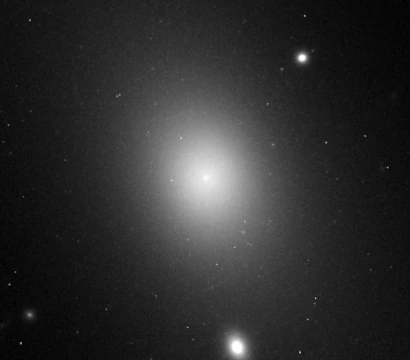
IC 1101, one of the largest known ellipticals, serves as the running case study across multiple chapters. Its estimated stellar mass and surprisingly low central density make it a favorite for illustrating how elliptical structure defies simple scaling relations.
Does Part 4 address any ongoing classification controversies?
Yes, a full subsection tackles the 'dE3 vs. dIrr' ambiguity for dwarf systems like NGC 4449, where gas fraction and morphology blur the traditional elliptical-irregular boundary. The encyclopedia presents both the classical de Vaucouleurs argument and the more recent kinematic-evidence counterpoints.
What notable observational milestone gets a dedicated 'Notable Moment' callout?
The 2022 Event Horizon Telescope image of M87's shadow is given a full sidebar linking the black-hole physics to the broader elliptical-galaxy context. The entry explains how that single image constrained the feedback models discussed throughout the section.
How long does it typically take a reader to work through Part 4?
Most fans report roughly ten to fourteen hours of reading if they engage with the data tables and figure captions. Skipping the optional 'Deep Dive' appendices on stellar-dynamical simulations can cut that to under seven hours.
Is Part 4 written for a general audience or does it require an astronomy background?
The prose is accessible to a curious layperson, but the quantitative sidebars on velocity dispersion and Toomre instability assume basic college-level physics. The community consensus is that it is the most technically demanding installment, though the narrative chapters remain readable without prior training.