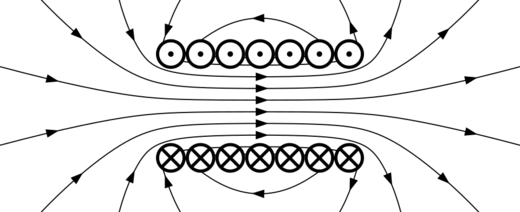
Electromagnetic induction
Production of emf across a conductor in a changing magnetic field.

Electromagnetic induction, or magnetic induction, happens when a changing magnetic field creates an electromotive force (emf) across an electrical conductor. The discovery is generally credited to Michael Faraday in 1831, and James Clerk Maxwell later gave it a mathematical description known as Faraday's law of induction. Lenz's law determines the direction of the induced field. Faraday's law was eventually broadened into the Maxwell–Faraday equation, one of the four Maxwell equations that form the foundation of his theory of electromagnetism. This phenomenon is used in many applications, including electrical components like inductors and transformers, and devices such as electric motors and generators.
Michael Faraday published his discovery of electromagnetic induction in 1831, and Joseph Henry independently found it the following year. In Faraday's first demonstration, on August 29, 1831, he wrapped two wires on opposite sides of an iron ring, similar to a modern toroidal transformer. Expecting a wave-like effect from his knowledge of electromagnets, he connected one wire to a galvanometer and the other to a battery. When he made or broke the battery connection, he saw a brief current—which he called a "wave of electricity"—caused by the change in magnetic flux. Within two months, Faraday found other examples: sliding a bar magnet quickly in and out of a wire coil produced transient currents, and rotating a copper disk near a bar magnet with a sliding contact generated a steady direct current (Faraday's disk). He explained induction using his concept of lines of force, but most scientists rejected his ideas because they lacked mathematical form. James Clerk Maxwell was an exception, using Faraday's ideas to build his quantitative electromagnetic theory. In Maxwell's model, the time-varying aspect of induction appears as a differential equation; Oliver Heaviside later called this Faraday's law, though it differs slightly from Faraday's original version and excludes motional emf. Heaviside's form, now known as the Maxwell–Faraday equation, is the one included in Maxwell's equations. In 1834, Heinrich Lenz formulated his law to describe the flux through a circuit, giving the direction of the induced emf and current.
Faraday's law of induction uses magnetic flux (ΦB), defined by a surface integral: ΦB = ∫Σ B · dA, where dA is a surface element, B is the magnetic field, and the dot product represents an infinitesimal amount of flux. Visually, the flux through a wire loop is proportional to the number of magnetic field lines passing through it. When this flux changes, the loop gains an emf. The common version of the law states that the induced emf in any closed circuit equals the negative rate of change of the magnetic flux through it: ℰ = –dΦB/dt. Lenz's law gives the direction: the induced current opposes the change that produced it, which is why the equation has a negative sign. To increase the emf, one can use a tightly wound coil of N identical turns, each with the same flux, producing an emf N times that of a single wire: ℰ = –N dΦB/dt. An emf can be generated by varying the magnetic flux through a wire loop in several ways, such as changing the magnetic field B (for example, with an alternating field) or moving the loop relative to a magnet.
- mathematically_described_by
- James Clerk Maxwell
- modern_form
- Maxwell–Faraday equation, one of Maxwell's equations
- applications
- Inductors, transformers, electric motors, generators
Lore & Background
He connected one wire to a galvanometer and the other to a battery, observing a transient current—which he called a 'wave of electricity'—when the battery was connected and disconnected. This induction was due to the change in magnetic flux. Within two months, Faraday found other manifestations, including transient currents from sliding a bar magnet in and out of a coil, and a steady DC current from rotating a copper disk near a bar magnet (Faraday's disk). Faraday explained induction using his concept of lines of force, but scientists at the time widely rejected his theoretical ideas because they were not formulated mathematically. An exception was James Clerk Maxwell, who used Faraday's ideas as the basis of his quantitative electromagnetic theory. In Maxwell's model, the time-varying aspect is expressed as a differential equation, which Oliver Heaviside referred to as Faraday's law, though it differs slightly from Faraday's original formulation and does not describe motional emf. Heaviside's version is the form recognized today as the Maxwell–Faraday equation. The law states that an induced current will flow in the direction that opposes the change which produced it, reflected by the negative sign in Faraday's law.
Reader's Guide
Electromagnetic induction is a cornerstone of classical electromagnetism and modern technology. James Clerk Maxwell later mathematically formalized this as Faraday's law of induction, which he generalized into the Maxwell–Faraday equation, one of the four Maxwell equations that unify electricity, magnetism, and optics. The principle has found widespread applications, including electrical components such as inductors and transformers, and devices such as electric motors and generators. Faraday's law describes two distinct phenomena: motional emf (from a moving wire in a magnetic field) and transformer emf (from a changing magnetic field). Albert Einstein noted that both situations correspond to relative motion between a conductor and a magnet, and the outcome is unaffected by which one moves—a key insight that contributed to his development of special relativity. The law remains fundamental in physics and engineering, enabling the generation and transformation of electrical energy.
Did You Know?
- Michael Faraday's first experimental demonstration of induction used two wires wrapped around opposite sides of an iron ring, similar to a modern toroidal transformer.
- Faraday observed a transient current, which he called a 'wave of electricity', when connecting and disconnecting a battery to one wire.
- The Maxwell–Faraday equation is one of the four Maxwell equations in the theory of electromagnetism.
More in Electromagnetism 1-21
Spotted an error? Know more?
This is a living reference — every entry is fact-audited, and reader corrections feed straight into our audit queue. Suggest an edit · See this site's audit record