Electromagnet
Electromagnet produces magnetic field via electric current.

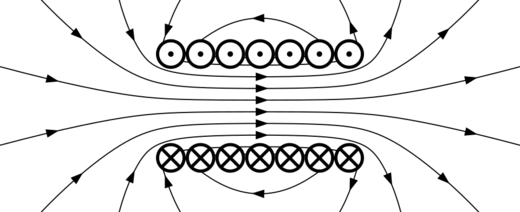
An electromagnet is a type of magnet in which the magnetic field is produced by an electric current. Electromagnets usually consist of copper wire wound into a coil; a current through the wire creates a magnetic field concentrated along the center of the coil, which disappears when the current is turned off. The main advantage over a permanent magnet is that the magnetic field can be quickly changed by controlling the electric current, though it requires a continuous supply of current to maintain the field. The strength of the generated magnetic field is proportional to the amount of current flowing through the winding. To increase this field, a core of ferromagnetic material, such as iron, is often placed inside the coil, which concentrates the magnetic flux and makes the magnet more powerful.
The history of the electromagnet began in 1820 when Hans Christian Ørsted discovered that electric currents create magnetic fields. That same year, André-Marie Ampère demonstrated that iron could be magnetized by inserting it into an electrically fed solenoid. The first working electromagnet was invented in 1824 by William Sturgeon, who wrapped about 18 turns of bare copper wire around a horseshoe-shaped piece of varnished iron. Despite weighing only seven ounces, it could lift nine pounds when powered by a single-cell supply. However, because the wire was uninsulated, it could only be wound in a single, spaced-out layer, limiting the number of turns and thus the magnet's strength. Beginning in 1830, Joseph Henry improved the design by using silk-insulated wire, allowing multiple layers of turns on the core and creating much more powerful magnets with thousands of turns. The first major application for these improved electromagnets was in telegraph sounders. The modern understanding of how ferromagnetic cores work was advanced in 1906 by Pierre-Ernest Weiss with his magnetic domain theory, and later refined in the 1920s by quantum mechanics.
Electromagnets are now essential components in motors, generators, transformers, relays, loudspeakers, hard disks, MRI machines, and scientific instruments. They are also used industrially to lift and move heavy iron objects like scrap metal. A common type is the tractive electromagnet, which consists of a solenoid coil and a soft iron plunger. Applying current forces the plunger to move until balanced. The maximum pull occurs w
- inventor
- William Sturgeon
- key_improver
- Joseph Henry
- core_discovery
- Hans Christian Ørsted (1820) that electric currents create magnetic fields
- field
- Physics and engineering
- known_for
- Producing magnetic field via electric current; widely used in motors, generators, relays, MRI machines, and industrial lifting
Lore & Background
Danish scientist Hans Christian Ørsted discovered in 1820 that electric currents produce magnetic fields, and later that year French scientist André-Marie Ampère demonstrated that iron could be magnetized by placing it inside a current-carrying solenoid. British scientist William Sturgeon built the first electromagnet in 1824, using a horseshoe-shaped iron core wrapped with about 18 turns of bare copper wire, which was varnished to insulate it from the windings. When current flowed, the iron became magnetized and attracted other iron; when the current stopped, the magnetism vanished. Sturgeon’s magnet weighed only about seven ounces (roughly 200 grams) but could lift nine pounds (about four kilograms) using a single-cell power supply. However, because the uninsulated wire could only be wound in a single, spaced-out layer, the number of turns was limited, making his magnets weak. Beginning in 1830, American scientist Joseph Henry improved the design by using silk-insulated wire, allowing multiple layers of turns around the core. This enabled him to create powerful magnets with thousands of turns, including one that could support 2,063 pounds. The first major application of electromagnets was in telegraph sounders. The magnetic domain theory explaining how ferromagnetic cores work was proposed in 1906 by French physicist Pierre-Ernest Weiss, and the modern quantum mechanical theory of ferromagnetism was developed in the 1920s by Werner Heisenberg, Lev Landau, Felix Bloch, and others.
Reader's Guide
Electromagnets are fundamental to modern technology, serving as components in motors, generators, transformers, relays, loudspeakers, hard disks, MRI machines, and magnetic separation equipment. They are also employed in industry for lifting heavy iron objects. The ability to control the magnetic field by varying the electric current makes them versatile, unlike permanent magnets that require no power. The physics relies on Ampere's law: an electric current in a wire creates a magnetic field, concentrated by winding the wire into a coil. The direction of the field is given by the right-hand rule. A common tractive electromagnet is a solenoid with a plunger; the force depends on factors such as cross-sectional area, number of turns, current, and solenoid length. Improvements like conical ends and magnetic return paths enhance performance. The historical development from Sturgeon's simple horseshoe magnet to Henry's layered coils enabled practical applications, and later quantum theory explained ferromagnetic behavior.
Did You Know?
- William Sturgeon's first electromagnet weighed seven ounces but could lift nine pounds.
- Joseph Henry used silk-thread-insulated wire to wind multiple layers, creating magnets that could support over 2,000 pounds.
- The magnetic field of an electromagnet disappears when the current is turned off.
- The first major use for electromagnets was in telegraph sounders.
More in Electromagnetism 1-21
Spotted an error? Know more?
This is a living reference — every entry is fact-audited, and reader corrections feed straight into our audit queue. Suggest an edit · See this site's audit record