Electrostatics
Branch of physics studying stationary electric charges and their forces.

Electrostatics is the study of electric charges that are stationary or moving very slowly on objects large enough that quantum effects don't matter. In this situation, the electric field, electric potential, and charge density are linked without interference from magnetic effects. People have known since ancient times that rubbing certain materials—like amber—makes them attract lightweight bits of matter. The Greek word for amber, *ḗlektron*, is where the term "electricity" comes from. Electrostatic effects are caused by the forces electric charges exert on one another, and these forces are described by Coulomb's law. Examples of electrostatic phenomena range from simple things—like plastic wrap clinging to your hand after you pull it off a package—to more dramatic events, such as grain silos exploding without warning, electronic parts getting damaged during manufacturing, and the way photocopiers and laser printers work. **Coulomb's law**
Coulomb's law states two things. First, the strength of the electrostatic force between two point charges is directly proportional to the product of the charges' magnitudes and inversely proportional to the square of the distance between them. Second, the force acts along the straight line connecting the charges. If the charges have the same sign, the force pushes them apart; if they have opposite signs, it pulls them together. If the distance between two charges is \( r \) (in meters), the force \( F \) between point charges \( Q \) and \( q \) is:
\[ F = \frac{1}{4\pi\varepsilon_0} \frac{|Qq|}{r^2} \]
Here, \( \varepsilon_0 = 8.8541878188(14) \times 10^{-12} \, \text{F} \cdot \text{m}^{-1} \) is the vacuum permittivity. Its SI units can also be written as \( \text{A}^2 \cdot \text{s}^4 \cdot \text{kg}^{-1} \cdot \text{m}^{-3} \), \( \text{C}^2 \cdot \text{N}^{-1} \cdot \text{m}^{-2} \), or \( \text{F} \cdot \text{m}^{-1} \). **Electric field**
The electric field \( \mathbf{E} \), measured in newtons per coulomb or volts per meter, is a vector field defined everywhere except at the exact location of a point charge (where it becomes infinite). It is the electrostatic force \( \mathbf{F} \) on a tiny hypothetical test charge at a point, divided by that test charge \( q \):
\[ \mathbf{E} = \frac{\mathbf{F}}{q} \]
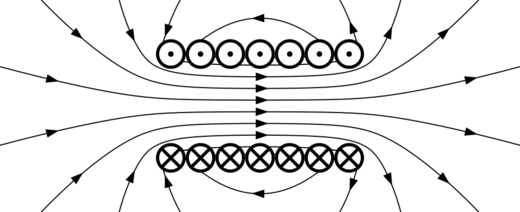
Electric field lines help visualize the field. They start on positive charges and end on negative charges. At any point, the lines run parallel to the field direction, and how closely packed they are shows the field's strength.
- field
- Physics
- known_for
- Study of stationary electric charges, Coulomb's law, electric field
- key_concept
- Coulomb's law: force between two point charges is proportional to product of charges and inversely proportional to square of distance
Lore & Background
Electrostatic phenomena arise from the forces that electric charges exert on each other, described by Coulomb's law. This law states that the magnitude of the electrostatic force between two point charges is directly proportional to the product of the magnitudes of charges and inversely proportional to the square of the distance between them, with the force along the line joining them. If the charges have the same sign, the force is repulsive; if different signs, attractive. The force is given by F = 1/(4πε₀) * |Qq|/r², where ε₀ is the vacuum permittivity.
The study of electrostatics has roots in classical antiquity, when it was observed that materials like amber attract lightweight particles after being rubbed. The Greek word for amber, *ēlektron*, gave rise to the term electricity. Electrostatic effects are common in everyday life, from the attraction of plastic wrap to a hand after removal from a package to the static cling of clothes. A classic demonstration involves foam peanuts clinging to a cat’s fur: the fur becomes charged through the triboelectric effect, and its electric field polarizes the foam molecules via electrostatic induction, creating a slight attraction. Electrostatic forces can also cause grain silo explosions and damage electronic components during manufacturing, while being essential to the operation of photocopiers and laser printers.
Key defining characteristics include the relationship between electric field, electric potential, and charge density without complications from magnetic effects. The electric field produced by a distribution of charges is given by the volume charge density and can be obtained by summing contributions from individual source particles, an example of the superposition principle. Gauss’s law states that the total electric flux through any closed surface is proportional to the total charge enclosed. The electrostatic potential, or voltage, is a scalar function whose gradient gives the electric field; the field points from regions of high potential to low potential. In the absence of time-varying magnetic fields, the electrostatic approximation applies, allowing analysis using only these principles. The total electric potential energy of a collection of charges is calculated by summing contributions from each pair of charges.
Reader's Guide
Electrostatics provides the foundational understanding of electric fields and forces in the absence of magnetic effects. The electric field E is defined as the electrostatic force F on a hypothetical small test charge divided by that charge, and is a vector field that can be defined everywhere except at point charges. Electric field lines, which begin on positive charge and terminate on negative charge, are useful for visualizing the field. The field generated by a collection of point charges is given by a sum over each charge, using the displacement vector from source to field point. Examples of electrostatic phenomena range from simple attractions, like plastic wrap sticking to a hand, to more complex events such as grain silo explosions and damage to electronic components during manufacturing, as well as the operation of photocopiers and laser printers.
Did You Know?
- The word electricity comes from the Greek word ḗlektron, meaning 'amber'.
- Coulomb's law states the electrostatic force is inversely proportional to the square of the distance between charges.
- Electric field lines begin on positive charge and terminate on negative charge.
The Force That Builds the World
The electromagnetic force stands as the second strongest among nature's four fundamental interactions and is unique in possessing unlimited range. Unlike friction or contact forces, which are merely derived effects, electromagnetism is a primary building block of physical reality. At the atomic level, it is the electrostatic attraction between positively charged nuclei and negatively charged electrons that keeps atoms intact, while the same electric forces enable distinct atoms to bond into the vast array of molecules we encounter. Beyond simple bonding, magnetic interactions tied to electron spin and angular momentum contribute to chemical reactivity, a domain explored in spin chemistry. Perhaps most remarkably, the very solidity of everyday objects traces back to this force. When we push or pull a material, what we feel is the electromagnetic repulsion between intermolecular structures in our hands and the object. Even the density and structure of matter at the molecular scale emerge from a delicate balance: the electromagnetic force pulling electrons toward nuclei, countered by the momentum electrons carry as they move between atoms, a momentum that necessarily rises as the Pauli exclusion principle confines them into tighter spaces.
From Ancient Curiosity to Unified Theory
Humanity's encounter with electromagnetism stretches back to antiquity, when observers noted the crackling of lightning, the cling of static electricity, and the curious pull between magnetized iron ore and compass needles. For centuries these remained separate curiosities. The true revolution arrived in the eighteenth and nineteenth centuries, when scientists began to forge precise mathematical relationships linking electric charges, currents, and the phenomena they produce. Crucially, they demonstrated that electricity and magnetism were not independent curiosities but two faces of a single interaction. This unification revealed that a changing electric field could spawn a magnetic disturbance, which in turn regenerated the electric field, producing a self-sustaining oscillation that propagates through space as an electromagnetic wave. The same mechanism underlies the entire electromagnetic spectrum, from gamma rays and x-rays through ultraviolet, visible light, and infrared, all the way to microwaves and radio waves. At sufficiently high energies, the electromagnetic force even merges with the weak nuclear force into a single electroweak interaction, hinting at a deeper unity among nature's forces.
Relativity, Quanta, and the Photon
The twentieth century forced a profound reckoning with classical electromagnetism. Einstein's 1905 special relativity was directly inspired by the peculiar behavior of electromagnetic fields: the requirement that physical observations remain consistent across different moving frames of reference, and the fact that the speed of light is fixed by the permeability and permittivity of the propagation medium, both pointed toward a radical restructuring of space and time. On the quantum side, the theory of quantum electrodynamics rewrites Maxwell's equations so they align with the quantized nature of matter. In this framework, changes in the electromagnetic field are no longer smooth, continuous ripples but are expressed as discrete excitations—particles called photons, the quanta of light. This quantum description has become essential for explaining how electromagnetic interactions operate at the subatomic level. Meanwhile, the broader field continues to be refined to incorporate the effects of both quantum mechanics and relativity, ensuring the theory remains coherent across all scales of observation.
The Mathematical Language of Fields
At its core, electromagnetism is rendered in the language of fields—physical quantities varying across space and time that encode the electric and magnetic influence acting upon charges at every point. The field at any location and instant is a composite of an electric field and a magnetic field, and because these components are deeply interrelated, a perturbation in one can generate a perturbation in the other, setting up the oscillatory propagation we recognize as electromagnetic waves. To capture the full range of physical situations, physicists employ six distinct quantities organized into three cases. In a vacuum, where all charges are known directly, the electric field E and magnetic flux density B suffice. When charges reside inside a material responding to applied fields, the electric displacement field D and magnetic field strength H are introduced alongside E and B. A third representation, useful when one prefers potential energy and momentum over force, introduces the electric potential V and the magnetic vector potential A. The force on a moving charge is captured by the Lorentz force law, combining the electric field contribution with the cross product of velocity and magnetic flux density, scaled by the charge.
Frequently Asked Questions
Who is Electrostatics?
Electrostatics is the branch of physics devoted to examining electric charges that are at rest or moving so slowly that quantum effects can be safely ignored. It deals with macroscopic objects and the forces their charges exert on one another.
What are Electrostatics's powers/role?
Its signature ability is Coulomb's law, which says the force between two point charges is proportional to the product of those charges and inversely proportional to the square of the distance between them. It also underpins the electric-field concept, describing how a charge shapes the space around it.
How does Electrostatics's story end?
Electrostatics hands the narrative to electrodynamics the instant charges begin moving at appreciable speeds, because time-varying fields introduce magnetic effects that fall outside its scope. In that sense, its 'ending' is the natural transition into the fuller theory of electromagnetism.
Why is Electrostatics important?
It lays the foundational framework for understanding how electric forces operate and serves as the starting point for nearly every subsequent topic in electromagnetism. Without a solid grasp of stationary-charge behavior, concepts like capacitance, dielectrics, and circuit theory become far harder to approach.
What is Electrostatics's origin story?
The phenomenon traces back to classical antiquity, when Greek observers noticed that rubbed amber would pull in light debris. The Greek word for amber, ḗlektron, is the very root from which 'electricity' and all related terminology descend.
More in Electromagnetism And Waves 1-23
Spotted an error? Know more?
This is a living reference — every entry is fact-audited, and reader corrections feed straight into our audit queue. Suggest an edit · See this site's audit record