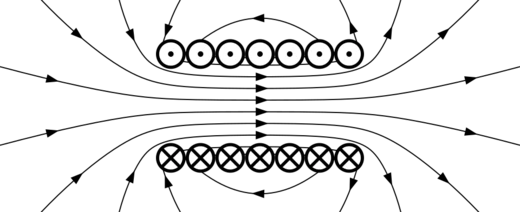
Electric displacement field
Auxiliary vector field in Maxwell's equations combining electric field and polarization.
Last updated

Modified by user:Guy vandegrift · CC0
The electric displacement field, symbolized by D and also called electric flux density, is a vector field used in Maxwell's equations. It functions as an auxiliary field that combines the effects of an electric field with those of polarization. This field is central to understanding several physical phenomena, including a material's capacitance, how dielectrics respond to an electric field, shape changes caused by electric fields in piezoelectricity and flexoelectricity, and the generation of voltages and charge transfer from elastic strains. The rate at which D changes over time is known as the displacement current density.
In a material with an inversion center, the charge at opposite positions is identical, meaning no dipole exists. When an electric field is applied to an insulator, negative charges shift slightly toward the positive side of the field, while positive charges move in the opposite direction. This creates an induced dipole, described as polarization. This can involve slight movements of electrons relative to nuclei in molecules, or displacements of atoms in an ionic compound.
Materials lacking an inversion center always exhibit polarization and piezoelectricity. In other materials, spatially varying strains can break inversion symmetry and induce polarization through the flexoelectric effect. Additionally, magnetic fields can cause polarization in some materials, an effect known as the magnetoelectric effect. The displacement field is defined by the equation D = ε₀E + P, where ε₀ is the vacuum permittivity, E is the electric field, and P is the macroscopic polarization density (the density of permanent and induced electric dipole moments in the material).
D satisfies Gauss's law in a dielectric: ∇·D = ρ_f, where ρ_f is the density of free charges per unit volume—charges that make the volume non-neutral, sometimes called space charge. This equation means that the flux lines of D begin and end on free charges. In contrast, bound charge is an effective density of charges that are part of a dipole. For an insulating dielectric between metal capacitor plates, free charges exist only on the plates, while the dielectric contains only dipoles.
The net unbalanced bound charge at the metal-dielectric interface balances the charge on the metal plate. If the dielectric is replaced by a doped semiconductor or ionized gas, electrons move relative to ions, and in a finite system both contribute to ρ_f at the edges. D is not determined solely by free charge.
In electrostatic situations, the curl of E is zero, leading to ∇×D = ∇×P. This is evident in an object with frozen-in polarization, like a bar electret (the electric analogue of a bar magnet). Such a material has no free charge, but its inherent polarization creates an electric field, showing that D is not entirely determined by free charge. The electric field is found using the relation between D, E, and P along with boundary conditions on polarization density to yield bound charges, which then determine the electric field. In a linear, homogeneous, isotropic dielectric that responds instantaneously to electric field changes, P depends linearly on E: P = ε₀χE, where χ is the electric susceptibility.
Thus, D = ε₀(1+χ)E = ε₀ε_rE = εE, with ε_r the relative permittivity and ε the permittivity. In such media, ε is constant, but in linear anisotropic media it is a tensor, and in nonhomogeneous media it varies with position. It can also depend on the electric field (nonlinear materials) or have a time-dependent response. Explicit time dependence occurs if materials move or change physically (e.g., Doppler shifts from a moving interface).
In a time-invariant medium, a time delay may exist between applying the electric field and the resulting polarization, making P a convolution of the impulse response susceptibility χ and E. In the frequency domain, this simplifies via Fourier transformation and the convolution theorem to (ω) = ε(ω) (ω), where ω is the frequency of the applied field. Causality imposes the Kramers–Kronig relations on the frequency dependence. This frequency-dependent permittivity is an example of material dispersion; all physical materials have some dispersion because they cannot respond instantaneously, but for narrow bandwidths the frequency dependence can often be ignored. At a boundary between two media, the normal component of D satisfies n·(D₁ - D₂) = σ_f, where σ_f is the free charge density and n is the unit normal pointing from medium 2 to medium 1.
History
The term "electric displacement field" was first used in 1864 by James Clerk Maxwell in his paper A Dynamical Theory of the Electromagnetic Field. Maxwell introduced D as "specific capacity of electric induction" in a form different from modern notation. Oliver Heaviside later reformulated Maxwell's complicated equations into their modern form. It was not until 1884 that Heaviside, along with Willard Gibbs and Heinrich Hertz, grouped the equations into a distinct set of four.
Quick Facts
- Field
- Physics
- Known for
- Auxiliary field in Maxwell's equations combining electric field and polarization
- Also called
- Electric flux density
Facts from the source article.
More in Electricity And Magnetism
Sources
Compiled from Wikipedia and the sources listed below. Text from Wikipedia is available under CC BY-SA 4.0; this entry is adapted from it.
- Wikipedia: Electric displacement field (CC BY-SA 4.0).
Spotted an error? Know more?
Reader corrections go straight into our review queue. Suggest an edit · How this site is sourced