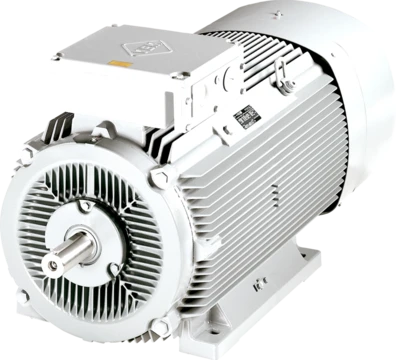
Traction motor
Last updated

N509FZ · CC BY-SA 4.0
A traction motor is an electric motor used to propel a vehicle such as a railway locomotive or tram.[1][2] The word "traction" derives from the Latin trahere, meaning "to pull", and was applied to traction engines around 1870.[3]
Key facts and history
Frank Sprague left Edison's firm in 1884 to found the Sprague Electric Railway & Motor Company.[4] Sprague developed a non-sparking motor that could maintain constant revolutions with varying loads.[4] Early AC induction motors were awkward for traction because of their fixed speed characteristic.[5] The advent of power semiconductors allowed variable frequency drives on locomotives.[5]
An experimental electric tramway using a traction motor was first demonstrated in 1875.[1]
What the cited sources add
The TGVweb account describes that TGV traction motors are slung from the vehicle body, not the bogie, to lighten the truck mass.[6] Each TGV motor can develop 1100 kW and spin at a maximum of 4000 rpm.[6] A tripod transmission using sliding cardan shafts decouples motor and wheel dynamics.[6] The Lemelson-MIT account states that Sprague's system included improved wheel suspension and automatic controls.[4]
The TGVweb source notes that thyristor development made frequency-controlled AC traction motors possible.[6] Traction inverters convert DC input into a computer-controlled three-phase AC waveform for each motor.[6] Synchronous AC traction motors have no collector, reducing wear and maintenance costs.[6]
References
- Wikipedia, "Traction motor" (CC BY-SA 4.0), which cites: "Popular Mechanics", Hearst Magazines, May 1929; "Frank Sprague Lemelson", lemelson.mit.edu; "Traction Motor Patented No. 292,529", January 29, 1884; "Ordinances of the City of Philadelphia", GMC, 1898, p. 134; Haupt, "Street railway motors", H.C. Baird & Company, 1893; "United States Census Office: Report on Transportation Business in the United States at the Eleventh Census: 1890: Street railways", U.S. Government Printing Office, 1892, p. 10 (we also read that source) en.wikipedia.org
- Wikipedia, "Traction motor" (CC BY-SA 4.0), which cites: "TGVweb - "Under the Hood" of a TGV", www.trainweb.org (we also read that source) en.wikipedia.org
- Wikipedia, "Traction motor" (CC BY-SA 4.0), which cites: Ainsworth, "Thesaurus Linguæ Latinæ Compendiarus, Or A Compendious Dictionary of the Latin Tongue ... By Mr. Robert Ainsworth", J. Johnson, J. Nichols and son, R. Baldwin [...], 1808; Houghton Mifflin, "The American Heritage Dictionary of the English Language", Houghton Mifflin, 2000, p. 1829; Merriam-Webster Unabridged (MWU). (Online subscription-based reference service of Merriam-Webster, based on Webster's Third New International Dictionary, Unabri; Burton, "Traction Engines: Two Centuries of Steam Power", Chartwell Books, 2000 (we al en.wikipedia.org
- "Frank Sprague Lemelson", lemelson.mit.edu. facts only, no text reused. lemelson.mit.edu
- Wikipedia, "Traction motor" (CC BY-SA 4.0), which cites: Andreas Steimel Electric Traction - Motive Power and Energy Supply: Basics and Practical Experience Oldenbourg Industrieverlag, 2008 ; Chapter 6 "Induction Trac (original not read by us) en.wikipedia.org
- "TGVweb - "Under the Hood" of a TGV", www.trainweb.org. facts only, no text reused. trainweb.org
Each numbered sentence above was checked against the source it cites before publication. Sentences citing Wikipedia adapt text from the English Wikipedia article Traction motor (contributors), used under CC BY-SA 4.0; this entry is available under the same licence. Other sources were used for facts only; no text or images are copied from them.
More in Electric Motors
Sources
Compiled from Wikipedia and the sources listed below. Text from Wikipedia is available under CC BY-SA 4.0; this entry is adapted from it.
- Wikipedia: Traction motor (CC BY-SA 4.0).
Spotted an error? Know more?
Reader corrections go straight into our review queue. Suggest an edit · How this site is sourced