Frequently Asked Questions
The most-asked questions about electric motors, part 3.
What does Part 3 of the Electric Motors fan encyclopedia actually cover?
Part 3 shifts focus from the basic construction and operating principles covered in Parts 1 and 2 toward advanced applications, historical milestones, and the engineering trade-offs that make each motor type suited to a particular job. It is the section where readers move from 'how does it spin?' to 'why did engineers choose this design for this machine?'
Who are the key historical figures highlighted in this section?
Part 3 spotlights Nikola Tesla for his polyphase AC motor work, Michael Faraday for establishing the foundational principles of electromagnetic induction, and the less-often-cited Hungarian engineer Károly Zipernowsky whose transformer designs made practical AC motor distribution possible. Community contributors also dedicate entries to modern researchers working on superconducting and brushless topologies.
Where should a complete beginner start if they jump straight into Part 3?
The community consensus is to skim Parts 1 and 2 first, then begin Part 3 with the 'Comparative Overview' chapter, which maps every motor family covered in the encyclopedia onto a single decision tree. From there, readers can branch into the application chapters that match their personal interest—industrial, automotive, aerospace, or hobbyist.
What is the single most-cited fact in Part 3?
It is the observation that no single motor topology dominates every application; the choice between induction, synchronous, BLDC, and stepper designs is almost always a compromise among efficiency, torque density, cost, and control complexity. This 'no free lunch' framing anchors most of the comparative tables in the section.
Which chapter do fans say is the 'notable moment' of Part 3?
Readers consistently point to the deep-dive on the 1928 General Electric demonstration of the first practical three-phase induction motor driving a full factory line, because it marks the moment electric motors displaced steam as the default industrial prime mover. The chapter pairs primary-source photos with a modern efficiency re-analysis of the same machine.
Does Part 3 include hands-on or DIY content?
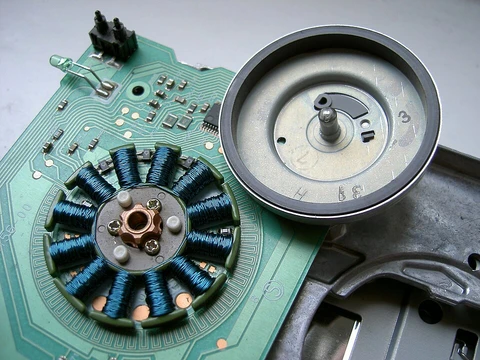
Yes—there is a dedicated workshop appendix with step-by-step teardown guides for common NEMA-frame induction motors and a troubleshooting flowchart for brushless DC hobby motors. The community stresses that all procedures assume proper lockout/tagout and that readers verify local electrical codes before working on live equipment.
How does Part 3 handle the growing role of electric motors in EVs and robotics?
A full chapter compares the axial-flux and radial-flux permanent-magnet motors now standard in electric vehicles against the high-KV BLDC units used in robotic joints, emphasizing thermal management and power-electronics pairing as the real differentiators. It also tracks the shift toward 800-volt architectures and their impact on motor winding design.
What common misconceptions does Part 3 try to correct?
Two stand out: the idea that 'bigger motor, more power' ignores the role of duty cycle and thermal limits, and the belief that AC and DC motors are fundamentally different categories rather than points on a spectrum of control strategy and commutation method. Both are addressed with worked numerical examples.
Is Part 3 written for a specific audience, or is it general-interest?
The language is pitched at a technically literate general audience—someone who can follow a circuit diagram and basic physics without needing a full EE degree. Jargon is defined on first use, and each chapter opens with a plain-English summary so readers can gauge relevance before diving into equations.
How is Part 3 maintained, and can fans contribute?
The encyclopedia is community-edited through a public revision log, and Part 3 currently has an open call for contributors with hands-on experience in motor control firmware or industrial drive commissioning. Edits go through a peer-review step where at least two other contributors verify technical accuracy before a change is published.