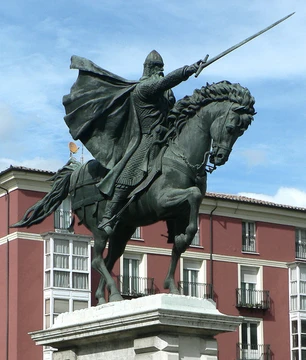
Tizona
One of El Cid's swords, now in the Museo de Burgos.
Tizona, sometimes called Tizón, is a sword linked to Rodrigo Díaz de Vivar, known as El Cid, in the epic Cantar de Mio Cid. His other blade is Colada. This weapon spent a long time at Marcilla Castle, then at Madrid’s Army Museum, and since 2007 it has been housed in the Museo de Burgos.
Quick Facts
- Length
- 93.5 cm / 3 ft 1 in
- Mass
- 1.15 kg / 2.54 lb
- Blade type
- Type XIII
- Current location
- Museo de Burgos
- Former location
- Marcilla Castle
- Given by
- Ferdinand II of Aragon
- Recipient
- Pedro de Peralta, count of Santisteban de Lerín
Facts from the source article.
Name
The Cantar de Mio Cid uses the form Tizón. The extended form Tizona appears from the 14th century onward. The blade inscription on the Marcilla sword reads TIZONA. Tizón means "firebrand" (from Latin titionem). James I of Aragon owned a sword named Tisó, with no reference to El Cid, indicating tizon was a generic term for sword. The feminine tizona later became a poetic synonym for sword.
Literary tradition
In the Cantar de Mio Cid, El Cid won Tizona from its previous owner, King Yucef in Valencia. He gave it to his sons-in-law, the Infantes de Carrión, but it eventually returned to him. The sword's power depends on the wielder; it frightens unworthy opponents. When the Infantes held Tizona, they underestimated it due to cowardice, but when Pero Vermúdez unsheathed it against Ferrán González, the latter surrendered in terror. After El Cid's death, legend says his body was seated in armour at San Pedro de Cardeña, and Tizona struck down a Jew who plucked the dead hero's beard; the Jew revived, was baptized as Diego Gil, and became servant to Gil Diaz.
Artefact
The sword long owned by the Marquesses of Falces and kept in Marcilla Castle is now in the Museo de Burgos. It measures 93.5 cm in length and has a mass of 1.15 kg. The broad blade is of type XIII, typical of about the 12th century, with a narrow fuller running less than half the blade's length. The hilt was added later, in the time of the Catholic Monarchs, with an elaborate curved crossguard in the Hispano-Moorish style. Debate surrounds the sword's authenticity. If authentic, the hilt and inscription were added later, the inscription possibly in the 13th to 14th century and the hilt in the 15th. The name Tizona suggests a late medieval date, as early references use Tizón.
More in El Cid
Spotted an error? Know more?
Reader corrections go straight into our review queue. Suggest an edit · How this site is sourced