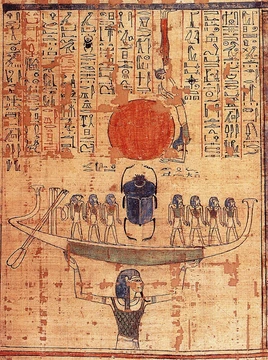
The Duat
Ancient Egyptian realm of the dead and nightly rebirth.

The Duat, also called Tuat, Te, or Amenthes, is an ancient Egyptian mythological concept tied to death, primarily understood as the realm the deceased enter. Most knowledge of it comes from funerary texts like the Book of Gates, the Book of Caverns, the Coffin Texts, the Amduat, and the Book of the Dead, among others. It is typically described as a dark, subterranean place that holds both the dead and many deities, including Osiris, Anubis, Thoth, Horus, and Maat in various forms. Each of these documents serves a different purpose and presents the Duat in distinct ways.
The Duat is often shown as the setting for rituals and myths, especially the soul’s journey and judgment after death, and the nightly rebirth of the sun god Ra. It is divided into twelve sections, each guarded by a gate representing an hour of the night, closely tied to Ra’s passage and featuring Osiris, the god of the Duat who embodies rebirth.
Burial chambers served as connections between the physical world and the Duat. The west bank of the Nile was linked to the dead, and funeral barges mirrored Ra’s daily sky journey. The Duat is frequently described with realistic features like rivers, islands, fields, paths, and lakes, but also fantastic ones such as lakes of fire, walls of iron, and trees of turquoise. These dark lands are partitioned by gates and mostly called Shetit, a dangerous region translated as “The Beyond.” Other titles include “The Hidden Place,” a region absent of mortals and gods, and “Road of the Secret Things of Re-stau,” a path Ra takes during his nightly journey. A key location for the dead is the Hall of Truth, often shown with the Weighing of the Heart ritual in the Book of the Dead and mentioned in the sixth hour of Ra’s journey. Virtuous souls may dwell in A’aru, or the Field of Reeds, a paradise where they live their former life with loved ones, free from pain, with eternal spring and abundant harvests.
Hundreds of deities of varying importance are linked to the Duat. Osiris, lord of the realm, personifies rebirth and the afterlife; after his brother Seth killed him, his wife Isis partially revived him. He is depicted as a green-skinned man partly wrapped in bandages. Anubis, son of Osiris and Nephthys, weighs the heart of the deceased, oversees embalming and mummification, and guides souls to the Duat. He is shown with the black head of a canine, often a jackal. Thoth records the verdict of the Weighing of the Heart and is depicted as an ibis-headed man with a stylus and tablet. Horus, son of Osiris and Isis, protects Ra during his Duat journey and is Osiris’s heir. Ma’at is both the goddess of order and the concept of truth and balance; her feather is weighed against the heart in the judgment ritual. Ammit eats the hearts and souls of those who fail the test, shown near the scales with a crocodile’s face, a lion’s mane and front half, and a hippopotamus’s hindquarters. Ra, the sun god, travels through the Duat each night to be reborn each morning. Apep, the embodiment of darkness and chaos, tries to devour Ra and bring eternal disorder.
To receive judgment, the dead journey through the Duat’s various parts. They must first name each of the forty-two Assessors of Maat and recite the sins they did not commit. Then Anubis weighs their heart against Maat’s feather. Hearts heavier than the feather fail, and Ammit devours them, denying the deceased an afterlife. Souls lighter than the feather pass and may travel to Aaru. The Duat is not like the Abrahamic concept of Hell; the ultimate punishment is the end of existence, not fiery torment.
Each night, Ra travels through the Duat in his ram-headed form, Af, on his Atet barge from west to east, bringing revivification to the dead.
- Also known as
- Tuat, Te, Amenthes
- Type
- Realm of the dead in ancient Egyptian mythology
- Associated deities
- Osiris, Anubis, Thoth, Horus, Maat, Ra, Apep, Ammit
- Key texts
- Book of Gates, Book of Caverns, Coffin Texts, Amduat, Book of the Dead
- Notable features
- Twelve guarded gates, Hall of Truth, A'aru (Field of Reeds), lakes of fire, walls of iron, trees of turquoise
Lore & Background
The Duat is a dark, subterranean realm described in funerary texts as a hidden place where both the deceased and numerous deities reside. Its geography is depicted with realistic features such as rivers, islands, fields, paths, and lakes, alongside fantastical elements like lakes of fire, walls of iron, and trees of turquoise. This dangerous land, sometimes called Shetit or 'The Beyond', is partitioned by a series of guarded gates, with the entire realm often referred to as 'The Hidden Place' or the 'Road of the Secret Things of Re-stau'. Burial chambers on the west bank of the Nile served as touchpoints between the mortal world and the Duat, and funeral barges mirrored the sun god Ra's daily sky journey. A key location is the Hall of Truth, where the Weighing of the Heart ritual occurs. Here, the deceased must name the forty-two Assessors of Maat and recite sins they did not commit. Anubis then weighs the heart against the feather of Maat; if the heart is heavier, it is devoured by Ammit, a creature with a crocodile face, lion mane and forequarters, and hippopotamus hindquarters. Thoth records the verdict. Those found virtuous dwell in A'aru, the Field of Reeds, a paradise of eternal spring with bountiful harvests where the dead live painlessly with loved ones. The Duat is also the nightly path of Ra, who must travel through its twelve hours to be reborn each morning, protected by Horus and threatened by the chaos serpent Apep. Osiris, depicted with green skin and bandages, is the lord of this realm and personifies rebirth.
Reader's Guide
The Duat is a central concept in ancient Egyptian mythology, representing the afterlife realm where souls journey after death. Its significance lies in its role as the setting for the judgment of the dead, where the heart is weighed against the feather of Maat by Anubis, with Thoth recording the verdict. Souls lighter than the feather pass to A'aru, a paradise of eternal spring and abundant harvests; those heavier are devoured by Ammit, ceasing to exist. The Duat also hosts the nightly journey of Ra, who travels through its twelve regions in his ram-headed form Af, battling Apep to bring order and reviving the dead with his light. The Book of the Dead is considered a vital resource for understanding the Duat, containing spells and prayers to protect the dead from its dangers. The Duat is not equivalent to Hell; the ultimate punishment is denial of afterlife, not eternal torment.
Did You Know?
- The Duat has also been called Te (Coptic) and Amenthes (Ancient Greek).
- The Duat is divided into twelve sections by guarded gates representing each hour of the night.
- A'aru, or the Field of Reeds, is described as a paradise where harvests are never poor and the land is in eternal spring.
- The Duat appears in popular culture including Rick Riordan's The Kane Chronicles, Assassin's Creed Origins, and the Disney+ series Moon Knight.
Common Misconceptions (Editorial)
Some believe the Duat is a single, static underworld, but it is divided into twelve sections by guarded gates, each tied to an hour of the night. Another common error is that only souls of the dead travel through the Duat; in fact, the sun god Ra also journeys through it nightly for rebirth. It is also sometimes assumed the Duat is purely a place of punishment, yet it includes A'aru, the Field of Reeds, described as a paradise with eternal spring and bountiful harvests.
Why It Matters (Editorial)
The Duat endures because it reflects humanity’s timeless need to make sense of death and what may come after, framing the afterlife as a structured, moral journey rather than an end. Its vivid imagery—gates, judgment halls, and a sun god’s nightly rebirth—continues to resonate in modern storytelling, reminding us how ancient myth still shapes our cultural imagination.
Spotted an error? Know more?
This is a living reference — every entry is fact-audited, and reader corrections feed straight into our audit queue. Suggest an edit · See this site's audit record