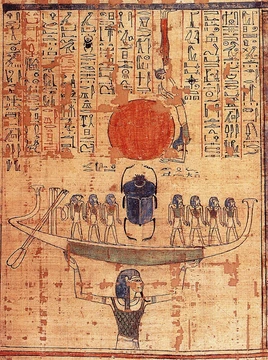
The Book of the Dead
Ancient Egyptian funerary spells for the afterlife journey.

The name "Book of the Dead" was given to a collection of ancient Egyptian funerary texts, typically written on papyrus, that were in use from the start of the New Kingdom (around 1550 BCE) until roughly 50 BCE. The term "book" is an approximation for a varied set of writings, which are actually a number of magical spells meant to guide a deceased person through the underworld (the Duat) and into the afterlife. These spells were composed by many different priests over a span of about a thousand years. In 1842, the Egyptologist Karl Richard Lepsius introduced the German name *Todtenbuch* (modern *Totenbuch*), which was translated into English as "Book of the Dead." The Egyptians themselves called the text *rw nw prt m hrw*, meaning "Spells of Coming Forth by Day."
The Book of the Dead was placed inside a coffin or burial chamber. It belonged to a tradition of funerary texts that included the earlier Pyramid Texts and Coffin Texts, which were painted onto objects rather than written on papyrus. Some of its spells were taken from these older works, dating back to the third millennium BCE, while others were composed later, during the Third Intermediate Period (11th to 7th centuries BCE). Many spells from the Book continued to be inscribed separately on tomb walls and sarcophagi, just as the earlier spells had been.
There was never a single, standard version of the Book of the Dead. The surviving papyri contain different selections of religious and magical texts, and their illustrations vary widely. Some individuals appear to have commissioned their own copies, possibly choosing the spells they considered most important for their own journey to the afterlife. The text was most often written in hieroglyphic or hieratic script on a papyrus scroll, and it was frequently decorated with vignettes showing the deceased and their journey through the underworld.
The finest surviving example from ancient times is the Papyrus of Ani. Ani was an Egyptian scribe. This papyrus was discovered in Luxor in 1888 by Egyptians dealing in illegal antiquities. It was acquired by E. A. Wallis Budge, as he described in his autobiography *By Nile and Tigris*, and was taken to the British Museum, where it remains today.
**Examples in museums** - Papyrus of Ani, British Museum - Papyrus of Hunefer, British Museum - Papyrus of Pinedjem II (or "Campbell Papyrus"), British Museum - Book of the Dead of Kha, Tomb of Kha and Merit, Museo Egizio, Turin, Italy - Book of the Dead of Nehem-es-Rataui, Museum August Kestner, Hanover, Germany - Book of the Dead of Amen-em-hat, Royal Ontario Museum - Book of the Dead of Qenna, Rijksmuseum van Oudheden, Leiden, Netherlands - Book of the Dead (Art Institute of Chicago) - Joseph Smith Papyri (Books of the Dead of TaSheritMin, Nefer-ir-nebu, and Amenhotep), fragments, many destroyed in modern times
**Development**
The Book of the Dead grew out of a tradition of funerary manuscripts that began in the Egyptian Old Kingdom. The earliest funerary texts were the Pyramid Texts, first used in the pyramid of King Unas of the 5th Dynasty, around 2400 BCE. These were carved onto the walls of burial chambers inside pyramids and were reserved exclusively for the pharaoh (and, from the 6th Dynasty, the queen). The Pyramid Texts were written in an unusual hieroglyphic style, with many human or animal figures left incomplete or mutilated, likely to prevent them from harming the dead king. Their purpose was to help the dead king take his place among the gods, especially to reunite him with his divine father Ra. At that time, the afterlife was thought to be in the sky, not the underworld described in the Book of the Dead. Toward the end of the Old Kingdom, the Pyramid Texts ceased to be a royal privilege and were adopted by regional governors and other high-ranking officials.
During the Middle Kingdom, a new funerary text emerged: the Coffin Texts. These used a newer version of the language, introduced new spells, and included illustrations for the first time. The Coffin Texts were most often written on the inner surfaces of coffins, though they occasionally appear on tomb walls or papyri. They were available to wealthy private individuals, greatly increasing the number of people who could expect to participate in the afterlife—a process often called the "democratization of the afterlife."
The Book of the Dead first developed in Thebes around the beginning of the Second Intermediate Period, about 1700 BCE. The earliest known occurrence of its spells is on the coffin of Queen Mentuhotep of the 16th Dynasty, where new spells were included alongside older texts from the Pyramid Texts and Coffin Texts. Some of the spells introduced at this time claimed an older origin; for example, the rubric to spell 30B states it was discovered by Prince Hordjedef during the reign of King Menkaure, many centuries before it appears in the archaeological record.
By the 17th Dynasty, the Book of the Dead had become widespread not only for royalty but also for courtiers and other officials. At this stage, the spells were typically inscribed on linen shrouds wrapped around the dead, though they are occasionally found on coffins or papyrus.
The New Kingdom saw the Book of the Dead develop and spread further. The famous Spell 125, the "Weighing of the Heart," first appears during the reign of Hatshepsut and Thutmose III, around 1475 BCE. From this period onward, the Book of the Dead was usually written on a papyrus scroll and illustrated with vignettes. During the 19th Dynasty in particular, the vignettes became lavish, sometimes at the expense of the surrounding text.
In the Third Intermediate Period, the Book of the Dead continued to be used, though its form and content evolved.
- field
- Funerary text
- culture
- Ancient Egyptian
- period
- c. 1550 BC – c. 50 BC
- known_for
- Collection of spells for the afterlife
- material
- Papyrus scroll
- language
- Hieroglyphic or hieratic script
Lore & Background
The Book of the Dead is the modern name for an ancient Egyptian collection of funerary spells, typically written on papyrus scrolls and used from the beginning of the New Kingdom (around 1550 BC) until roughly 50 BC. The original Egyptian title translates as "Spells of Coming Forth by Day." These texts were not a single, canonical work; surviving papyri contain varying selections of spells and illustrations, as individuals often commissioned copies with the spells they considered most important for their own journey through the underworld, or Duat, and into the afterlife. The spells were composed by many priests over about a thousand years, with some drawn from older funerary traditions like the Pyramid Texts and Coffin Texts, which date to the third millennium BC, while others were added later, during the Third Intermediate Period. The Book of the Dead was most commonly written in hieroglyphic or hieratic script and was often illustrated with vignettes—detailed scenes showing the deceased and their journey. A famous example is the Papyrus of Ani, discovered in Luxor in 1888 and now in the British Museum. Another well-known scene, from the Papyrus of Hunefer, depicts the scribe Hunefer’s heart being weighed on the scale of Maat against the feather of truth by the jackal-headed god Anubis, while the ibis-headed Thoth records the result. If the heart balances, the deceased passes into the afterlife; if not, they are devoured by Ammit, a chimeric creature composed of a crocodile, lion, and hippopotamus. The book was placed in the coffin or burial chamber of the deceased.
Reader's Guide
The Book of the Dead is significant as a key source for understanding ancient Egyptian beliefs about death, the afterlife, and magic. It was not a single canonical work; surviving papyri contain varying selections of spells and illustrations, with some people commissioning their own copies. The spells served purposes such as preserving the deceased's being, guiding them through the underworld, and protecting them from hostile forces. The text was standardized during the 25th and 26th Dynasties as the 'Saite recension,' and its last use was in the 1st century BC. The Book of the Dead reflects the integration of magical and religious practice in ancient Egypt, where hieroglyphic script was held to have been invented by the god Thoth and the hieroglyphs themselves were considered powerful.
Did You Know?
- The original Egyptian name for the Book of the Dead is translated as 'Spells of Coming Forth by Day.'
- The Book of the Dead was most commonly written in hieroglyphic or hieratic script on a papyrus scroll.
- The Book of the Dead was part of a tradition that includes the earlier Pyramid Texts and Coffin Texts.
Common Misconceptions (Editorial)
Some people think "The Book of the Dead" was a single, standardized book, but it was actually a loose collection of magic spells with no fixed order. Others assume it was used throughout all of ancient Egyptian history, yet it dates specifically from around 1550 BC to about 50 BC. A further misconception is that it was always written on tomb walls, whereas the facts confirm it was generally written on papyrus scrolls.
Why It Matters (Editorial)
The Book of the Dead endures because it reveals how ancient Egyptians confronted humanity's oldest questions about death and what comes after. Its spells and rituals offer a window into their beliefs about judgment, resurrection, and the soul's journey—themes that still resonate across cultures and centuries.
Spotted an error? Know more?
This is a living reference — every entry is fact-audited, and reader corrections feed straight into our audit queue. Suggest an edit · See this site's audit record