Eidyn
Brittonic region and stronghold of the Gododdin kingdom.
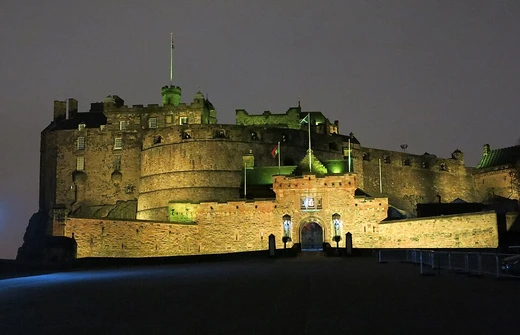
Eidyn was the Brittonic region around modern Edinburgh in sub-Roman and early medieval Britain, centred on the stronghold of Din Eidyn at Castle Rock. It was the most important district of the Gododdin kingdom and a significant power in the Hen Ogledd, the Brittonic-speaking area of what is now southern Scotland and northern England. Its legacy includes the name of Edinburgh and its prominence in the medieval poem Y Gododdin.
Quick Facts
- Period
- 5th–7th centuries
- Central stronghold
- Din Eidyn (Castle Rock, Edinburgh)
- Kingdom
- Gododdin
- Part of
- Hen Ogledd
- Conquered by
- Angles (638)
- Notable poem
- Y Gododdin
Facts from the source article.
Name and location
The name Eidyn certainly included the fortress of Din Eidyn, a Brittonic term meaning the dun or hillfort of Eidyn, in modern Edinburgh. Place-name evidence suggests the name spread more widely, surviving also in Carriden (from Caer Eidyn), eighteen miles to the west. Kenneth H. Jackson argued that Eidyn referred exclusively to Din Eidyn, proposing a different origin for Carriden, while Ifor Williams and Nora K. Chadwick supported the Caer Eidyn etymology and believed Eidyn represented a wider region.
Rachel Bromwich, accepting the latter view, wrote that Eidyn would have covered much of the area south of the Firth of Forth, possibly including or abutting Manaw Gododdin. The Angles, after conquering the area in the 7th century, replaced the Brittonic din with the Old English burh to produce Edinburgh; in Scottish Gaelic it became Dùn Èideann. The origin of the name Eidyn is not known; it may not have been known even in the 7th century, as both Angles and Gaels adopted it phonetically.
Some sources suggest an Old English form referring to Edwin of Northumbria, but modern scholarship refutes this because Eidyn predates Edwin. Later Welsh sources also refer to Lleuddiniawn, the region now known as Lothian. John T. Koch traces these names to the god Lugus, arguing the original form was Luguduniana, implying a Lugudunon or 'Fort of Lugus' that may have been an alternative name for Din Eidyn.
History
People built fortified settlements around what is now Edinburgh during the Bronze Age and early Iron Age. In the early Roman period, this area belonged to the Votadini, a group that stayed mostly independent but came under Roman influence in the second century. Around 143, Emperor Antoninus Pius started building the Antonine Wall to the north of the Votadini and the future site of Eidyn; its eastern end was probably at Carriden. The Votadini might have become a Roman client kingdom, charged with guarding the frontier against the Picts and Scots.
The idea of Eidyn as Britain’s northern boundary against barbarians stayed popular for centuries. After the Romans left, the Votadini turned into the Gododdin kingdom. The early medieval poem Y Gododdin tells of three hundred elite warriors from across the Brittonic world gathering at Din Eidyn for a raid on Catraeth, likely Catterick, around 600. Ifor Williams thought the warriors were called by Mynydawc Eidyn, possibly a Gododdin ruler.
Later scholars John Koch and Graham Isaac disagree, reading Mynydawc as a place name and suggesting the ruler was Ureui or Gwylget Gododdin.
Din Eidyn
The stronghold of Din Eidyn was the most important location in the region of Eidyn. Its initial Iron Age settlement was likely a dun or hill fort, with similar remains found at Arthur's Seat, Castle Rock (now home to Edinburgh Castle), and other local hilltops. Archaeologists generally identify Castle Rock as Din Eidyn because evidence shows it was a major center from Roman times through the Middle Ages. Castle Rock has been inhabited since the Bronze Age, possibly making it Scotland’s oldest nearly continuously occupied site, though it was initially less significant than other contemporary places.
During the Iron Age, it was a fortified village among several in the Edinburgh area, but its defensible position gave it an edge over unstable sites like Arthur’s Seat. In the Roman era, it supported a prosperous settlement that likely included a hillfort and possibly a broch, and it became a major center of the Votadini, though Traprain Law was ten times larger. After Traprain Law was abandoned in the early 5th century, Din Eidyn became the main political center of the Gododdin kingdom.
By the 7th century, as the kingdom declined, its lords may have controlled only the Eidyn district. Following the Anglian conquest, the site remained a fortified settlement for the Angles and later for the Scots.
Legacy
Even after the Angles took control of Eidyn, it stayed important in Brittonic stories. In the early poem Pa gur yv y porthaur?, King Arthur and his men are said to defend "Eidyn at the border," and Arthur’s company fights dog-headed creatures on the "Mountain of Eidyn." One of the Welsh Triads, number 33, names a warrior called Llawgat Trwm Bargod Eidyn, who killed Afaon, the son of Taliesin, as part of the "Three Unfortunate Slaughters of the Island of Britain."
The poem Y Gododdin, which tells of Eidyn, seems to have existed in several medieval copies, but only the version in the 13th-century Book of Aneirin survives, likely drawn from two or three older manuscripts. Figures tied to Eidyn, such as Clyddno Eidyn and his son Cynon ap Clydno—a survivor of the battle of Catraeth—appear in later poetry, the Triads, and Arthurian tales. A family tree for Clyddno, found in the Harleian genealogies and the Bonedd Gwŷr y Gogledd, might preserve the line of Eidyn’s kings.
More in Edinburgh Castle
Spotted an error? Know more?
Reader corrections go straight into our review queue. Suggest an edit · How this site is sourced